 Back
BackChemistry Comes Alive: Structure and Properties of Matter
Study Guide - Smart Notes
 Tailored notes based on your materials, expanded with key definitions, examples, and context.
Chemistry Comes Alive
Introduction to Matter
Matter is the foundation of all substances in the universe, including the human body. Understanding its properties is essential for studying anatomy and physiology.
Matter: Anything that has mass and occupies space.
Weight: The pull of gravity on mass.
States of Matter:
Solid: Definite shape and volume.
Liquid: Changeable shape; definite volume.
Gas: Changeable shape and volume.
Composition of Matter: Elements and Atoms
Elements
Elements are the simplest forms of matter with unique chemical properties. They cannot be broken down by ordinary chemical means.
Physical properties: Detectable with senses or measurable (e.g., color, mass).
Chemical properties: Describe how atoms interact or bond with each other.
Atoms
Atoms are the smallest units of elements that retain the properties of that element. Each element is represented by a unique atomic symbol (one or two letters).
Atomic symbol: Shorthand for each element (e.g., C for carbon).
Major, Lesser, and Trace Elements of the Human Body
The human body is primarily composed of a few key elements, with others present in smaller amounts.
Category | Elements | Body Mass (%) |
|---|---|---|
Major | Oxygen (O), Carbon (C), Hydrogen (H), Nitrogen (N) | 96.1 |
Lesser | Calcium (Ca), Phosphorus (P), Potassium (K), Sulfur (S), Sodium (Na), Chlorine (Cl), Magnesium (Mg), Iodine (I), Iron (Fe) | 3.9 |
Trace | Chromium (Cr), Copper (Cu), Fluorine (F), Manganese (Mn), Silicon (Si), Zinc (Zn), etc. | <0.01 |
Trace elements are often essential for enzyme function.
Atomic Structure
Subatomic Particles
Atoms are composed of three main subatomic particles:
Protons: Positive charge, mass = 1 amu, located in the nucleus.
Neutrons: No charge, mass = 1 amu, located in the nucleus.
Electrons: Negative charge, mass ≈ 0 amu (1/2000 of a proton), orbit the nucleus in an electron cloud.
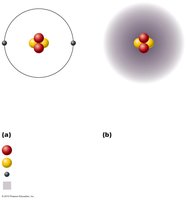
Models of the Atom
There are two main models used to represent atomic structure:
Planetary model: Electrons orbit the nucleus in fixed paths (outdated but useful for illustrations).
Orbital model: Shows probable regions of electron density (electron cloud); more accurate for predicting chemical behavior.
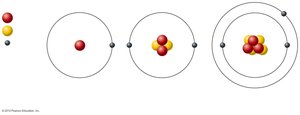
Atomic Structure of Elements
Each element has a unique number of protons, neutrons, and electrons.
Hydrogen: 1 proton, 0 neutrons, 1 electron
Helium: 2 protons, 2 neutrons, 2 electrons
Lithium: 3 protons, 4 neutrons, 3 electrons
Isotopes and Atomic Weight
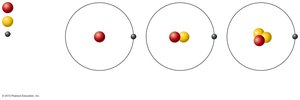
Isotopes are atoms of the same element with different numbers of neutrons. Atomic weight is the average mass of all isotopes of an element.
Isotopes of Hydrogen: Protium (1H), Deuterium (2H), Tritium (3H)
Radioisotopes
Radioisotopes are unstable isotopes that decay to more stable forms, emitting radiation. They are used in medical diagnosis and treatment but can also damage living tissue.
Applications: Diagnostic tracers, cancer treatment, biological research.
Combining Matter: Molecules and Compounds
Molecules and Compounds
Atoms combine to form molecules and compounds through chemical bonds.
Molecule: Two or more atoms bonded together (e.g., H2, O2).
Compound: Two or more different kinds of atoms bonded together (e.g., H2O, CO2).
Chemical Bonds
Types of Chemical Bonds
Chemical bonds are energy relationships between electrons of reacting atoms. The three major types are:
Ionic bonds
Covalent bonds
Hydrogen bonds
Ionic Bonds
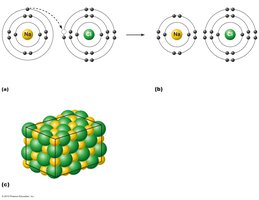
Ionic bonds form when electrons are transferred from one atom to another, creating ions. The attraction between oppositely charged ions forms the bond.
Anion: Atom that gains electrons (negative charge).
Cation: Atom that loses electrons (positive charge).
Example: Sodium chloride (NaCl) forms when sodium donates an electron to chlorine.
Ionic Compounds
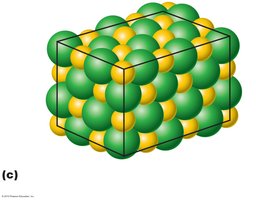
Most ionic compounds are salts. When dry, salts form crystals rather than individual molecules.
Example: NaCl forms a crystal lattice structure.
Covalent Bonds
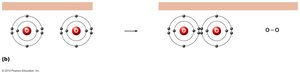
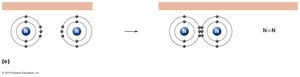
Covalent bonds are formed by the sharing of two or more valence electrons between atoms. This allows each atom to fill its valence shell at least part of the time.
Single bond: Sharing one pair of electrons (e.g., H2).
Double bond: Sharing two pairs of electrons (e.g., O2).
Triple bond: Sharing three pairs of electrons (e.g., N2).
Nonpolar and Polar Covalent Bonds
Covalent bonds can be classified based on how electrons are shared:
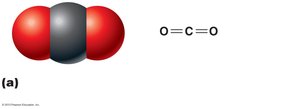
Nonpolar covalent bonds: Electrons are shared equally, resulting in electrically balanced molecules (e.g., CO2).
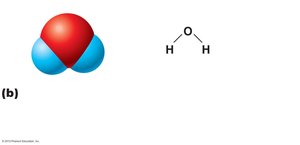
Polar covalent bonds: Electrons are shared unequally, creating molecules with partial charges (dipoles), such as H2O.
Comparison of Bond Types
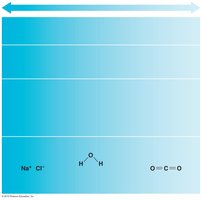
The three main bond types can be compared based on electron sharing and charge distribution:
Bond Type | Electron Sharing | Example | Charge Distribution |
|---|---|---|---|
Ionic | Complete transfer | NaCl | Separate ions form |
Polar Covalent | Unequal sharing | H2O | Partial charges (dipole) |
Nonpolar Covalent | Equal sharing | CO2 | Charge balanced |
Hydrogen Bonds
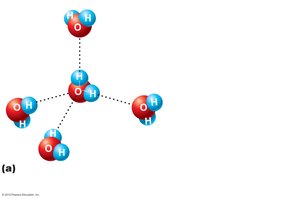
Hydrogen bonds are weak attractions between the electropositive hydrogen of one molecule and an electronegative atom (often oxygen or nitrogen) of another. They are not true bonds but are important for the structure and properties of water and biological molecules.
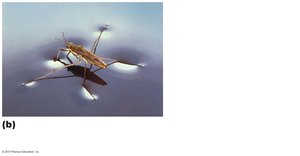
Common in water: Responsible for water's high surface tension and unique properties.
Intramolecular bonds: Help stabilize the three-dimensional structure of large molecules (e.g., proteins, DNA).
Key Concepts and Equations
Atomic number (Z): Number of protons in the nucleus.
Mass number (A): Total number of protons and neutrons.
Isotopes: Atoms with the same atomic number but different mass numbers.
Octet rule: Atoms tend to gain, lose, or share electrons to achieve eight electrons in their valence shell (except for the first shell, which is full with two electrons).
Additional info: Understanding chemical bonds and atomic structure is foundational for topics such as metabolism, enzyme function, and cellular communication in anatomy and physiology.
