 Back
Chemistry of Life: Foundations for Anatomy & Physiology
Study Guide - Smart Notes
 Tailored notes based on your materials, expanded with key definitions, examples, and context.
Chemistry of Life
Introduction to Biochemistry
The study of chemistry is fundamental to understanding anatomy and physiology because all physiological processes are based on chemical interactions. Biochemistry focuses on the chemical substances and vital processes occurring in living organisms, providing the foundation for understanding the human body at the molecular level.
Biochemistry: The branch of science concerned with the chemical substances and processes in living organisms.
Building blocks of matter: Atoms, molecules, and compounds form the basis of all substances in the body.
Levels of Chemical Organization
Atoms and Subatomic Particles
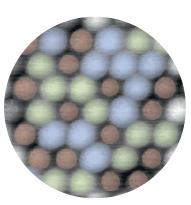
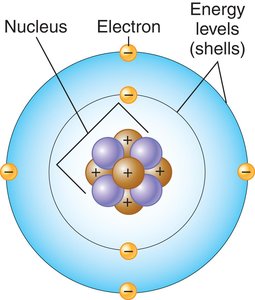
Atoms are the smallest units of matter, composed of subatomic particles: protons, neutrons, and electrons. The arrangement and interactions of these particles determine the properties of elements and compounds.
Proton: Positively charged particle found in the nucleus.
Neutron: Uncharged particle found in the nucleus.
Electron: Negatively charged particle found in energy levels (shells) around the nucleus.
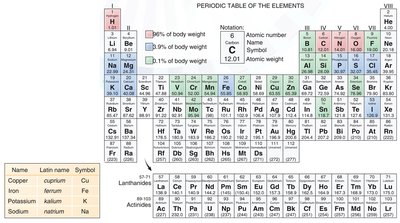
Atomic number: Number of protons in the nucleus; defines the element.
Atomic mass: Total number of protons and neutrons in the nucleus.
Energy Levels and Electron Shells
Electrons occupy specific energy levels or shells around the nucleus. The arrangement of electrons in these shells determines how atoms interact and bond with each other.
Each shell can hold a specific maximum number of electrons (e.g., 2 in the first shell, 8 in the second).
Atoms are most stable when their outermost shell is full.
Elements, Molecules, and Compounds
Elements are pure substances made of only one kind of atom. Molecules are groups of atoms bonded together, and compounds are molecules that contain more than one kind of atom.
Element: Cannot be broken down into simpler substances by chemical means.
Molecule: Two or more atoms bonded together (e.g., O2).
Compound: Molecule containing different types of atoms (e.g., H2O).
Chemical Bonding
Ionic Bonds
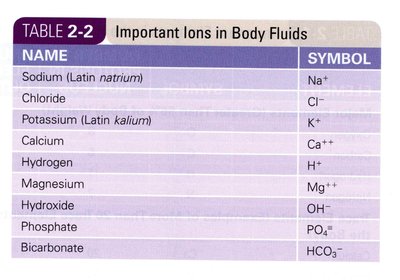
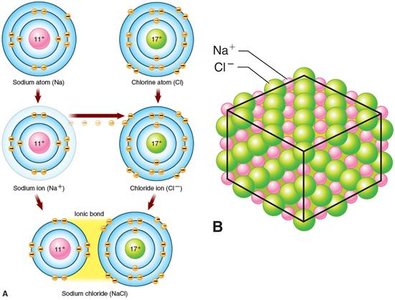
Ionic bonds form when atoms transfer electrons, resulting in the formation of charged particles called ions. Oppositely charged ions attract each other to form ionic compounds.
Ion: Atom or molecule with a net electric charge due to the loss or gain of electrons.
Electrolyte: Ionic compound that dissociates in water to form ions, essential for many physiological processes.
NAME | SYMBOL |
|---|---|
Sodium (Latin natrium) | Na+ |
Chloride | Cl− |
Potassium (Latin kalium) | K+ |
Calcium | Ca++ |
Hydrogen | H+ |
Magnesium | Mg++ |
Hydroxide | OH− |
Phosphate | PO4= |
Bicarbonate | HCO3− |
Covalent Bonds
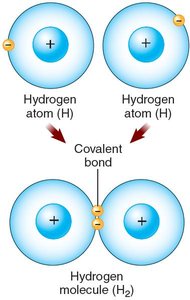
Covalent bonds form when atoms share electrons to fill their outermost energy levels. These bonds are strong and form the backbone of organic molecules in the body.
Covalent bonds do not easily dissociate in water.
All major organic compounds in the body are formed by covalent bonding.
Hydrogen Bonds
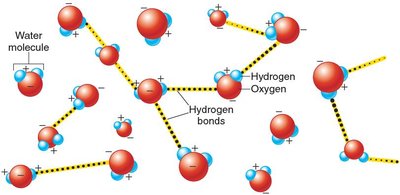
Hydrogen bonds are weak attractions between the positive end of one polar molecule and the negative end of another. They are crucial for the structure and function of water, DNA, and proteins.
Hydrogen bonds do not create new molecules but stabilize structures.
They are responsible for the unique properties of water and the double helix structure of DNA.
Inorganic and Organic Chemistry
Inorganic Compounds
Inorganic compounds generally do not contain carbon-carbon or carbon-hydrogen bonds. Water is the most important inorganic compound in the body, serving as a solvent and medium for chemical reactions.
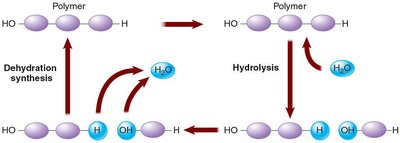
Water participates in dehydration synthesis and hydrolysis reactions.
Chemical equations represent these reactions, showing the transformation of reactants to products.
Acids, Bases, and pH
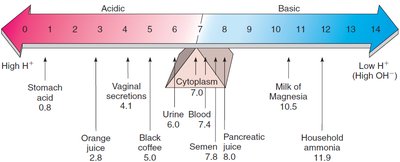
Acids and bases are substances that alter the concentration of hydrogen ions (H+) in solution. The pH scale measures the relative concentration of H+ in a solution, with 7 being neutral, values below 7 acidic, and above 7 basic.
Acid: Increases H+ concentration.
Base: Decreases H+ concentration (increases OH−).
Buffer: Chemical system that maintains stable pH by absorbing excess acids or bases.
Organic Compounds
Carbohydrates
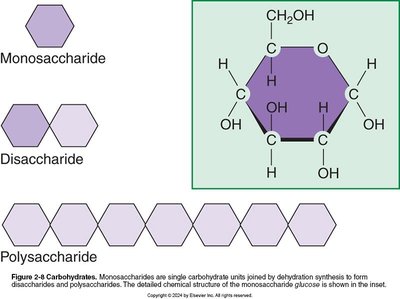
Carbohydrates are organic molecules composed of carbon, hydrogen, and oxygen. They serve as a primary energy source and are classified by the number of sugar units they contain.
Monosaccharide: Single sugar unit (e.g., glucose).
Disaccharide: Two monosaccharides joined together (e.g., sucrose, lactose).
Polysaccharide: Many monosaccharides linked together (e.g., glycogen, starch).
Lipids
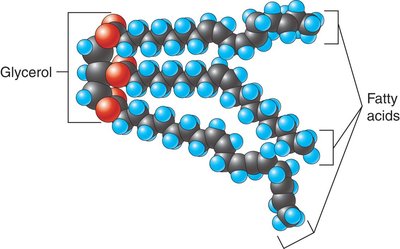
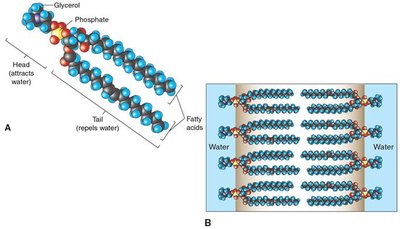
Lipids are hydrophobic organic molecules that include fats, oils, phospholipids, and steroids. They are important for energy storage, cell membrane structure, and hormone synthesis.
Triglycerides: Composed of glycerol and three fatty acids; store energy.
Phospholipids: Contain a phosphate group; form cell membranes due to their hydrophilic heads and hydrophobic tails.
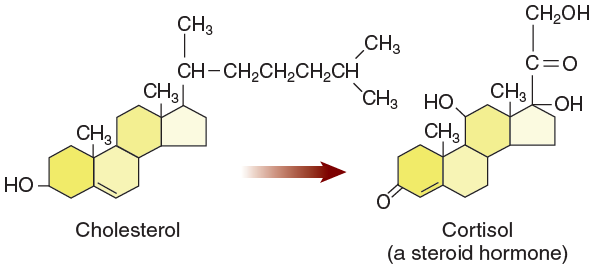
Cholesterol: Steroid molecule that stabilizes cell membranes and is a precursor for steroid hormones.
Proteins
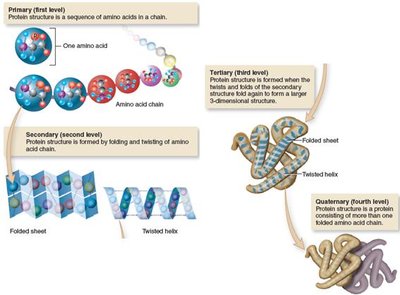
Proteins are large, complex molecules made of amino acids linked by peptide bonds. They serve structural and functional roles in the body, including as enzymes, hormones, and antibodies.
Structural proteins: Provide support and shape to cells and tissues (e.g., collagen, keratin).
Functional proteins: Participate in chemical processes (e.g., enzymes, hormones, receptors).
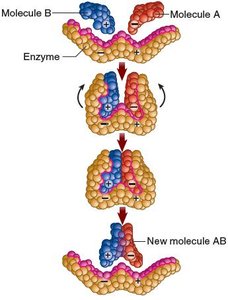
Enzymes: Biological catalysts that speed up chemical reactions without being consumed.
Nucleic Acids
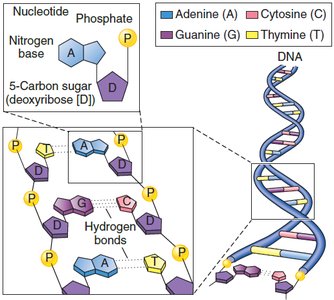
Nucleic acids store and transmit genetic information. They are composed of nucleotides, each containing a sugar, phosphate group, and nitrogenous base. The two main types are DNA and RNA.
DNA (Deoxyribonucleic acid): Double helix structure; contains genetic code for protein synthesis.
RNA (Ribonucleic acid): Single-stranded; acts as a messenger and translator of genetic information.
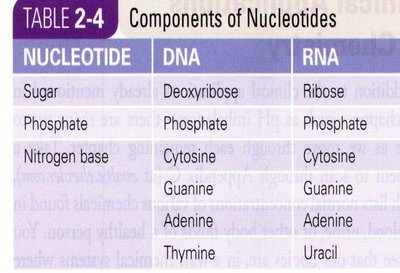
Nucleotide | DNA | RNA |
|---|---|---|
Sugar | Deoxyribose | Ribose |
Phosphate | Phosphate | Phosphate |
Nitrogen base | Cytosine, Guanine, Adenine, Thymine | Cytosine, Guanine, Adenine, Uracil |
Adenosine Triphosphate (ATP)
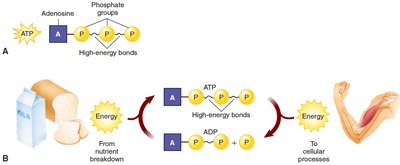
ATP is the primary energy carrier in cells. It stores energy in high-energy phosphate bonds and releases it to power cellular processes.
ATP is produced from the breakdown of nutrients and is used for muscle contraction, nerve impulse transmission, and other cellular activities.
Summary Table: Major Types of Organic Compounds
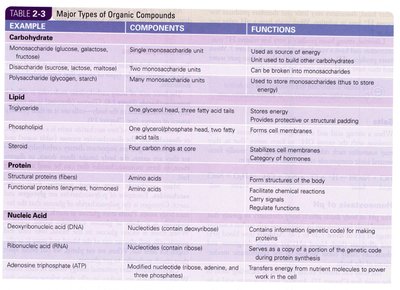
Example | Components | Functions |
|---|---|---|
Carbohydrate | Monosaccharide units | Source of energy, storage, structure |
Lipid | Glycerol, fatty acids, phosphate | Energy storage, membrane structure, hormones |
Protein | Amino acids | Structure, enzymes, transport, regulation |
Nucleic Acid | Nucleotides | Genetic information, protein synthesis, energy transfer |
Review Questions
Which of the following are subatomic particles?
Protons, Neutrons, Electrons (All of these are subatomic particles)
Which chemical bond involves the sharing of electrons to satisfy the outermost energy level?
Covalent
Our blood pH typically falls within the range of 7.35 to 7.45. Which of the following describes the pH of the blood?
Slightly alkaline
Which of the following is an inorganic molecule?
Water
_______ is a sterol lipid that performs several important functions in the body.
Cholesterol
Which type of organic molecule is responsible for the structure of enzymes?
Protein
Maintaining a relative constancy of the internal environment is defined as:
Homeostasis
The events that cause rapid increases in uterine contractions before the birth of a baby are controlled by what feedback loop?
Positive feedback
