 Back
BackChemistry of Life: Foundations for Anatomy & Physiology
Study Guide - Smart Notes
 Tailored notes based on your materials, expanded with key definitions, examples, and context.
Chemistry of Life
Introduction to Biochemistry
The study of life is fundamentally rooted in chemistry. Understanding the chemical structures and processes is essential for grasping the principles of anatomy and physiology. Biochemistry focuses on the chemical aspects of living organisms, providing insight into the building blocks of matter and their interactions within the human body.
Levels of Chemical Organization
Atoms and Subatomic Particles
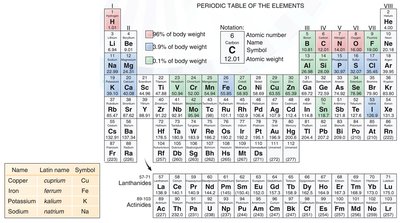
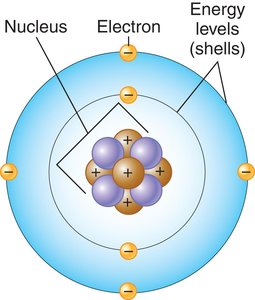
Atoms are the smallest units of matter, composed of subatomic particles: protons (positively charged), neutrons (uncharged), and electrons (negatively charged). The nucleus contains protons and neutrons, while electrons orbit in energy levels (shells) around the nucleus. The atomic number is the number of protons, and the atomic mass is the sum of protons and neutrons.
Proton: Positive charge, found in nucleus
Neutron: No charge, found in nucleus
Electron: Negative charge, orbits nucleus
Energy Levels (Shells)
Electrons occupy energy levels, or shells, which increase in energy the farther they are from the nucleus. Each shell can hold a specific number of electrons, with the outermost shell being crucial for chemical bonding.
Elements, Molecules, and Compounds
Definitions and Classifications
Element: Pure substance made of only one kind of atom (e.g., oxygen, carbon)
Molecule: Group of atoms bonded together (e.g., O2, H2O)
Compound: Molecule containing more than one kind of atom (e.g., NaCl)
Chemical Bonding
Overview of Chemical Bonds
Chemical bonds form to stabilize atoms by filling their outermost energy levels. Atoms may share, donate, or borrow electrons to achieve stability.
Ionic Bonds
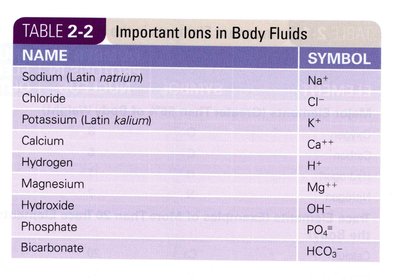
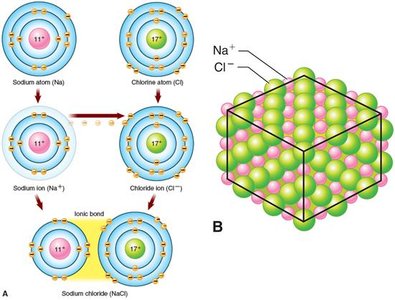
Ionic bonds occur when atoms transfer electrons, resulting in the formation of ions. Positive ions (cations) have lost electrons, while negative ions (anions) have gained electrons. Oppositely charged ions attract to form ionic bonds. Electrolytes are ionic compounds that dissociate in water to form ions, essential for physiological functions.
Positive ion (cation): e.g., Na+, Ca++
Negative ion (anion): e.g., Cl-
Name | Symbol |
|---|---|
Sodium (natrium) | Na+ |
Chloride | Cl- |
Potassium (kalium) | K+ |
Calcium | Ca++ |
Hydrogen | H+ |
Magnesium | Mg++ |
Hydroxide | OH- |
Phosphate | PO4= |
Bicarbonate | HCO3- |
Covalent Bonds
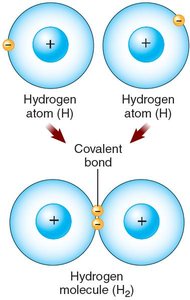
Covalent bonds form when atoms share electrons to complete their outer energy levels. These bonds are strong and do not easily dissociate in water. Covalent bonding is fundamental to the structure of organic compounds in the body.
Hydrogen Bonds
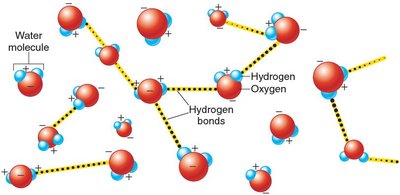
Hydrogen bonds are weak attractions between molecules, such as those found in water, DNA, and proteins. They do not form new molecules but are crucial for stabilizing structures and facilitating interactions.
Inorganic Chemistry
Organic vs. Inorganic Compounds
Organic compounds contain carbon-carbon (C-C) or carbon-hydrogen (C-H) covalent bonds and are generally larger and more complex. Inorganic compounds lack these bonds and are typically simpler.
Organic molecules: e.g., carbohydrates, lipids, proteins, nucleic acids
Inorganic molecules: e.g., water, salts, acids, bases
Water
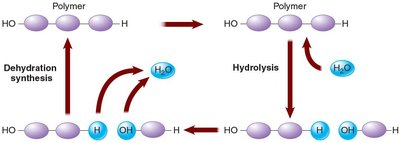
Water is an essential inorganic compound, acting as a solvent and participating in chemical reactions such as dehydration synthesis and hydrolysis. It forms aqueous solutions and is involved in energy transfer processes.
Acids, Bases, and Salts
Definitions and pH
Water molecules can dissociate into hydrogen ions (H+) and hydroxide ions (OH-). Acids increase H+ concentration, while bases decrease it. The pH scale measures the relative concentration of H+ in a solution, with 7 being neutral, values below 7 acidic, and above 7 basic.
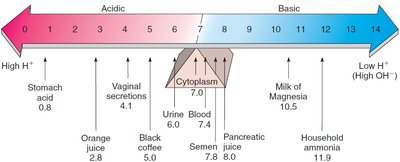
Acid: Shifts balance toward H+
Base: Shifts balance against H+ (alkaline)
Neutralization: Mixing acids and bases forms salts
Buffer: Chemical systems that maintain stable pH
Organic Chemistry
Carbohydrates
Carbohydrates are sugars and complex carbohydrates composed of carbon, hydrogen, and oxygen. They serve as energy sources and structural components. The basic unit is the monosaccharide (e.g., glucose), with disaccharides (e.g., sucrose, lactose) and polysaccharides (e.g., glycogen) formed by joining monosaccharides.
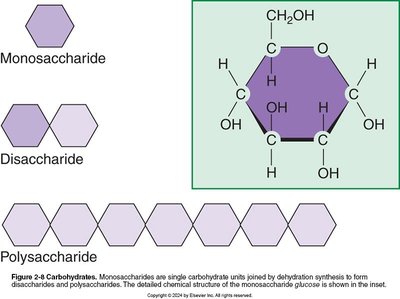
Example | Components | Functions |
|---|---|---|
Monosaccharide (glucose, galactose, fructose) | Single monosaccharide unit | Source of energy |
Disaccharide (sucrose, lactose, maltose) | Two monosaccharide units | Used to build larger carbohydrates |
Polysaccharide (glycogen, starch) | Many monosaccharide units | Storage of energy |
Lipids
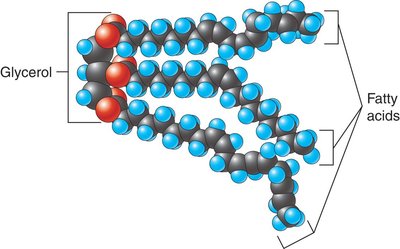
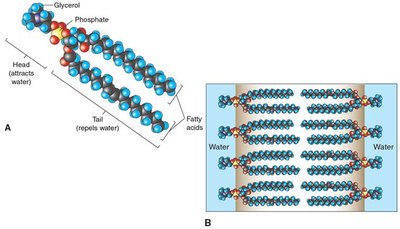
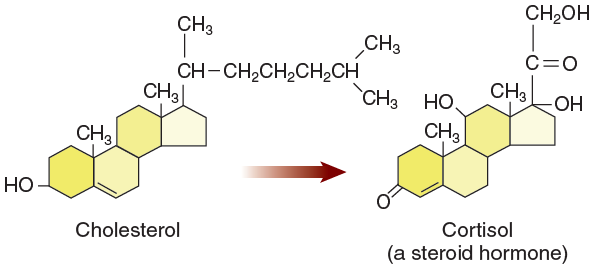
Lipids include fats and oils, primarily triglycerides (glycerol + three fatty acids), which store energy. Phospholipids have a phosphate-containing head and two fatty acid tails, forming cell membranes. Cholesterol is a steroid molecule that stabilizes cell membranes and is converted into steroid hormones.
Proteins
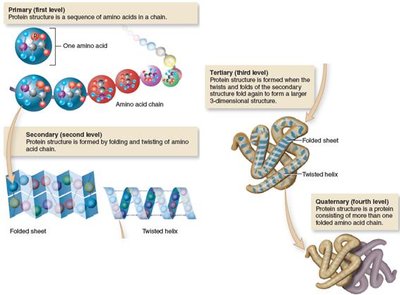
Proteins are large molecules made of amino acids linked by peptide bonds. They serve structural roles (e.g., collagen, keratin) and functional roles (e.g., enzymes, hormones, receptors). Protein structure is organized into primary, secondary, tertiary, and quaternary levels.
Functional Proteins and Enzymes
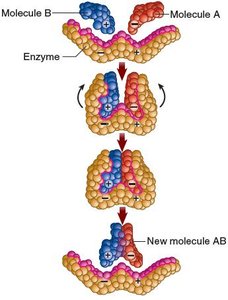
Functional proteins participate in chemical processes, including enzymes, which act as catalysts to speed up reactions. Enzyme action is often described by the lock-and-key model, where the enzyme fits specific substrates.
Nucleic Acids
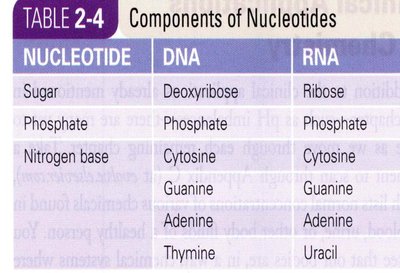
Nucleic acids are composed of nucleotides, each containing a phosphate unit, a sugar (ribose or deoxyribose), and a nitrogen base (adenine, thymine, uracil, guanine, cytosine). The two main types are DNA and RNA.
Nucleotide | DNA | RNA |
|---|---|---|
Sugar | Deoxyribose | Ribose |
Phosphate | Phosphate | Phosphate |
Nitrogen base | Cytosine, Guanine, Adenine, Thymine | Cytosine, Guanine, Adenine, Uracil |
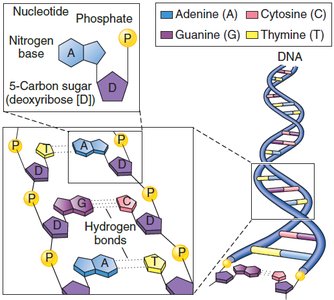
Deoxyribonucleic Acid (DNA)
DNA serves as the cell's master code for protein assembly, using deoxyribose as the sugar and bases A, T, C, and G. It forms a double helix structure.
Ribonucleic Acid (RNA)
RNA acts as a temporary working copy of a gene, using ribose as the sugar and bases A, U, C, and G.
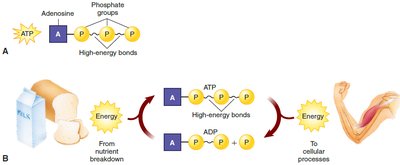
Adenosine Triphosphate (ATP)
ATP is the energy currency of the cell, transferring energy from nutrient molecules to power cellular processes. It consists of adenosine and three phosphate groups, with high-energy bonds between the phosphates.
Summary Table: Major Types of Organic Compounds
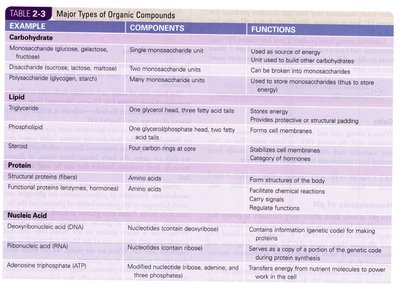
Example | Components | Functions |
|---|---|---|
Carbohydrate | Monosaccharide, disaccharide, polysaccharide | Energy source, storage |
Lipid | Glycerol, fatty acids, phosphate | Energy storage, membrane structure, hormone synthesis |
Protein | Amino acids | Structure, enzymes, regulation |
Nucleic Acid | Nucleotides | Genetic information, energy transfer |
Review Questions
Which of the following are subatomic particles? Protons, Neutrons, Electrons
Which chemical bond involves the sharing of electrons to satisfy the outermost energy level? Covalent
Our blood pH typically falls within the range of 7.35 to 7.45. Which of the following describes the pH of the blood? Slightly alkaline
Which of the following is an inorganic molecule? Water
_______ is a sterol lipid that performs several important functions in the body. Cholesterol
Which type of organic molecule is responsible for the structure of enzymes? Protein
Maintaining a relative constancy of the internal environment is defined as: Homeostasis
The events that cause rapid increases in uterine contractions before the birth of a baby are controlled by what feedback loop? Positive feedback
Additional info: These notes provide foundational knowledge for understanding the chemical basis of anatomy and physiology, as outlined in Chapter 2: Chemistry Comes Alive.
