 Back
Cholinergic & Adrenergic Drugs: The Autonomic Nervous System and Pharmacology
Study Guide - Smart Notes
 Tailored notes based on your materials, expanded with key definitions, examples, and context.
Autonomic Nervous System Overview
Introduction to the Autonomic Nervous System (ANS)
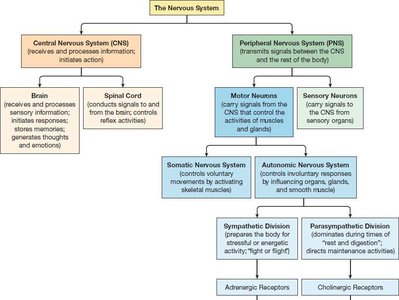
The autonomic nervous system (ANS) is a division of the peripheral nervous system that regulates involuntary physiological processes, including heart rate, blood pressure, respiration, digestion, and sexual arousal. It is essential for maintaining homeostasis and is divided into two main branches: the sympathetic and parasympathetic nervous systems.
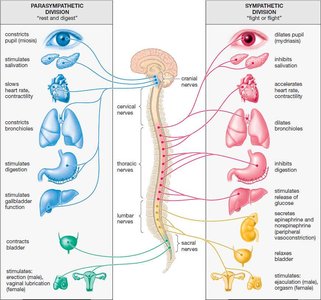
Sympathetic Division: Prepares the body for stressful or emergency situations ("fight or flight").
Parasympathetic Division: Promotes restful and restorative functions ("rest and digest").
Homeostasis: The ANS maintains the internal balance of body systems.
Neurotransmitters of the ANS
Neurotransmitters are chemical messengers that transmit signals across synapses. The two primary neurotransmitters in the ANS are:
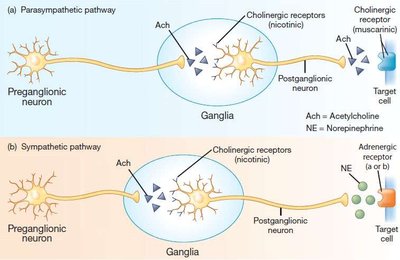
Acetylcholine (ACh): Main neurotransmitter of the parasympathetic division.
Norepinephrine (NE): Main neurotransmitter of the sympathetic division.
Receptors in the ANS
Receptors are proteins on the surface of cells that respond to neurotransmitters. The main types in the ANS are:
Nicotinic Receptors: Found on all postganglionic neurons (both sympathetic and parasympathetic).
Muscarinic Receptors: Found on target organs of the parasympathetic system.
Alpha and Beta Receptors: Found on target organs of the sympathetic system.
Key Terminology
-ergic: Activated by or resembling the effect produced by a specific neurotransmitter (e.g., cholinergic, adrenergic).
-mimetic: Mimics the action of a neurotransmitter (e.g., sympathomimetic).
-lytic: Inhibits or blocks the action (e.g., parasympatholytic).
-esterase: Enzymes that catalyze the breakdown of neurotransmitters (e.g., acetylcholinesterase).
Agonist: Activates a receptor to produce a response.
Antagonist: Blocks or opposes the action of a receptor.
Cholinergic Drugs
Mechanism and Classification
Cholinergic drugs stimulate the parasympathetic nervous system by mimicking or enhancing the action of acetylcholine. They are divided into two subclasses:
Direct-acting: Bind directly to cholinergic receptors to produce a rest-and-digest response.
Indirect-acting: Inhibit acetylcholinesterase (AChE), increasing acetylcholine levels at synapses.
These drugs have a high potential for serious adverse effects due to widespread activation of the parasympathetic system.
Cholinergic Agents (Parasympathomimetics)
Prototype Drug: Bethanechol (Urecholine)
Mechanism of Action: Activates the parasympathetic nervous system directly or indirectly, inducing rest/digest responses.
Uses: Glaucoma, urinary retention, myasthenia gravis, Alzheimer disease.
Adverse Effects: Profuse salivation, sweating, increased muscle tone, urinary frequency, bradycardia.
Examples of Cholinergic Drugs and Their Uses
Drug | Type | Primary Use |
|---|---|---|
Bethanechol (Urecholine) | Direct acting (muscarinic agonist) | Urinary retention |
Carbachol (Miostat) | Direct acting | Glaucoma |
Cevimeline (Evoxac) | Direct acting | Dry mouth |
Pilocarpine (Isopto Carpine, Salagen) | Direct acting | Glaucoma |
Donepezil (Aricept) | Cholinesterase inhibitor | Alzheimer disease |
Galantamine (Razadyne) | Cholinesterase inhibitor | Alzheimer disease |
Neostigmine (Prostigmin) | Cholinesterase inhibitor | Myasthenia gravis, postoperative urinary retention |
Physostigmine (Antilirium) | Cholinesterase inhibitor | Severe anticholinergic toxicity |
Pyridostigmine (Mestinon, Regonol) | Cholinesterase inhibitor | Myasthenia gravis |
Rivastigmine (Exelon) | Cholinesterase inhibitor | Alzheimer disease |
Anticholinergic Drugs
Mechanism and Effects
Anticholinergic drugs block the action of acetylcholine in the parasympathetic nervous system, resulting in effects opposite to cholinergic stimulation. These drugs are also known as parasympatholytics.
Effects: Pupil dilation (mydriasis), increased heart rate, drying of glandular secretions, relaxation of bronchi (useful in asthma).
Prototype Anticholinergic Drug: Atropine
Mechanism of Action: Inhibits acetylcholine binding, blocking parasympathetic nerve impulses.
Uses: Irritable bowel syndrome (IBS), ulcers, asthma, bradycardia.
Adverse Effects: Dry mouth, blurry vision, pupil dilation, constipation, tachycardia.
Examples of Anticholinergic Drugs and Their Uses
Drug | Primary Use |
|---|---|
Atropine (AtroPen) | Poisoning with anticholinesterase agents, increase heart rate, dilate pupils |
Benztropine (Cogentin) | Parkinson disease, neuroleptic side effects |
Cyclopentolate (Cyclogyl) | Pupil dilation |
Darifenacin (Enablex) | Overactive bladder |
Dicyclomine (Bentyl) | Irritable bowel syndrome |
Donepezil (Aricept) | Alzheimer disease |
Fesoterodine (Toviaz) | Urinary urgency/frequency |
Glycopyrrolate (Cuvposa, Robinul) | Dry field prior to anesthesia, reduce salivation, peptic ulcers |
Ipratropium (Atrovent) | Asthma, COPD |
Methscopolamine (Pamine) | Peptic ulcers |
Oxybutynin (Ditropan, Oxytrol) | Incontinence |
Propantheline (Pro-Banthine) | Irritable bowel syndrome, peptic ulcer |
Scopolamine (Transderm-Scop) | Motion sickness, IBS, anesthesia adjunct |
Solifenacin (Vesicare) | Overactive bladder |
Tiotropium (Spiriva) | Asthma, COPD |
Tolterodine (Detrol) | Overactive bladder |
Trihexyphenidyl | Parkinson disease |
Tropicamide (Mydriacyl, Tropicacyl) | Mydriasis, cycloplegia for diagnostics |
Trospium (Sanctura) | Overactive bladder |
Adrenergic Drugs
Mechanism and Classification
Adrenergic drugs stimulate the sympathetic nervous system by mimicking the action of norepinephrine and epinephrine. These drugs are also known as sympathomimetics.
Primary Neurotransmitter: Norepinephrine (NE), synthesized in nerve terminals and released by most postganglionic sympathetic nerves.
Catecholamines: Class of agents involved in neurotransmission. Includes natural (NE, epinephrine, dopamine) and synthetic (isoproterenol, dobutamine) catecholamines.
Adrenergic Receptors
Alpha-1: Constriction of blood vessels, dilation of pupils (except heart).
Alpha-2: Inhibit release of norepinephrine at presynaptic terminals.
Beta-1: Heart and kidneys; increase heart rate, force of contraction, release of renin.
Beta-2: Inhibit smooth muscle in sympathetic target organs (except heart).
Beta-3: Adipose tissue and urinary bladder; lipolysis, relaxation of detrusor muscle.
Prototype Adrenergic Drug: Phenylephrine
Therapeutic Class: Nasal decongestant
Mechanism of Action: Selective alpha-adrenergic agonist; actions are extensions of sympathetic stimulation.
Uses: Nasal congestion, hypotension
Adverse Effects: Headache, nausea, hypertension
Adrenergic Blockers (Adrenergic Antagonists)
Mechanism and Uses
Adrenergic blockers inhibit the sympathetic nervous system by blocking adrenergic receptors. They are used primarily to treat hypertension, but also for angina, heart failure, migraines, and benign prostatic hyperplasia (BPH).
Beta Blockers: Block beta-adrenergic receptors; decrease heart rate and blood pressure.
Alpha Blockers: Block alpha-adrenergic receptors; used for hypertension and BPH.
Prototype Adrenergic Blocking Drug: Prazosin (Minipress)
Mechanism of Action: Inhibits the sympathetic nervous system by blocking alpha-1 receptors.
Primary Uses: Hypertension, dysrhythmias, angina, heart failure, BPH, narrow-angle glaucoma.
Adverse Effects: Dizziness, drowsiness, headache, loss of energy, palpitations, dry mouth.
Examples of Adrenergic Blockers and Their Uses
Drug | Primary Receptor Subtype | Primary Use |
|---|---|---|
Acebutolol (Sectral) | Beta1 | Hypertension, dysrhythmias, angina |
Alfuzosin (UroXatral) | Alpha1 | BPH |
Atenolol (Tenormin) | Beta1 | Hypertension, angina |
Bisoprolol (Zebeta) | Beta1 | Hypertension, heart failure |
Carteolol (Cartrol) | Beta1, Beta2 | Hypertension, glaucoma |
Carvedilol (Coreg) | Alpha1, Beta1, Beta2 | Hypertension, heart failure, acute MI |
Doxazosin (Cardura) | Alpha1 | Hypertension, BPH |
Esmolol (Brevibloc) | Beta1 | Hypertension, dysrhythmias |
Metoprolol (Lopressor, Toprol) | Beta1 | Hypertension, acute MI, heart failure |
Nadolol (Corgard) | Beta1, Beta2 | Hypertension, angina |
Phentolamine (Regitine) | Alpha1 | Severe hypertension |
Prazosin (Minipress) | Alpha1 | Hypertension |
Propranolol (Inderal, Innopran XL) | Beta1, Beta2 | Hypertension, dysrhythmias, heart failure |
Sotalol (Betapace, Sorine) | Beta1, Beta2 | Dysrhythmias |
Tamsulosin (Flomax) | Alpha1 | BPH |
Terazosin (Hytrin) | Alpha1 | Hypertension |
Timolol (Blocadren, Timoptic) | Beta1, Beta2 | Hypertension, acute MI, glaucoma |
Nursing Priorities and Key Takeaways
Monitor vital signs when administering ANS drugs.
Watch for side effects such as changes in heart rate, blood pressure, and glandular secretions.
Educate patients about the actions and possible adverse effects of these medications.
Key Takeaways: The sympathetic and parasympathetic systems have opposite effects; understanding receptor types is crucial for safe drug administration.
