 Back
BackComprehensive Review of the Human Skull and Major Bones
Study Guide - Smart Notes
 Tailored notes based on your materials, expanded with key definitions, examples, and context.
Overview of the Human Skull
Introduction to the Skull
The human skull is a complex structure composed of several bones that protect the brain and form the structure of the face. It is divided into the cranium, which encases the brain, and the facial bones.
Cranium: Consists of 8 bones that surround and protect the brain.
Facial bones: Provide the framework for the face and support for teeth.
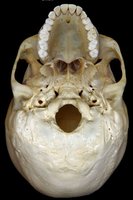
Major Sutures of the Skull
Coronal, Sagittal, and Lambdoid Sutures
Sutures are immovable joints found only between skull bones. They are important anatomical landmarks and sites of bone growth during development.
Coronal Suture: Separates the frontal bone from the parietal bones.
Sagittal Suture: Divides the two parietal bones along the midline of the skull.
Lambdoid Suture: Separates the occipital bone from the parietal bones.
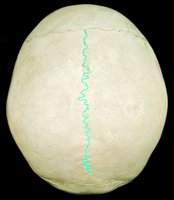
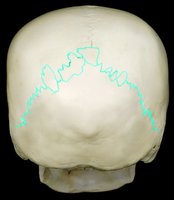
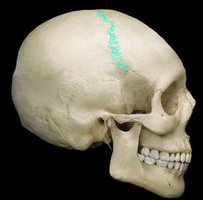
Major Cranial Bones
Frontal Bone
The frontal bone forms the forehead and the superior part of the eye sockets. It articulates with the parietal bones at the coronal suture.
Location: Anterior part of the cranium.
Function: Protects the frontal lobe of the brain and forms the upper part of the eye orbits.
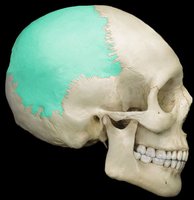
Parietal Bones
The parietal bones are paired bones that form the superior and lateral aspects of the cranium.
Location: Sides and roof of the cranial cavity.
Function: Protect the parietal lobes of the brain.
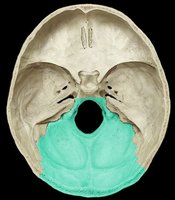
Occipital Bone
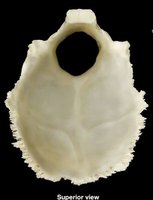
The occipital bone forms the posterior and base of the skull. It contains the foramen magnum, through which the spinal cord passes.
Location: Posterior and inferior part of the cranium.
Function: Protects the occipital lobe and allows passage of the spinal cord.
Key Foramina of the Skull
Foramen Magnum, Jugular Foramen, and Internal Acoustic Meatus
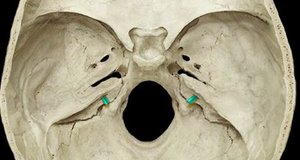
The base of the skull contains several important foramina (openings) that allow the passage of nerves and blood vessels.
Foramen Magnum: Large opening in the occipital bone for the spinal cord.
Jugular Foramen: Passage for the internal jugular vein and cranial nerves IX, X, and XI.
Internal Acoustic Meatus: Passage for cranial nerves VII and VIII.
Temporal Bone
Structure and Function
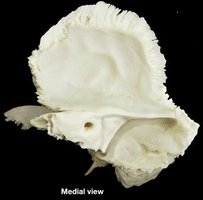
The temporal bones are located at the sides and base of the skull. They house structures of the ear and form part of the cranial floor.
Key features: Mastoid process, external auditory meatus, and zygomatic process.
Function: Protects the temporal lobe and supports the structures of hearing.
Summary Table: Major Cranial Bones and Sutures
Bone/Suture | Location | Function |
|---|---|---|
Frontal Bone | Anterior cranium | Forehead, upper orbits |
Parietal Bones | Superior/lateral cranium | Protect parietal lobes |
Occipital Bone | Posterior/inferior cranium | Protect occipital lobe, foramen magnum |
Temporal Bones | Lateral/base of cranium | Protect temporal lobes, house ear structures |
Coronal Suture | Between frontal and parietal bones | Immovable joint |
Sagittal Suture | Between parietal bones | Immovable joint |
Lambdoid Suture | Between parietal and occipital bones | Immovable joint |
Additional info:
The skull contains several other bones and features, such as the sphenoid and ethmoid bones, which contribute to the cranial floor and nasal cavity.
Fontanels are soft spots on an infant's skull where ossification is incomplete, allowing for growth of the brain and skull.
