 Back
BackComprehensive Study Notes: Blood (Chapter 19) – Structure, Function, and Clinical Relevance
Study Guide - Smart Notes
 Tailored notes based on your materials, expanded with key definitions, examples, and context.
Blood: Structure and Function
Overview of Blood
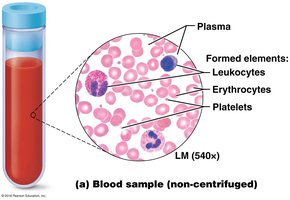
Blood is the body's only liquid connective tissue, accounting for about 8% of total body mass (5-6 liters in males, 4-5 liters in females). Unlike typical connective tissues, blood lacks collagen and elastic fibers. It consists of formed elements (cells and cell fragments) suspended in plasma (the non-living fluid matrix).
Formed elements: Erythrocytes (RBCs), Leukocytes (WBCs), Platelets
Plasma: Water, proteins, nutrients, electrolytes, hormones, gases, and wastes
Functions of Blood
Blood performs three primary functions:
Transport: Oxygen, carbon dioxide, nutrients, wastes, and hormones
Protection: Clotting (hemostasis) and immune defense against pathogens
Regulation: Body temperature, pH (buffering via bicarbonate), and fluid volume
Blood Composition
Plasma and Formed Elements
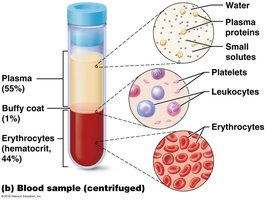
Blood is composed of plasma (about 55% of volume) and formed elements (about 45% of volume).
Plasma: Mostly water (92%), with proteins (albumins, globulins, fibrinogen), nutrients, electrolytes, and wastes
Formed elements:
Erythrocytes (RBCs): Oxygen transport
Leukocytes (WBCs): Immune defense
Platelets: Clotting
Plasma Proteins
Plasma contains three major categories of proteins:
Albumins: Smallest and most abundant; contribute to viscosity, osmolarity, and influence blood pressure
Globulins: Antibodies and transport proteins; alpha, beta, and gamma types
Fibrinogen: Precursor to fibrin, essential for clot formation
Formed Elements: Erythrocytes (RBCs)
Structure and Function
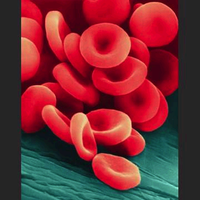
Erythrocytes are small, biconcave, non-nucleated cells specialized for gas transport. Their shape maximizes surface area for efficient exchange of oxygen and carbon dioxide.
Do not consume the oxygen they transport (anaerobic metabolism)
Renewed by division of precursor cells in bone marrow
Hemoglobin
Hemoglobin is the oxygen-carrying protein in erythrocytes.
Composed of four globin chains (2 alpha, 2 beta)
Each chain is bound to a heme group containing iron
Each iron atom binds reversibly to one O2 molecule
Erythropoiesis: RBC Production
Erythropoiesis is the process of RBC formation, occurring in the red bone marrow.
Stimulated by erythropoietin (EPO) from the kidneys
Development involves reduction in cell size, synthesis of hemoglobin, and loss of nucleus
Average lifespan of RBC: ~120 days
Iron Metabolism
Iron is essential for hemoglobin synthesis.
Dietary iron (Fe3+) is converted to Fe2+ (usable form) by stomach acid
Transported in blood by transferrin; stored in liver as ferritin
Erythrocyte Death and Removal
Old erythrocytes are removed by macrophages in the spleen and liver. Hemoglobin is broken down into heme and globin; iron is recycled, and bilirubin is excreted in bile.
Anemia
Anemia is a condition of reduced oxygen-carrying capacity of blood.
Causes: Decreased hemoglobin, decreased hematocrit, abnormal hemoglobin
Types: Hemorrhagic, hemolytic, iron-deficiency, pernicious, sickle cell
Symptoms: Fatigue, pale skin, shortness of breath, edema, increased heart rate
Formed Elements: Leukocytes (WBCs)
Types and Functions
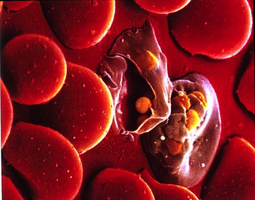
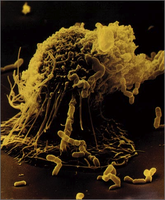
Leukocytes are complete cells with nuclei and organelles, responsible for immune defense.
Granulocytes:
Neutrophils: Phagocytize bacteria, release antimicrobial chemicals
Eosinophils: Attack parasites, phagocytize antigen-antibody complexes
Basophils: Release histamine (inflammation) and heparin (anticoagulant)
Agranulocytes:
Lymphocytes: Destroy cancer/virus-infected cells, secrete antibodies, immune memory
Monocytes: Differentiate into macrophages, phagocytize pathogens and debris
Leukopoiesis: WBC Production
Leukocytes are produced from hemopoietic stem cells in bone marrow.
Myeloblasts form granulocytes
Monoblasts form monocytes
Lymphoblasts form lymphocytes
Formed Elements: Platelets and Hemostasis
Platelet Structure and Function
Platelets are cytoplasmic fragments of megakaryocytes, essential for blood clotting.
Secrete vasoconstrictors, form platelet plugs, release clotting factors
Initiate clot-dissolving enzymes, attract immune cells, repair blood vessels
Hemostasis: Steps in Blood Clotting
Hemostasis is the process of stopping bleeding, involving several steps:
Vascular Spasm: Vasoconstriction reduces blood flow
Platelet Plug Formation: Platelets adhere to exposed collagen and aggregate
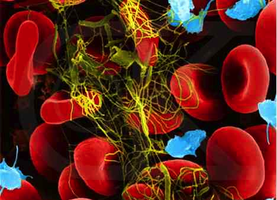
Coagulation: Fibrin mesh forms, trapping blood cells and stabilizing the clot
Clot Retraction and Thrombolysis: Clot contracts and is eventually dissolved
Blood Typing and Matching
ABO and Rh Blood Groups
Blood types are determined by antigens (agglutinogens) on erythrocyte surfaces and antibodies (agglutinins) in plasma.
ABO System:
Type A: A antigen, anti-B antibody
Type B: B antigen, anti-A antibody
Type AB: A and B antigens, no antibodies (universal recipient)
Type O: No antigens, anti-A and anti-B antibodies (universal donor)
Rh System:
Rh+ has D antigen; Rh- lacks D antigen
Anti-D antibodies form only after exposure to Rh+ blood
Transfusion Reactions
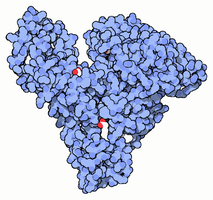
Transfusion of incompatible blood leads to agglutination (clumping) and destruction of erythrocytes, which can be life-threatening.
Rh Factor and Pregnancy
Rh incompatibility can cause hemolytic disease of the newborn if an Rh- mother carries an Rh+ fetus. Preventive treatment with Rh immune globulin is used to avoid antibody formation.
Summary Table: Blood Components
Component | Main Function | Key Features |
|---|---|---|
Erythrocytes (RBCs) | Oxygen transport | Biconcave, no nucleus, hemoglobin |
Leukocytes (WBCs) | Immune defense | Complete cells, several types |
Platelets | Clotting | Cell fragments, form plugs |
Plasma | Transport medium | Water, proteins, solutes |
Key Equations
Bicarbonate Buffer System: Hematocrit Calculation: Oxygen Binding to Hemoglobin: Iron Transport: Coagulation Cascade (simplified): Agglutination Reaction:
Additional info:
Blood is classified as a connective tissue due to its origin from mesenchyme and its function in connecting body systems via transport.
Serum is plasma without clotting factors (fibrinogen).
Blood typing is crucial for safe transfusions and organ transplants.
