 Back
BackComprehensive Study Notes for ANP College Final Exam: Special Senses, Endocrine, Blood, Cardiovascular, Lymphatic, Respiratory, Digestive, Urinary, and Reproductive Systems
Study Guide - Smart Notes
 Tailored notes based on your materials, expanded with key definitions, examples, and context.
Special Senses
Layers of the Eye
The eye is a complex organ with three main layers, each with specialized functions for vision and protection.
Fibrous Layer (Outer Layer): Includes the sclera (white, tough connective tissue for structure and muscle attachment) and the cornea (clear, dome-shaped front for light entry and focusing).
Vascular Layer (Middle Layer/Uvea): Contains the iris (controls pupil size and light entry), ciliary body (changes lens shape, produces aqueous humor), and choroid (provides blood supply and pigment to absorb stray light).
Inner Layer (Retina): Houses photoreceptors (rods and cones) and nerve cells, responsible for detecting light and sending visual information to the brain via the optic nerve.
Optic Components: Aqueous humor (anterior fluid), vitreous humor (posterior gel), and lens (focuses light by changing shape).
Summary: From outside to inside: Fibrous layer → Vascular layer → Retina. Each layer supports protection, nourishment, and vision.
Anatomy of the Ear
The ear is divided into three regions, each contributing to hearing and equilibrium.
Outer Ear: Pinna (collects sound), external auditory canal (channels sound), tympanic membrane (vibrates with sound).
Middle Ear: Ossicles (malleus, incus, stapes amplify vibrations), eustachian tube (equalizes pressure).
Inner Ear: Cochlea (hearing), semicircular canals & vestibule (balance and equilibrium).
How Hearing Works: Sound waves → outer ear → eardrum → ossicles → cochlea → nerve impulses to brain.
Equilibrium: Semicircular canals and vestibule detect head movement and position for balance.
Endocrine System
Major Hormones and Their Functions
Hormone | Function | Production Site |
|---|---|---|
ADH | Reduces urine output; conserves water | Hypothalamus (released by posterior pituitary) |
Insulin | Lowers blood glucose | Pancreas (beta cells) |
TSH | Stimulates thyroid hormone release | Anterior pituitary |
Cortisol | Increases blood glucose; stress response | Adrenal cortex |
Glucagon | Raises blood glucose | Pancreas (alpha cells) |
ANP | Lowers blood pressure | Atria of heart |
Epinephrine | Fight-or-flight response | Adrenal medulla |
Growth Hormone | Stimulates tissue/bone growth | Anterior pituitary |
Aldosterone | Increases sodium reabsorption | Adrenal cortex |
Thymosin | Promotes T-cell development | Thymus gland |
Melatonin | Regulates sleep-wake cycles | Pineal gland |
Prolactin | Stimulates milk production | Anterior pituitary |
Oxytocin | Uterine contractions, milk ejection | Hypothalamus (released by posterior pituitary) |
Estrogen | Female secondary sex characteristics | Ovaries |
Progesterone | Prepares uterus for pregnancy | Ovaries |
Testosterone | Male secondary sex characteristics | Testes |
Calcitonin | Lowers blood calcium | Thyroid gland |
PTH | Raises blood calcium | Parathyroid glands |
Additional info: The pituitary gland is a major hormone hub; the adrenal glands produce several key hormones for stress and metabolism.
Blood
Functions of Blood Cells
Erythrocytes (RBCs): Transport O2 and CO2; biconcave, no nucleus, filled with hemoglobin.
Leukocytes (WBCs): Defend against infection; have a nucleus; types include neutrophils, lymphocytes, monocytes, eosinophils, basophils.
Thrombocytes (Platelets): Aid in blood clotting; small, no nucleus.
Blood Typing
Antigens: Surface proteins on RBCs (A, B, Rh).
Antibodies: Plasma proteins that attack foreign antigens.
ABO System: Types A, B, AB, O based on antigens present.
Rh System: Rh+ (antigen present), Rh- (absent).
Hemolytic Disease of the Newborn: Occurs when an Rh- mother carries an Rh+ fetus; maternal antibodies attack fetal RBCs in subsequent pregnancies.
Cardiovascular System
Heart Chambers and Blood Flow
The heart consists of four chambers and a series of valves that ensure unidirectional blood flow.
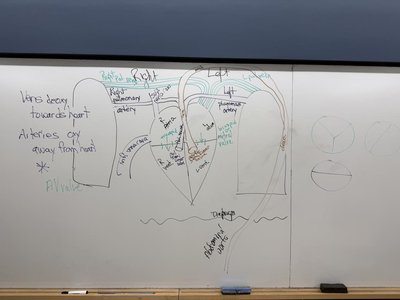
Right atrium → tricuspid valve → right ventricle → pulmonary valve → pulmonary artery → lungs (oxygenation)
Lungs → pulmonary veins → left atrium → bicuspid (mitral) valve → left ventricle → aortic valve → aorta → body
Valves: Tricuspid, pulmonary, mitral, aortic
Heart Sounds: "Lub" (S1): AV valves close; "Dub" (S2): semilunar valves close
Oxygenation: Right side = deoxygenated; left side = oxygenated
Basic Anatomy: Valves, septum, pericardium (protective sac), myocardium (muscle layer)
Electrical Conduction of the Heart
The heart's electrical system coordinates contraction for effective pumping.
SA node: Pacemaker, initiates impulse in right atrium
Impulse spreads through atria → AV node (delay for atrial contraction)
Impulse travels down Bundle of His → right and left bundle branches → Purkinje fibers (ventricular contraction)
Sequence: SA node → atria → AV node → Bundle of His → bundle branches → Purkinje fibers → ventricles
Arteries, Veins, and Capillaries
Arteries: Carry blood away from the heart; thick, elastic walls; branch into arterioles.
Capillaries: Smallest vessels; one cell thick; site of gas and nutrient exchange.
Veins: Carry blood toward the heart; formed by merging venules; thinner walls than arteries.
Key Point: Blood flows: arteries → capillaries → veins; capillaries are the main site of exchange.
Lymphatic System and Body Defenses
Lymphoid Organs and Functions
Tonsils: Trap and remove pathogens from food and air; three sets (pharyngeal, palatine, lingual).
Lymph Nodes: Filter lymph, destroy pathogens.
Peyer's Patches: Monitor intestinal bacteria in the ileum.
MALT: Mucosa-associated lymphoid tissue; protects mucosal surfaces.
Spleen: Filters blood, removes old RBCs, immune responses, blood reservoir.
Thymus: T cell maturation; most active in childhood.
Red Bone Marrow: Site of hematopoiesis and B cell maturation.
Appendix: Contains lymphoid tissue; may generate immune responses in the gut.
Immune System Terms
Pyrogens: Cause fever by acting on the hypothalamus; fever slows pathogens and boosts immunity.
Antigens: Molecules on pathogens that trigger immune responses.
Perforin: Protein released by cytotoxic T and NK cells; forms pores in target cells, causing lysis.
Immune Cell Functions
Helper T Cell (CD4+): Coordinates immune response, activates B and cytotoxic T cells.
B Cell: Recognizes antigens, produces antibodies, differentiates into plasma and memory cells.
Plasma Cell: Specialized B cell that secretes antibodies.
Cytotoxic T Cell: Destroys infected/cancerous cells using perforins and granzymes.
Memory Cell: Long-lived B or T cell for rapid future responses.
Respiratory System
Anatomy and Zones
Conducting Zone: Nose, pharynx, larynx, trachea, bronchi, bronchioles (air passage, warming, filtering).
Respiratory Zone: Respiratory bronchioles, alveolar ducts, alveoli (site of gas exchange).
Pharynx: Nasopharynx (air), oropharynx (air/food), laryngopharynx (air/food separation).
Larynx: Glottis (airway opening), epiglottis (protects airway during swallowing), vocal folds (sound production).
Respiratory Physiology
Pulmonary Ventilation: Air movement in/out of lungs (breathing).
External Respiration: Gas exchange between alveoli and blood.
Internal Respiration: Gas exchange between blood and tissues.
Lung Volumes and Capacities
Tidal Volume (TV): Normal breath volume.
Inspiratory Reserve Volume (IRV): Extra air inhaled after normal inhalation.
Expiratory Reserve Volume (ERV): Extra air exhaled after normal exhalation.
Vital Capacity (VC): Maximum exhaled after maximum inhalation.
Dead Space Volume: Air in conducting airways, not involved in gas exchange.
Residual Volume: Air remaining after maximal exhalation (~1200 mL).
Digestive System
Key Structures and Functions
Mouth: Mechanical (chewing) and chemical (amylase) digestion begins.
Stomach: Mixes food, digests proteins (pepsin), begins fat digestion, secretes acid and mucus.
Small Intestine: Duodenum, jejunum, ileum; main site for digestion and absorption; receives enzymes and bile.
Liver: Produces bile for fat emulsification, processes nutrients, detoxifies substances.
Urinary System
Nephron Anatomy and Function
Renal Corpuscle: Glomerulus (filtration), Bowman's capsule (collects filtrate).
Afferent/Efferent Arterioles: Bring blood to/from glomerulus.
Renal Tubule: Proximal tubule (reabsorption), Loop of Henle (descending: water, ascending: ions), distal tubule (further modification), macula densa (regulation).
Collecting Duct: Final urine modification and transport.
Types: Cortical (short loops), juxtamedullary (long loops, concentrated urine).
Urinary System Locations
Kidneys: Posterior abdominal wall (T12–L3).
Ureters: From kidneys to bladder.
Bladder: Pelvic cavity.
Urethra: From bladder to outside (shorter in females).
Nephron: Cortex and medulla of kidney.
Key Terms
Osmosis: Water movement across membranes.
Glomerular Filtration: Blood pressure forces filtrate into Bowman's capsule.
Tubular Secretion: Active transport of substances into tubule.
Tubular Reabsorption: Reclaiming useful substances from filtrate.
Pyelonephritis: Kidney infection.
Glomerulonephritis: Glomerular inflammation.
Cystitis: Bladder inflammation.
Urethritis: Urethra inflammation.
Incontinence: Inability to control urination.
Nocturia: Nighttime urination.
Micturition: Urination process.
Role of ADH
Produced by hypothalamus, released by posterior pituitary.
Increases water reabsorption in collecting ducts, reducing urine volume and concentrating urine.
High ADH: water conserved; low ADH: more water excreted.
pH Changes: Acidosis and Alkalosis
Acids: Increase H+ concentration; Bases: decrease H+.
pH Scale: <7 acidic, >7 basic.
Acidosis: Blood pH <7.35; excess H+; impairs function.
Alkalosis: Blood pH >7.45; H+ deficit; disrupts metabolism.
Reproductive System
Key Terms and Structures
Gametes: Sperm (male), egg (female); haploid (23 chromosomes).
Zygote: Fertilized egg; diploid (46 chromosomes).
Spermatids: Immature sperm cells; haploid.
Male Reproductive Anatomy
Interstitial Cells (Leydig): Produce testosterone.
Ejaculatory Duct: Transports semen to urethra.
Rete Testis: Channels sperm to epididymis.
Seminiferous Tubules: Site of spermatogenesis.
Lobules: Testicular compartments with seminiferous tubules.
Glans Penis: Sensitive tip; passage for semen/urine.
Urethra: Carries urine/semen out of body.
Seminal Vesicles: Secrete nutrient-rich fluid for sperm.
Epididymis: Sperm maturation/storage.
Ductus Deferens: Transports sperm to ejaculatory duct.
Fertilization and Female Reproductive Anatomy
Fertilization: Occurs in ampulla of fallopian tube.
Corpus Luteum: Temporary ovarian structure; secretes progesterone after ovulation; supports early pregnancy.
Uterine Layers: Perimetrium (outer), myometrium (muscle), endometrium (inner, for implantation).
Hormonal Regulation
LH: Triggers ovulation, corpus luteum formation, testosterone production.
FSH: Stimulates follicle growth, spermatogenesis.
Testosterone: Male characteristics, spermatogenesis.
Inhibin: Inhibits FSH, regulates gamete production.
Progesterone: Maintains uterine lining, pregnancy.
Developmental Stages and Terms
Ovulation: Egg release from ovary.
Fertilization: Sperm and egg fusion.
Cleavage: Rapid cell division post-fertilization.
Implantation: Embryo embeds in uterine lining.
Primary Oocyte: Immature egg in ovary.
Secondary Oocyte: Released at ovulation; completes meiosis II if fertilized.
Ovum: Mature egg post-fertilization.
Polar Body: Small cell discarding extra chromosomes.
Zygote: Fertilized egg cell.
Morula: Solid ball of cells post-cleavage.
Blastocyst: Hollow structure; implants in uterus.
Corona Radiata: Protective cell layer around oocyte.
Embryo: Weeks 3–8; organ formation.
Fetus: Week 9–birth; growth/maturation.
Meiosis in Reproduction
Reduces chromosome number (diploid to haploid).
Creates genetic diversity (crossing over, independent assortment).
Produces gametes for sexual reproduction.
Sex Chromosomes
Female: XX (egg always donates X)
Male: XY (sperm donates X or Y)
Result: XX = female, XY = male
Female Reproductive Terms
Menarche: First menstruation.
Menstruation: Monthly uterine lining shedding.
Menses: Blood/tissue flow during menstruation.
Menopause: End of menstruation/reproductive years.
Placenta Formation
Begins at implantation (weeks 2–3), functional by week 4, fully formed by week 12.
