 Back
Comprehensive Study Notes: Human Anatomy and Physiology Final Exam Review
Study Guide - Smart Notes
 Tailored notes based on your materials, expanded with key definitions, examples, and context.
Chapter 20 – The Lymphatic System
Overview of Lymphatic System Functions
The lymphatic system is essential for fluid recovery, immunity, and lipid absorption. It returns excess interstitial fluid to the bloodstream, houses immune cells, and absorbs dietary fats from the digestive tract.
Fluid Recovery: Collects and returns interstitial fluid to the circulatory system.
Immunity: Provides sites for immune surveillance and lymphocyte activation.
Lipid Absorption: Specialized lymphatic capillaries (lacteals) absorb dietary lipids in the small intestine.
Lymph and Lymphatic Vessels
Lymph: The fluid transported within lymphatic vessels, similar to plasma but lower in protein.
Lymphatic Capillaries: Closed at one end, highly permeable, and found throughout most tissues.
Collecting Vessels: Carry lymph from capillaries to lymphatic trunks.
Lymphatic Trunks and Ducts: Large vessels that drain lymph into the venous system.
Major Lymphatic Ducts
The body is drained by two main lymphatic ducts:
Right Lymphatic Duct: Drains lymph from the right upper limb, right side of the head and thorax.
Thoracic Duct: Drains lymph from the rest of the body (left side of head, left upper limb, left thorax, abdomen, pelvis, and both lower limbs).
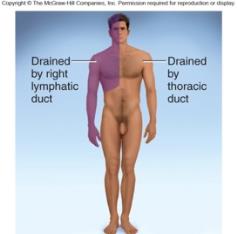
This image illustrates the regions of the body drained by the right lymphatic duct (right upper quadrant) and the thoracic duct (the remainder of the body).
Lymphatic Cells and Tissues
Natural Killer (NK) Cells: Destroy bacteria, transplanted tissue, and infected host cells.
T Lymphocytes (T Cells): Mature in the thymus; involved in cell-mediated immunity.
B Lymphocytes (B Cells): Mature in bone marrow; differentiate into plasma cells that produce antibodies.
Macrophages: Phagocytize debris and pathogens; present antigens to lymphocytes.
Mucosa-Associated Lymphatic Tissue (MALT): Lymphatic tissue found in mucous membranes throughout the body.
Lymphatic Organs
Red Bone Marrow: Site of hemopoiesis (blood cell formation).
Thymus: Site of T cell maturation.
Lymph Nodes: Filter lymph and house lymphocytes.
Tonsils: Protect against inhaled and ingested pathogens.
Spleen: Filters blood, recycles erythrocytes, and houses immune cells.
