 Back
Comprehensive Study Notes: Human Reproductive System (Anatomy & Physiology)
Study Guide - Smart Notes
 Tailored notes based on your materials, expanded with key definitions, examples, and context.
Introduction to Human Reproductive System
Overview of Reproduction
The reproductive system is essential for the survival of species, enabling organisms to produce offspring and ensure genetic continuity. In humans, reproduction involves complex anatomical structures and physiological processes, regulated by hormones and specialized cells.
Reproduction: The biological process by which new individual organisms are produced from their parents.
Ensures the continued existence of species.
Involves both asexual and sexual mechanisms, though humans reproduce sexually.
Types of Reproduction
Asexual vs. Sexual Reproduction
Reproduction can occur without sex (asexual) or with the fusion of gametes (sexual). In humans, sexual reproduction is the norm, involving specialized reproductive organs and cells.
Asexual reproduction: Offspring arise from a single organism, inheriting the genes of that parent only.
Sexual reproduction: Involves the fusion of male and female gametes (sperm and ovum), resulting in genetic variation.
The Reproductive System: Gonads and Gametes
Gonads and Gamete Production
The primary sex organs, or gonads, are responsible for producing gametes and sex hormones. The male gonads are the testes (produce sperm), and the female gonads are the ovaries (produce ova).
Testes: Produce sperm and testosterone.
Ovaries: Produce ova (eggs), estrogen, and progesterone.
Accessory reproductive organs support gamete transport and fertilization.
Male Reproductive System
Anatomy of the Male Reproductive System
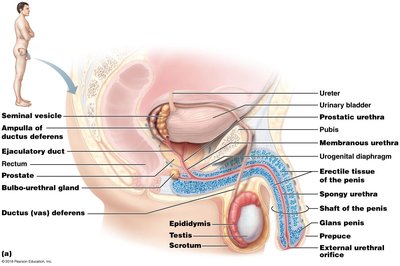
The male reproductive system is specialized for the production, maturation, and delivery of sperm. It consists of the testes, duct system, accessory glands, and external genitalia.
Testes: Site of sperm and testosterone production.
Duct system: Includes the epididymis, ductus (vas) deferens, and urethra, which transport sperm.
Accessory glands: Seminal vesicles, prostate, and bulbourethral glands produce seminal fluid.
External genitalia: Penis (organ of copulation) and scrotum (houses testes).

Testes
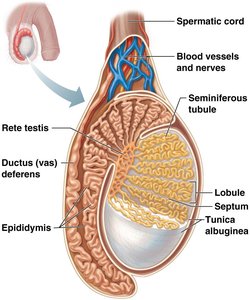
The testes are paired organs suspended in the scrotum, responsible for sperm and hormone production. Each testis is divided into lobules containing seminiferous tubules, where spermatogenesis occurs.
Tunica albuginea: Fibrous capsule surrounding each testis.
Septa: Extensions of the capsule dividing the testis into lobules.
Seminiferous tubules: Sperm-forming factories.
Interstitial (Leydig) cells: Produce testosterone.
Sertoli cells: Support spermatogenesis.

Duct System: Epididymis, Ductus Deferens, and Urethra
The duct system transports sperm from the testes to the exterior. It includes the epididymis (site of sperm maturation), ductus deferens (transports sperm during ejaculation), and urethra (common passage for urine and semen).
Epididymis: Highly convoluted tube; sperm mature here.
Ductus (vas) deferens: Muscular tube; moves sperm by peristalsis.
Urethra: Extends from the bladder to the tip of the penis; carries urine and semen.
Accessory Organs: Seminal Vesicles, Prostate, Bulbourethral Glands, and Semen
Accessory glands produce seminal fluid, which nourishes and protects sperm. Semen is a mixture of sperm and glandular secretions.
Seminal vesicles: Produce alkaline fluid with fructose, vitamin C, prostaglandins.
Prostate gland: Produces thin, milky fluid with enzymes and citrate; activates sperm.
Bulbourethral glands: Secrete alkaline mucus to neutralize urethral acidity.
Semen: Contains sperm, nutrients, and substances that enhance motility and survival.

External Genitalia: Penis and Scrotum
The penis delivers sperm into the female reproductive tract, while the scrotum maintains optimal temperature for spermatogenesis.
Penis: Shaft, glans penis (tip), and prepuce (foreskin).
Scrotum: Sac of skin housing the testes; maintains temperature 3°C below body temperature.
Male Reproductive Functions
The male reproductive system produces androgens (mainly testosterone), supports spermatogenesis, and enables sperm delivery for fertilization.
Testosterone: Maintains male reproductive function, induces secondary sexual characteristics, and regulates libido and bone health.
Spermatogenesis
Spermatogenesis is the process of sperm production in the seminiferous tubules, beginning at puberty and continuing throughout life.
Involves mitosis, meiosis, and spermiogenesis (differentiation of spermatids into spermatozoa).
Regulated by follicle-stimulating hormone (FSH) and luteinizing hormone (LH).
Each primary spermatocyte (2n) produces four haploid (n) sperm cells.
Key stages:
Mitosis of spermatogonia → primary spermatocytes
Meiosis I → secondary spermatocytes
Meiosis II → spermatids
Spermiogenesis → mature spermatozoa
Sperm structure: Head (with acrosome), midpiece, tail.
Female Reproductive System
Anatomy of the Female Reproductive System
The female reproductive system is specialized for the production of ova, reception of sperm, fertilization, and support of embryonic development. It includes the ovaries, duct system, and external genitalia.
Ovaries: Produce ova and secrete estrogen and progesterone.
Duct system: Uterine (fallopian) tubes, uterus, vagina.
External genitalia: Mons pubis, labia, clitoris, urethral and vaginal orifices, greater vestibular glands.
Ovaries
The ovaries are paired organs anchored by ligaments and contain ovarian follicles at various stages of development.
Ovarian follicles: Consist of an oocyte (immature egg) surrounded by follicle cells.
Follicular development: Primary follicle → vesicular (Graafian) follicle → ovulation → corpus luteum.
Corpus luteum: Secretes estrogen and progesterone after ovulation.
Duct System: Uterine Tubes, Uterus, and Vagina
The female duct system transports the ovulated oocyte, provides a site for fertilization, and supports embryonic development.
Uterine (fallopian) tubes: Receive oocyte, site of fertilization, transport to uterus via cilia and peristalsis.
Uterus: Receives, retains, and nourishes fertilized egg; regions include body, fundus, and cervix.
Vagina: Canal for menstrual flow, childbirth, and copulation; partially closed by the hymen.
External Genitalia and Female Perineum
The external genitalia, collectively called the vulva, protect the internal reproductive organs and facilitate sexual intercourse.
Mons pubis: Fatty area overlying the pubic bone.
Labia: Folds of skin protecting the vaginal and urethral openings.
Clitoris: Erectile tissue, pleasure center.
Greater vestibular glands: Secrete lubricating mucus.
Female Reproductive Functions and Cycles
Oogenesis and Ovarian Cycles
Oogenesis is the process of egg formation, beginning before birth and completed upon fertilization. The ovarian cycle regulates the maturation and release of oocytes.
Oogonia (stem cells) divide to form primary oocytes, which are arrested in prophase I until puberty.
At puberty, FSH stimulates follicle growth and meiosis resumes.
Ovulation: Release of secondary oocyte at metaphase II; completes meiosis II only if fertilized.
Corpus luteum forms from ruptured follicle, secreting estrogen and progesterone.
Hormonal Regulation of the Ovarian and Menstrual Cycles
The ovarian and menstrual cycles are regulated by the hypothalamic-pituitary-gonadal axis, involving GnRH, FSH, LH, estrogen, and progesterone.
Follicular phase (days 0–14): FSH and LH stimulate follicle growth; estrogen production increases.
Ovulation: Triggered by LH surge.
Luteal phase (days 15–28): Corpus luteum secretes hormones; negative feedback inhibits FSH/LH.
If no fertilization, corpus luteum degenerates, hormone levels fall, and cycle restarts.
Menstrual Cycle
The menstrual cycle involves cyclic changes in the endometrium, preparing the uterus for possible implantation.
Menstrual phase (days 1–5): Shedding of the endometrial lining; low hormone levels.
Proliferative phase (days 6–14): Endometrium regenerates; rising estrogen levels.
Secretory phase (days 15–28): Endometrium thickens; progesterone increases; prepares for implantation.
Fertilization and Early Development
Fertilization
Fertilization occurs in the uterine tube when a sperm penetrates the oocyte, triggering completion of meiosis II and formation of a zygote.
Acrosome reaction: Enzymes from the sperm acrosome digest the oocyte membrane.
Cortical reaction: Prevents polyspermy by modifying the oocyte membrane.
Zygote (2n=46): Result of fusion of sperm and egg nuclei.
Embryonic and Fetal Development
After fertilization, the zygote undergoes cleavage, forming a blastocyst that implants in the endometrium. The placenta forms to support the embryo/fetus.
Embryo: Fertilization to week 8.
Fetus: Week 9 to birth.
Placenta: Facilitates nutrient, gas, and waste exchange; produces hormones to maintain pregnancy.
Parturition (Labor)
Parturition is the process of childbirth, involving uterine contractions, cervical dilation, delivery of the baby, and expulsion of the placenta.
Triggered by hormonal changes (oxytocin, prostaglandins).
Three stages: Dilation, expulsion, placental delivery.
Contraception and Abortion
Contraceptive Methods
Contraception refers to deliberate prevention of pregnancy through various methods, including hormonal, barrier, surgical, and emergency techniques.
Method | Mechanism |
|---|---|
Vasectomy | Cuts/seals vas deferens to prevent sperm release |
Tubal ligation | Blocks/removes fallopian tubes to prevent egg transport |
Vaginal ring | Releases hormones to inhibit ovulation and thicken cervical mucus |
Spermicide | Kills sperm in the vagina |
IUD | Prevents implantation or fertilization |
Morning-after pill | Delays ovulation |
Abortion
Abortion is the termination of pregnancy, which may occur spontaneously (miscarriage) or be induced for medical or elective reasons.
Spontaneous abortion: Occurs naturally, often due to abnormal embryo development.
Induced abortion: Performed deliberately, may be therapeutic or elective.
Methods include medication (e.g., RU486), suction aspiration, and dilation and evacuation.
Comparison of Male and Female Gametogenesis
Feature | Male (Spermatogenesis) | Female (Oogenesis) |
|---|---|---|
Number of functional gametes | 4 sperm per meiosis | 1 ovum per meiosis |
Timing | Continuous from puberty | Begins before birth, resumes at puberty, ends at menopause |
Gamete size | Small, motile | Large, nonmotile |
Nutrient reserves | Minimal | Substantial (for embryo) |
Summary
The human reproductive system is a complex network of organs and hormones that ensures the continuation of the species. Understanding its anatomy and physiology is essential for comprehending human development, reproductive health, and the basis of many clinical interventions.
