 Back
Core Principles of Physiology: Homeostasis, Membrane Transport, and Body Compartments
Study Guide - Smart Notes
 Tailored notes based on your materials, expanded with key definitions, examples, and context.
Introduction to Physiology
Definition and Scope
Physiology is the study of the normal functioning of living organisms and their component parts, encompassing all chemical and physical processes. It is an integrative science, closely tied to anatomy, as the structure of cells, tissues, and organs provides the physical basis for their function.
Emergent properties: Properties of a complex system that cannot be explained by knowledge of the system's individual components. These arise from complex, nonlinear interactions among system components.
Levels of organization: Atoms → molecules → cells → tissues → organs → organ systems → organisms → populations → ecosystems → biosphere.
Cells: The smallest unit capable of carrying out life processes.
Tissues: Collections of cells carrying out related functions.
Organs: Formed by tissues into structural and functional units.
Organ systems: Integrated groups of organs, usually studied separately but highly interconnected.
Homeostasis and Control Systems
Homeostasis: The Central Principle
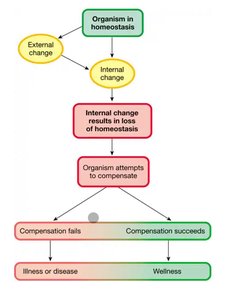
Homeostasis refers to the maintenance of a relatively stable internal environment. The body monitors its internal state and takes action to correct disruptions that threaten normal function. Failure to maintain homeostasis results in disease or pathological conditions.
Internal and external changes can disrupt homeostasis.
Compensation mechanisms attempt to restore balance; failure leads to illness or disease, while success results in wellness.
Mechanisms of Homeostatic Regulation
Teleological approach: Explains the function or "why" (e.g., why RBCs transport oxygen: because cells need oxygen).
Mechanistic approach: Explains the process or "how" (e.g., how RBCs transport oxygen: oxygen binds to hemoglobin in RBCs).
Physiology focuses on mechanistic explanations.
Control Systems and Feedback Loops
All control systems have three components: an input signal, an integrating center, and an output signal that creates a response. Control can be local (restricted to a tissue) or reflex (long-distance, involving nervous and/or endocrine systems).
Negative feedback: The response opposes or removes the original stimulus, stabilizing the variable (e.g., blood glucose regulation).
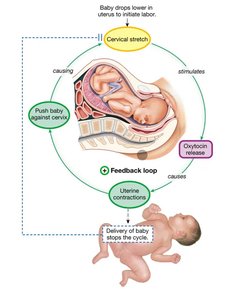
Positive feedback: The response reinforces the stimulus, sending the system temporarily out of control (e.g., childbirth).
Feedforward control: Anticipates change and starts the response loop in advance (e.g., salivation at the sight of food).
Response Loop Structure
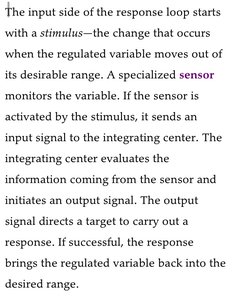
The input side of the response loop starts with a stimulus (change in the regulated variable). A specialized sensor monitors the variable and sends an input signal to the integrating center, which evaluates the information and initiates an output signal to a target, producing a response that returns the variable to its desired range.
Example: Positive Feedback in Childbirth
During labor, cervical stretch stimulates oxytocin release, which causes uterine contractions. These contractions push the baby against the cervix, causing more stretch and more oxytocin release—a positive feedback loop. Delivery of the baby stops the cycle.
Compartmentation: Cells and Body Cavities
Body Compartments
The body is divided into three major cavities: cranial (brain), thoracic (heart and lungs), and abdominopelvic (digestive and reproductive organs). Compartments allow separation of biochemical processes but can make transport of materials challenging, requiring specialized mechanisms.
Fluid compartments: Intracellular fluid (ICF) and extracellular fluid (ECF), separated by cell membranes.
ECF is further divided into plasma (fluid portion of blood) and interstitial fluid (surrounds most cells).
Membrane Dynamics and Transport
Osmosis, Osmolarity, and Tonicity
Water moves freely between cells and ECF, reaching osmotic equilibrium. However, chemical and electrical disequilibrium exist due to selective permeability and active transport.
Osmolarity: Number of osmotically active particles per liter of solution (osmol/L or mOsM).
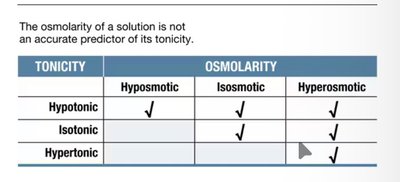
Tonicity: Describes how a solution affects cell volume (hypotonic, isotonic, hypertonic).
Osmolarity alone cannot predict tonicity; the nature of solutes (penetrating vs. nonpenetrating) must be considered.
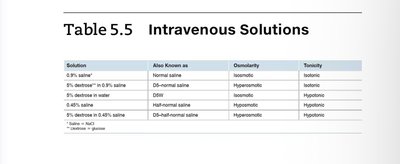
Clinical Application: Intravenous Solutions
Solution | Also Known As | Osmolarity | Tonicity |
|---|---|---|---|
0.9% saline | Normal saline | Isosmotic | Isotonic |
5% dextrose in 0.9% saline | D5–normal saline | Hyperosmotic | Isotonic |
5% dextrose in water | D5W | Isosmotic | Hypotonic |
0.45% saline | Half-normal saline | Hyposmotic | Hypotonic |
5% dextrose in 0.45% saline | D5–half-normal saline | Hyperosmotic | Hypotonic |
Membrane Transport Mechanisms
Diffusion and Fick's Law
Diffusion is the movement of molecules from high to low concentration. The rate of diffusion depends on several factors, summarized by Fick's Law:
Rate of diffusion is proportional to surface area, concentration gradient, and membrane permeability.

Simple diffusion: Lipophilic molecules cross membranes directly.
Facilitated diffusion: Polar molecules cross with the help of membrane proteins (e.g., glucose transporters).
Active transport: Moves substances against their concentration gradient, requiring energy (e.g., Na+/K+ ATPase).
Summary Table: Key Terms and Concepts
Term | Definition |
|---|---|
Homeostasis | Maintenance of a stable internal environment |
Negative Feedback | Response opposes the original stimulus |
Positive Feedback | Response reinforces the original stimulus |
Osmolarity | Number of osmotically active particles per liter |
Tonicity | Effect of a solution on cell volume |
Diffusion | Movement of molecules from high to low concentration |
Facilitated Diffusion | Protein-mediated passive transport |
Active Transport | Energy-requiring movement against a gradient |
Additional info: This guide covers foundational concepts from Chapters 1, 3, 4, and 5 of a typical ANP college course, including homeostasis, compartmentation, membrane dynamics, and transport mechanisms. The included images and tables directly reinforce the explanations of homeostatic regulation, feedback loops, tonicity, and membrane transport.
