 Back
BackCytology: The Cytoplasm, Organelles, and Cell Cycle
Study Guide - Smart Notes
 Tailored notes based on your materials, expanded with key definitions, examples, and context.
The Cytoplasm
Overview of the Cytoplasm
The cytoplasm is the entire cellular material surrounding the nucleus and enclosed by the plasma membrane. It is a complex, dynamic environment that supports cellular processes and contains various structures essential for cell function.
Cytosol: The fluid component of the cytoplasm, containing dissolved ions, nutrients, and proteins.
Organelles: Specialized structures performing distinct cellular functions.
Cellular Structures: Includes the cytoskeleton and other non-membranous elements.
Cellular Inclusions: Non-living substances such as stored nutrients or pigments.
Organelles
Nucleus
The nucleus is the control center of the cell, housing genetic material and coordinating cellular activities.
Contains linear, double-stranded DNA organized as chromatin, which condenses into chromosomes during cell division.
Nuclear envelope: Double membrane with nuclear pores for molecular transport.
Nucleoplasm: The substance within the nuclear envelope.
Nucleolus: Synthesizes ribosomal RNA (rRNA) and ribosomal subunits.
Mitochondrion
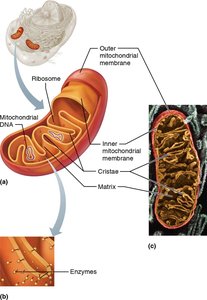
Mitochondria are the sites of ATP synthesis, crucial for cellular energy production. They possess a double membrane and are semi-autonomous, containing their own DNA.
Outer and inner membranes: The inner membrane forms cristae, increasing surface area for energy reactions.
Matrix: The internal space containing enzymes and mitochondrial DNA.
Resemble bacteria: Reflecting their evolutionary origin.
Endoplasmic Reticulum (ER)
The ER is a network of membrane channels and cisterns, continuous with the nuclear envelope, involved in synthesis and transport.
Rough ER: Studded with ribosomes, synthesizes proteins.
Smooth ER: Lacks ribosomes, synthesizes lipids and detoxifies chemicals.
Golgi Apparatus
The Golgi apparatus processes, packages, and distributes molecules within the cell.
Stacked, flattened membranous sacs: Modify proteins and lipids received from the ER.
Vesicles: Transport processed molecules to their destinations.
Peroxisomes
Peroxisomes are small, spherical organelles containing oxidative enzymes. They detoxify substances and break down fatty acids.
Single-membranous sacs: Isolate harmful reactions.
Oxidative enzymes: Catalyze reactions to neutralize toxins.
Lysosomes
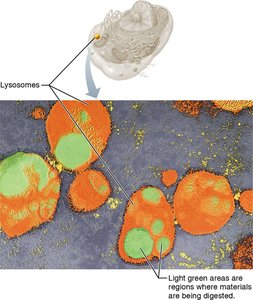
Lysosomes are small, spherical organelles containing digestive enzymes. They are abundant in phagocytes and require an acidic environment for function.
Digestive enzymes: Break down cellular waste and foreign material.
Acidic environment: Maintained for optimal enzyme activity.
Cellular Structures
Ribosomes
Ribosomes are the cellular machinery for protein synthesis, composed of rRNA and riboproteins.
Two subunits: Large (60S) and small (40S).
Exist freely or membrane-bound: Free in cytosol or attached to ER.
The Cytoskeleton
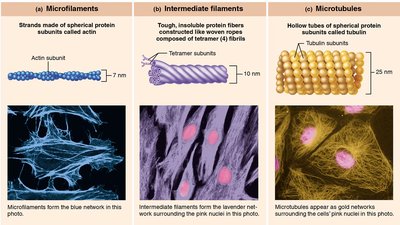
The cytoskeleton is a network of macromolecular fibers that maintains cell shape and assists in movement.
Microfilaments (Actin filaments): Long, thin fibers involved in cell movement and structural support.
Intermediate filaments: Rope-like fibers providing strength and structural support.
Microtubules: Hollow tubes composed of tubulin, involved in intracellular organization and movement.
Centrosomes
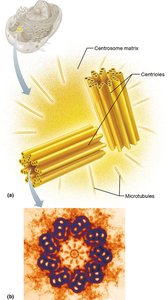
Centrosomes are microtubule-organizing regions near the nucleus, essential for cell division.
Contain centrioles: Cylindrical structures involved in organizing microtubules during mitosis.
The Cell Surface
Cellular Extensions
Cellular extensions increase surface area or facilitate movement.
Cilia: Short, hairlike extensions that move together in a sweeping motion.
Flagella: Long extensions that propel the whole cell.
Microvilli: Minute, fingerlike projections that increase surface area for absorption.
Cell Growth and Reproduction
The Cell Cycle
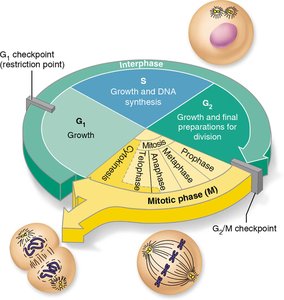
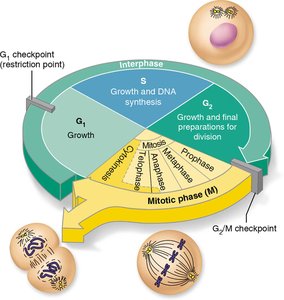
The cell cycle is an ordered sequence of events involving cell growth and nuclear division. It consists of two main stages: interphase and mitosis.
Interphase: Cellular growth and DNA synthesis occur.
Mitosis: Nuclear division and cell division.
Interphase
Interphase is the stage of the cell cycle where the cell grows and replicates its DNA. It is divided into three sub-stages:
G1 stage: Cell growth; G1 checkpoint ensures readiness for DNA synthesis.
S stage: DNA synthesis (replication).
G2 stage: Growth and final preparations for division; G2/M checkpoint ensures readiness for mitosis.
DNA Replication
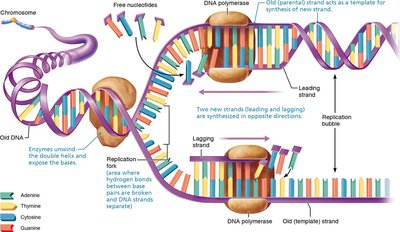
DNA replication is the process of synthesizing a new DNA double helix. Semiconservative replication ensures that each strand of the original molecule serves as a template for constructing a new strand.
Enzymes: DNA polymerase synthesizes new strands; helicase unwinds the double helix.
Replication fork: Area where the DNA is actively being unwound and replicated.
Leading and lagging strands: New strands are synthesized in opposite directions.
Additional info:
The cytoplasm and its organelles are central to cellular metabolism, signaling, and structural integrity.
Cell cycle checkpoints are critical for preventing errors in DNA replication and division, which can lead to disease.
Semiconservative replication is fundamental to genetic inheritance and cellular function.
