 Back
BackDigestion and Absorption in the Human Digestive System
Study Guide - Smart Notes
 Tailored notes based on your materials, expanded with key definitions, examples, and context.
Digestion and Absorption of Lipids
Overview of Lipid Digestion
Lipid digestion is a complex process that occurs primarily in the small intestine, involving several steps to break down insoluble triglycerides into absorbable molecules.
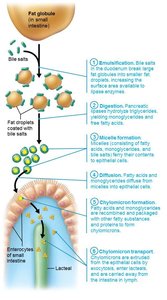
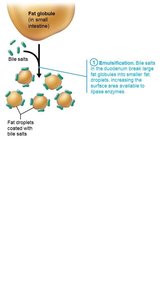
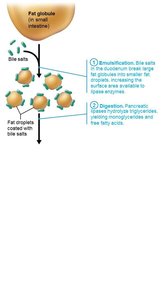
Emulsification: Bile salts break large fat globules into smaller droplets, increasing surface area for enzyme action.
Digestion: Pancreatic lipases hydrolyze triglycerides into monoglycerides and free fatty acids.
Micelle Formation: Digestion products are coated with bile salts and lecithin, forming micelles that facilitate transport across the intestinal epithelium.
Diffusion: Lipid products leave micelles and diffuse across the epithelial membrane.
Chylomicron Formation: Lipid products are reassembled into triglycerides and packaged with proteins to form chylomicrons.
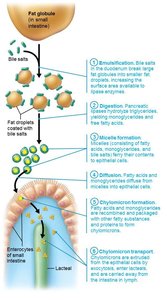
Chylomicron Transport: Chylomicrons are exocytosed into lymphatic lacteals and eventually enter venous blood.
Enzymes and Sites of Action
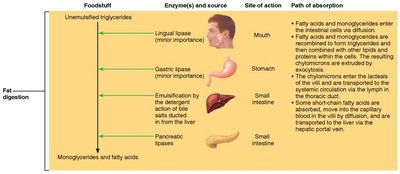
Lingual Lipase: Acts in the mouth; minor importance.
Gastric Lipase: Acts in the stomach; minor importance.
Bile Salts: Produced by the liver, act in the small intestine for emulsification.
Pancreatic Lipase: Major enzyme for fat digestion in the small intestine.
Absorption Pathways
Fatty acids and monoglycerides enter intestinal cells by diffusion.
Chylomicrons are transported via lymphatic lacteals and eventually reach the bloodstream.
Short-chain fatty acids can diffuse directly into blood.
Stepwise Process of Fat Digestion and Absorption
Emulsification: Bile salts break up fat globules.
Digestion: Pancreatic lipases hydrolyze triglycerides.
Micelle Formation: Bile salts and lecithin form micelles with digestion products.
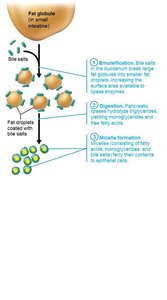
Diffusion: Fatty acids and monoglycerides diffuse into epithelial cells.
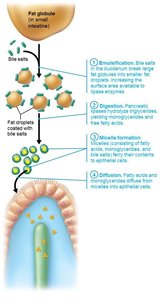
Chylomicron Formation: Lipid products are reassembled and packaged.
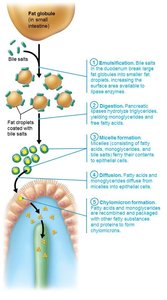
Chylomicron Transport: Chylomicrons enter lymphatic lacteals.
Digestion and Absorption of Nucleic Acids
Overview of Nucleic Acid Digestion
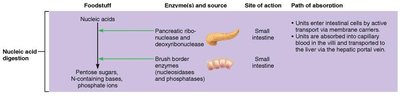
Nucleic acids from ingested cells are broken down in the small intestine by specific enzymes.
Pancreatic Nucleases: Hydrolyze DNA and RNA into nucleotide monomers.
Brush Border Enzymes: Nucleosidases and phosphatases further break down nucleotides into nitrogenous bases, pentose sugars, and phosphate ions.
Absorption: Breakdown products are actively transported by carriers in the epithelium of villi.
Absorption of Vitamins, Electrolytes, and Water
Vitamin Absorption
Vitamins are absorbed in both the small and large intestines, depending on their solubility.
Fat-soluble vitamins (A, D, E, K): Carried by micelles and diffuse into absorptive cells.
Water-soluble vitamins (C, B): Absorbed by diffusion or via passive/active transporters.
Vitamin B12: Binds with intrinsic factor and is absorbed by endocytosis.
Large intestine: Absorbs vitamin K and B vitamins produced by bacterial metabolism.
Electrolyte Absorption
Most ions are actively transported along the small intestine.
Iron and calcium are absorbed in the duodenum; iron is stored with ferritin and transported by transferrin when needed.
Calcium absorption is regulated by vitamin D and parathyroid hormone (PTH).
Sodium absorption is coupled with glucose and amino acid absorption.
Potassium diffuses in response to osmotic gradients.
Water Absorption
About 9 liters of water enter the small intestine daily, mostly from GI tract secretions.
95% is absorbed in the small intestine by osmosis; most of the rest is absorbed in the large intestine.
Water uptake is coupled with solute uptake.
Clinical Aspects and Homeostatic Imbalances
Malabsorption Syndromes
Caused by anything interfering with delivery of bile or pancreatic juice.
Damaged intestinal mucosa (e.g., bacterial infection, antibiotics) can impair absorption.
Celiac Disease: Immune reaction to gluten damages intestinal villi and brush border; treatment is gluten-free diet.
Congenital and Genetic Disorders
Cleft Palate and Cleft Lip: Failure of palatine bones/processes to fuse; affects feeding in infants.
Tracheoesophageal Fistula: Abnormal connection between esophagus and trachea.
Cystic Fibrosis: Thick mucus blocks pancreatic duct, affecting digestion.
Developmental Aspects of the Digestive System
Embryonic Development
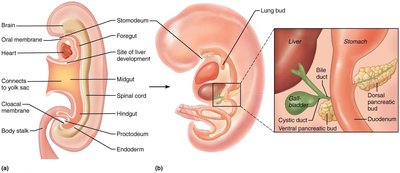
The digestive system develops from the primitive gut, with the epithelial lining formed from endoderm and other structures from mesoderm.
Oral membrane: Becomes the mouth.
Cloacal membrane: Becomes the anus.
By week 5, the alimentary canal is a continuous tube from mouth to anus.
Accessory organs bud from the mucosa shortly after.
Digestive System After Birth
Fetal nutrition occurs via placenta; GI tract matures by swallowing amniotic fluid.
Newborns have rooting and sucking reflexes for feeding.
Newborns double birth weight in 6 months; adult diet by 2 years.
Gastroenteritis, cholecystitis, and ulcers are common in middle age.
Aging and the Digestive System
GI tract activity declines with age; less digestive juice, less efficient absorption, slower peristalsis.
Taste and smell decline; periodontal disease is common.
Diverticulosis, fecal incontinence, and GI cancers are frequent in elderly.
Stomach and colon cancers rarely have early symptoms; metastasized colon cancer often spreads to liver.
Oral cancers can be detected during dental exams; most GI cancers are treatable if caught early.
Prevention: regular dental and medical examinations.
