 Back
Digestive System and Blood: Anatomy & Physiology Study Guide
Study Guide - Smart Notes
 Tailored notes based on your materials, expanded with key definitions, examples, and context.
Digestive System Anatomy and Physiology
Overview of the Digestive System
The digestive system is responsible for breaking down food, absorbing nutrients, and eliminating waste. It consists of a series of organs and accessory structures that work together to accomplish these functions. - Main organs: Oral cavity, pharynx, esophagus, stomach, small intestine, large intestine, rectum, and anus. - Accessory organs: Salivary glands, liver, pancreas, gallbladder. 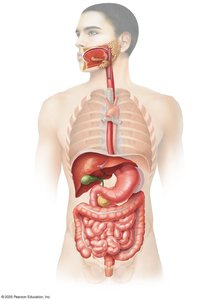
Functions of Digestive Organs
Each organ in the digestive system has a specific function in the process of digestion and absorption. - Salivary glands: Produce saliva containing lysozyme (antibacterial) and amylase (breaks down starch). - Liver: Produces bile, which contains bilirubin (a breakdown product of heme) and aids in fat digestion. - Pancreas: Produces digestive enzymes, bicarbonate (neutralizes acidic chyme), and hormones (insulin and glucagon). - Gallbladder: Stores and concentrates bile. - Oral cavity: Teeth cut, tear, and crush food; tongue mixes food with saliva for swallowing. - Pharynx: Bolus (chewed food) is pushed into the esophagus during deglutition (swallowing). - Esophagus: Propels bolus by peristalsis (wave-like muscle contraction). - Stomach: Churns bolus, mixes with hydrochloric acid and pepsin to form acidic chyme. - Small intestine: Main site of nutrient absorption; receives bile and pancreatic enzymes. - Large intestine: Absorbs water and vitamins, forms and stores feces.
Oral Cavity and Pharynx
The oral cavity and pharynx are the entry points for food and play a crucial role in mechanical and chemical digestion. - Teeth: Incisors, canines, premolars, molars (including wisdom teeth) are specialized for mastication (chewing). - Tongue: Mixes food with saliva, aids in swallowing. - Palate and uvula: Separate oral and nasal cavities, assist in swallowing. - Epiglottis: Prevents food from entering the airway during swallowing. 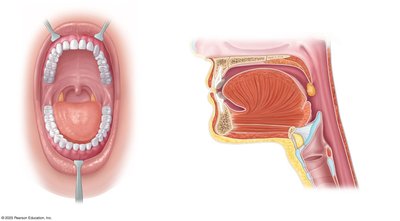
Tooth Anatomy
Teeth are complex structures designed for mechanical digestion. - Enamel: Hard, mineralized layer covering the crown. - Dentin: Softer mineralized tissue forming most of the tooth. - Cementum: Covers the root, anchors tooth to jawbone. - Pulp cavity: Contains blood vessels and nerves. - Root canal: Passageway for vessels and nerves. - Periodontal ligaments: Anchor tooth in alveolar socket. - Bone: Maxilla and mandible contain alveolar margins for tooth embedding. 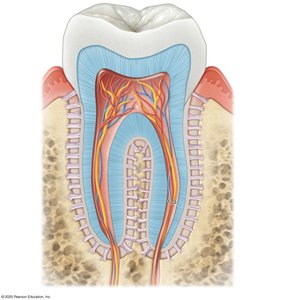
Salivary Glands
Salivary glands produce saliva, which begins the process of digestion and protects oral tissues. - Parotid gland: Largest, located near the ear. - Submandibular gland: Under the jaw. - Sublingual gland: Under the tongue. - Salivary ducts: Deliver saliva to the mouth. 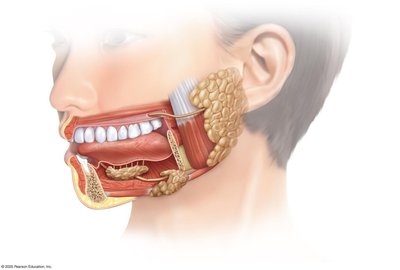
Stomach Anatomy
The stomach is a muscular organ that mixes and digests food. - Regions: Cardia (entry), fundus (above entry), body (main part), pyloric (distal, near exit). - Muscle layers: Longitudinal, circular, oblique. - Rugae: Folds that allow expansion. - Pyloric sphincter: Controls passage to the small intestine.
Small Intestine Anatomy
The small intestine is the primary site for digestion and absorption. - Sections: Duodenum, jejunum, ileum. - Ileocecal valve: Regulates flow into the large intestine. 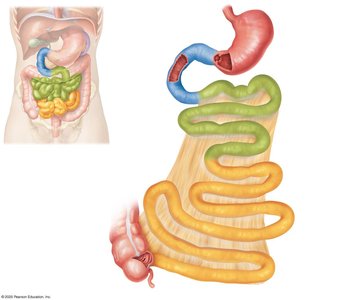
Large Intestine Anatomy
The large intestine absorbs water and forms feces. - Sections: Cecum, ascending colon, transverse colon, descending colon, sigmoid colon, rectum, anal sphincter muscles. - Appendix: Small, tube-like structure attached to the cecum. 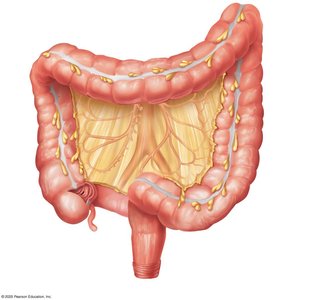
Liver, Gallbladder, and Pancreas Anatomy
These organs are essential for digestion and metabolism. - Liver: Produces bile, processes nutrients. - Gallbladder: Stores and concentrates bile. - Pancreas: Produces digestive enzymes and hormones. - Bile and pancreatic ducts: Deliver secretions to the duodenum. 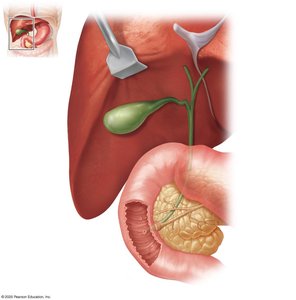
Selected Digestive Hormones
Hormones regulate digestive processes and metabolism.
Source | Hormones |
|---|---|
Pancreas | Insulin, Glucagon, Cholecystokinin, GLP-1 |
Stomach | Gastrin, Ghrelin |
Intestine | Various regulatory hormones |
Adipose | Leptin |
Metabolism and Cellular Respiration
Aerobic Respiration
Aerobic respiration is the process of making ATP using oxygen, primarily in the mitochondria. - Reactants: Oxygen and carbon fuel (e.g., glucose). - Products: ATP, carbon dioxide, water. - Site: Mitochondria. $\text{C}_6\text{H}_{12}\text{O}_6 + 6\text{O}_2 \rightarrow 6\text{CO}_2 + 6\text{H}_2\text{O} + \text{ATP}$ 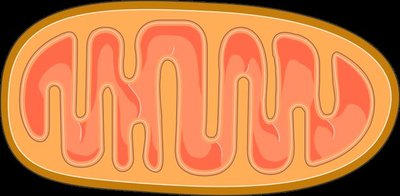
Anaerobic Respiration
Anaerobic respiration occurs without oxygen and produces less ATP. - Reactants: Glucose or other carbon fuel. - Products: Lactate (lactic acid), ATP. - Effect: Makes blood pH more acidic. $\text{C}_6\text{H}_{12}\text{O}_6 \rightarrow 2\text{C}_3\text{H}_6\text{O}_3 + \text{ATP}$
Blood Anatomy and Physiology
Components of Blood
Blood is composed of plasma, buffy coat, and hematocrit. - Plasma: 50-64% of blood; contains water and plasma proteins. - Buffy coat: Less than 1%; contains white blood cells (WBCs) and platelets. - Hematocrit: 36-50%; contains red blood cells (RBCs). 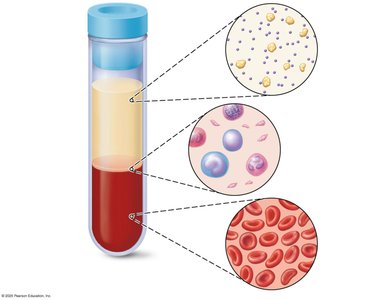
Erythrocyte Structure and Function
Erythrocytes (RBCs) are specialized for oxygen transport. - Hemoglobin: Protein inside RBCs; contains iron-heme groups for oxygen binding. - Structure: Biconcave shape increases surface area for gas exchange. 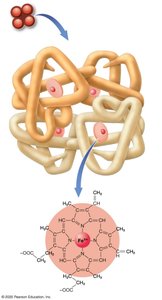
Hematopoiesis
Hematopoiesis is the process of blood cell formation from stem cells. - Hematopoietic stem cell: Gives rise to all blood cells. - Myeloid stem cell: Produces erythrocytes, platelets, neutrophils, eosinophils, basophils, monocytes. - Lymphoid stem cell: Produces T and B lymphocytes, natural killer cells. 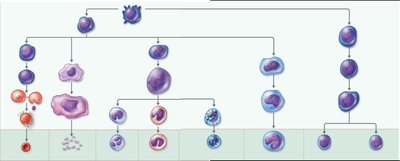
Blood Types
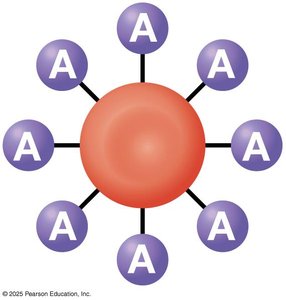
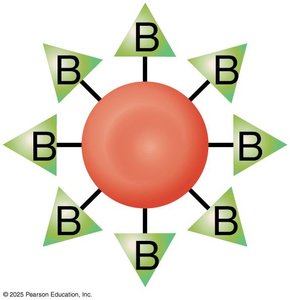
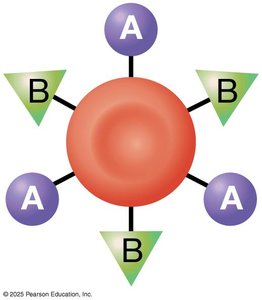
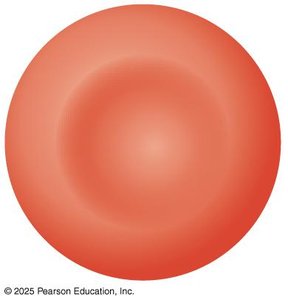
Blood types are determined by antigens on the surface of RBCs.
Blood Type | Antigens | Antibodies | Transfusion Compatibility |
|---|---|---|---|
A | A | Anti-B | Can receive A, O |
B | B | Anti-A | Can receive B, O |
AB | A, B | None | Universal recipient |
O | None | Anti-A, Anti-B | Universal donor |
Leukemia
Leukemia is a cancer of blood-forming tissues, affecting white blood cells. - Lymphocytic leukemia: Cancerous lymphoid stem cells. - Myeloblastic leukemia: Cancerous myeloblast stem cells. - Acute: Rapid onset and progression. - Chronic: Slower onset and progression.
Summary Table: Digestive and Blood System Key Points
System | Main Structures | Key Functions |
|---|---|---|
Digestive | Oral cavity, pharynx, esophagus, stomach, small intestine, large intestine, liver, pancreas, gallbladder | Digestion, absorption, waste elimination |
Blood | Plasma, RBCs, WBCs, platelets | Transport, immunity, clotting |
