 Back
Digestive System and Blood: Structure and Function Study Guide
Study Guide - Smart Notes
 Tailored notes based on your materials, expanded with key definitions, examples, and context.
Digestive System
Overview of the Digestive System
The digestive system is responsible for the breakdown of food, absorption of nutrients, and elimination of waste. It consists of the alimentary canal and accessory organs that aid in digestion and absorption.
Alimentary canal: Mouth, pharynx, esophagus, stomach, small intestine, large intestine, rectum, and anus.
Accessory organs: Salivary glands, liver, gallbladder, and pancreas.
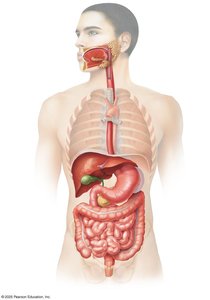
Functions of Major Digestive Organs
Salivary glands: Produce saliva containing lysozyme (antibacterial) and amylase (starch digestion).
Liver: Produces bile, which contains bilirubin (a breakdown product of heme) and aids in fat digestion.
Gallbladder: Stores and concentrates bile.
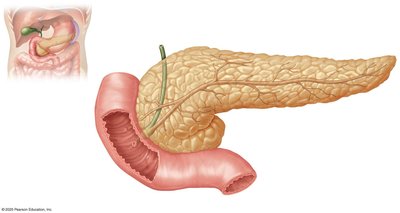
Pancreas: Produces digestive enzymes, bicarbonate (neutralizes acid), and hormones (insulin and glucagon).
Oral cavity: Teeth cut, tear, and crush food (mastication); tongue mixes food with saliva for swallowing (deglutition).
Pharynx and esophagus: Move bolus to stomach via peristalsis.
Stomach: Churns food with acid and pepsin to form chyme.
Small intestine: Main site of nutrient absorption; receives bile and pancreatic enzymes.
Large intestine: Absorbs water and vitamins, forms and stores feces.
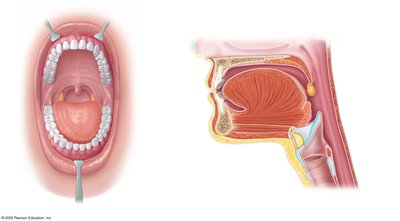
Oral Cavity and Pharynx Anatomy
The oral cavity contains teeth, tongue, palate, uvula, and palatine tonsils. The pharynx connects the mouth to the esophagus and is involved in swallowing.
Teeth types: Incisors, canines, premolars, molars (including wisdom teeth).
Other structures: Palate (roof of mouth), uvula, palatine tonsils, tongue, epiglottis, esophagus.
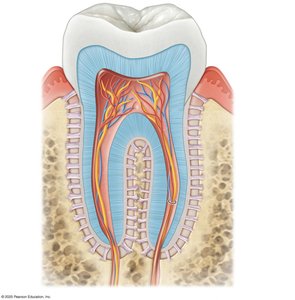
Tooth Anatomy
Teeth are specialized for mastication and consist of several mineralized and soft tissue components.
Enamel: Hardest substance in the body, covers the crown.
Dentin: Softer than enamel, forms the bulk of the tooth.
Cementum: Covers the root, anchors tooth via periodontal ligaments.
Pulp cavity: Contains blood vessels and nerves.
Root canal: Passageway for vessels and nerves.
Periodontal ligaments: Anchor tooth to alveolar socket.
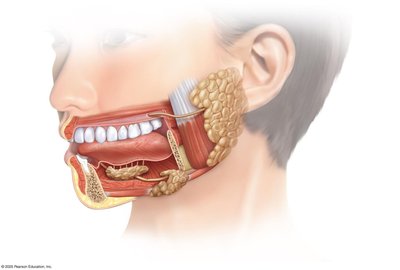
Salivary Glands
There are three major pairs of salivary glands, each with distinct locations and ducts that secrete saliva into the oral cavity.
Parotid gland: Largest, near the ear.
Submandibular gland: Under the jaw.
Sublingual gland: Under the tongue.
Abdominal Cavity and Mesenteries
The abdominal cavity contains the digestive organs, which are supported and stabilized by mesenteries and omenta.
Greater omentum: Fatty apron over intestines.
Lesser omentum: Connects stomach and liver.
Mesenteries: Folds of peritoneum that support intestines.
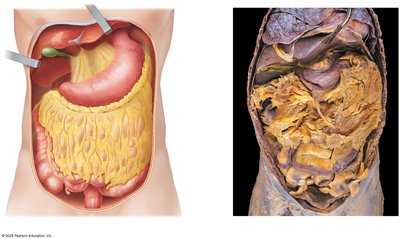
Stomach Anatomy
The stomach is divided into regions and has three layers of smooth muscle for mechanical digestion.
Regions: Cardia (entry), fundus (above entry), body (main part), pyloric (distal, near exit).
Muscle layers: Longitudinal, circular, oblique.
Rugae: Folds that allow expansion.
Pyloric sphincter: Controls passage to duodenum.
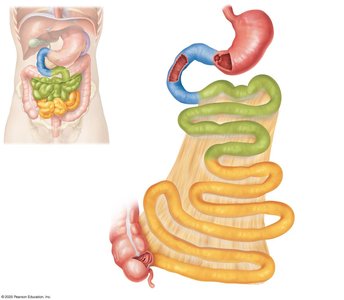
Small Intestine
The small intestine is the main site of digestion and absorption, divided into three regions.
Duodenum: Receives chyme, bile, and pancreatic enzymes.
Jejunum: Main site of nutrient absorption.
Ileum: Absorbs remaining nutrients, connects to large intestine via ileocecal valve.
Large Intestine
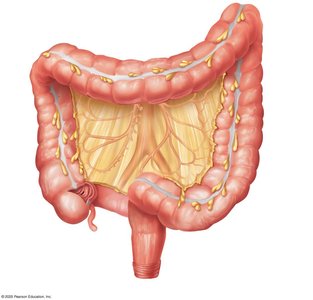
The large intestine absorbs water and forms feces. It includes several distinct regions.
Cecum: Receives material from ileum.
Colon: Ascending, transverse, descending, sigmoid regions.
Rectum and anal canal: Store and eliminate feces.
Appendix: Small lymphatic organ attached to cecum.
Liver, Gallbladder, and Pancreas
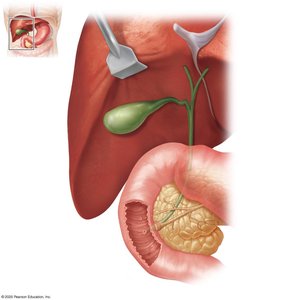
These accessory organs play key roles in digestion and metabolism.
Liver: Produces bile, processes nutrients, detoxifies substances.
Gallbladder: Stores and concentrates bile.
Pancreas: Secretes digestive enzymes and hormones (insulin, glucagon).
Bile and pancreatic ducts: Deliver secretions to duodenum.
Hormones of the Digestive System
Several hormones regulate digestive processes, including those produced by the pancreas, stomach, intestine, and adipose tissue.
Pancreas: Insulin, glucagon, cholecystokinin, GLP-1.
Stomach: Gastrin, ghrelin.
Adipose tissue: Leptin.
Metabolism and Cellular Respiration
Metabolism includes all chemical reactions in the body, with cellular respiration being the process of making ATP from nutrients.
Aerobic respiration: Uses oxygen, occurs in mitochondria, produces ATP, CO2, and water.
Anaerobic respiration: Occurs without oxygen, produces less ATP and lactic acid (can lower blood pH).
Equation for aerobic respiration:
Blood
Components of Blood
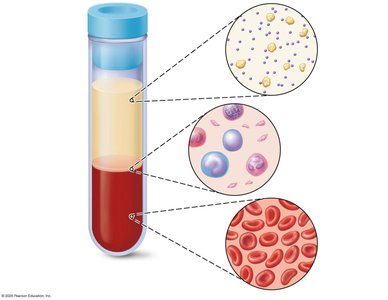
Blood is a connective tissue with three main components: plasma, buffy coat, and hematocrit.
Plasma: 50-64% of blood; mostly water and proteins.
Buffy coat: <1%; white blood cells and platelets.
Hematocrit: 36-50%; red blood cells (erythrocytes).
Erythrocyte Structure and Hemoglobin
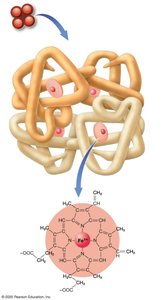
Red blood cells (erythrocytes) transport oxygen using hemoglobin, a protein containing iron-bound heme groups.
Hemoglobin: Binds oxygen for transport; each molecule contains four heme groups.
Iron: Essential for oxygen binding.
Hematopoiesis
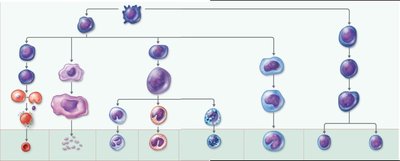
Hematopoiesis is the process of blood cell formation from hematopoietic stem cells in the bone marrow.
Myeloid stem cells: Give rise to erythrocytes, platelets, neutrophils, eosinophils, basophils, and monocytes.
Lymphoid stem cells: Give rise to T and B lymphocytes, and natural killer cells.
Blood Types
Blood types are determined by antigens on the surface of erythrocytes. The main groups are ABO and Rh.
Type A: A antigens on RBCs.
Type B: B antigens on RBCs.
Type AB: Both A and B antigens (universal recipient).
Type O: No A or B antigens (universal donor).
Rh factor: Presence (+) or absence (−) of Rh antigen.
Blood Type | Antigens | Antibodies | Can Donate To | Can Receive From |
|---|---|---|---|---|
A | A | Anti-B | A, AB | A, O |
B | B | Anti-A | B, AB | B, O |
AB | A, B | None | AB | All types |
O | None | Anti-A, Anti-B | All types | O |
Leukemia
Leukemia is a cancer of blood-forming tissues, often involving abnormal proliferation of white blood cells.
Lymphocytic leukemia: Cancer of lymphoid stem cells.
Myeloblastic leukemia: Cancer of myeloid stem cells.
Acute: Rapid onset and progression.
Chronic: Slower onset and progression.
