 Back
Digestive System and Metabolism: Structure, Function, and Regulation
Study Guide - Smart Notes
 Tailored notes based on your materials, expanded with key definitions, examples, and context.
Digestive System Overview
Introduction to the Digestive System
The digestive system is responsible for the intake, breakdown, absorption, and elimination of food and nutrients. It also plays a critical role in protecting the body from pathogens and in immune system learning.
Alimentary Canal (GI Tract): The main passageway for food, extending from the mouth to the anus.
Accessory Organs: Organs that assist in digestion but are not part of the GI tract, such as the liver, pancreas, and gall bladder.
Main Functions: Ingestion, mechanical and chemical digestion, absorption, secretion, propulsion, and elimination of waste.
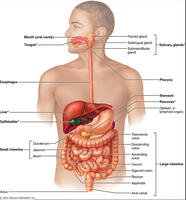
Anatomy of the Digestive System
Major Structures and Their Functions
The digestive system consists of several specialized regions, each with distinct roles in processing food.
Oral Cavity: Ingestion, chewing, mixing food with saliva, and voluntary initiation of swallowing.
Pharynx and Esophagus: Propulsion of food to the stomach via involuntary swallowing and peristalsis.
Stomach: Mixing food with gastric juice to form chyme, partial protein digestion, and regulated release to the small intestine.
Small Intestine: Main site for digestion and absorption of nutrients, ions, and water; segmentation and propulsion of chyme.
Large Intestine: Final absorption of water and ions, compaction of feces, and propulsion to the rectum.
Rectum and Anus: Storage and elimination of feces.
Accessory Organs
Teeth: Mechanical breakdown of food.
Salivary Glands: Production of saliva containing enzymes for initial digestion.
Liver: Secretion of bile for lipid digestion.
Gall Bladder: Storage and concentration of bile.
Pancreas: Secretion of digestive enzymes and bicarbonate.
Digestive Processes
Motility
Motility refers to the muscular contractions that mix and propel contents through the GI tract.
Tonic Contractions: Sustained contractions, especially in sphincters and the stomach's fundus.
Phasic Contractions: Cycles of contraction and relaxation, including peristalsis (propulsion) and segmentation (mixing).
Secretion
Secretion involves the movement of water, ions, enzymes, and other solutes into the GI tract to aid digestion.
Saliva: Contains water, ions, amylase, and lysozyme.
Gastric Juice: Secreted by parietal and chief cells; contains HCl, pepsinogen, and intrinsic factor.
Intestinal Juice: Secreted by enterocytes; contains enzymes for final digestion.
Bile: Produced by the liver, stored in the gall bladder; contains bile salts, bicarbonate, and pigments.
Pancreatic Juice: Contains digestive enzymes and bicarbonate.
Mucus
Mucus protects and lubricates the GI tract. Gastric mucus is slightly alkaline to protect the stomach lining from acid and pepsin.
Regulation of Digestion
Neural and Hormonal Regulation
GI processes are regulated by neural (enteric and autonomic nervous systems) and hormonal mechanisms. Reflexes are triggered by volume, osmolarity, acidity, and chemical composition of chyme.
Enteric Nervous System (ENS): Intrinsic neurons in the gut wall form local reflex arcs, controlling secretion and motility independently of the CNS.
Short Reflexes: Local reflexes within the ENS, such as the myenteric (motility) and submucosal (secretion) plexuses.
Long Reflexes: Integrate with the CNS; include cephalic (sight, smell, thought of food) and emotional reflexes.
Hormonal Regulation
Gastrin: Stimulates gastric acid and mucosal growth.
Cholecystokinin (CCK): Stimulates pancreatic enzyme secretion and bile release; inhibits gastric activity.
Secretin: Stimulates pancreatic bicarbonate secretion; inhibits gastric acid secretion.
GIP and GLP-1: Stimulate insulin secretion; inhibit gastric activity.
Phases of Digestion
Cephalic Phase
Initiated by the sight, smell, or thought of food. Prepares the mouth and stomach for food intake by increasing saliva and gastric secretions.
Saliva: Contains amylase (starch digestion) and lingual lipase (fat digestion).
Gastric Phase
Begins when food enters the stomach. Focuses on mixing, protein digestion, and regulated emptying into the small intestine.
Parietal Cells: Secrete HCl and intrinsic factor.
Chief Cells: Secrete pepsinogen and gastric lipase.
Feedback Inhibition: Somatostatin inhibits acid and pepsinogen secretion when pH is too low.
Intestinal Phase
Triggered by chyme entering the small intestine. Inhibits gastric activity and promotes intestinal digestion and absorption.
Hormonal Feedback: CCK, secretin, GIP, and GLP-1 regulate pancreatic, biliary, and intestinal secretions.
Digestion and Absorption of Biomolecules
Carbohydrates
Carbohydrates are digested to monosaccharides by amylase and brush border enzymes, then absorbed via active transport or facilitated diffusion.
Proteins
Proteins are digested to amino acids and small peptides by pepsin, pancreatic proteases, and brush border peptidases. Absorbed via active transport or transcytosis.
Lipids
Lipids are emulsified by bile salts, digested by lipases, and absorbed as monoglycerides and fatty acids. These are reassembled into triglycerides and packaged as chylomicrons for lymphatic absorption.
Vitamins and Minerals
Fat-Soluble Vitamins (A, D, E, K): Absorbed with lipids.
Water-Soluble Vitamins: Absorbed by active or facilitated transport.
Vitamin B12: Requires intrinsic factor for absorption.
Minerals: Absorbed mainly by active transport; iron and calcium absorption are tightly regulated.
Ion Absorption
Na+: Absorbed by diffusion or active transport; regulated by aldosterone in the large intestine.
K+: Absorbed by diffusion; excreted in feces as needed.
Ca++: Mostly passive absorption; active absorption in the duodenum regulated by calcitriol and PTH.
Cl-: Absorbed along electrochemical gradients.
Metabolism and Energy Balance
ATP Synthesis and Reaction Pathways
Absorbed nutrients are used to synthesize ATP, the cell's main energy currency. ATP is produced through glycolysis, the citric acid cycle, and the electron transport chain.
Glycolysis: Occurs in the cytosol; converts glucose to pyruvate, producing ATP and NADH.
Citric Acid Cycle: Occurs in the mitochondrial matrix; processes acetyl CoA to produce ATP, NADH, and FADH2.
Electron Transport Chain: Occurs on the inner mitochondrial membrane; uses NADH and FADH2 to generate most ATP via oxidative phosphorylation.
Catabolism and Anabolism
Catabolism: Breakdown of biomolecules to release energy.
Anabolism: Synthesis of new molecules for storage or structural purposes.
Regulation of Metabolism
Metabolism is regulated by the hormones insulin and glucagon, secreted by pancreatic islet cells.
Insulin: Promotes glucose uptake, glycogenesis, and lipogenesis; prevents hyperglycemia.
Glucagon: Promotes glycogenolysis, gluconeogenesis, and lipolysis; prevents hypoglycemia.
Phases of Metabolism
Absorptive (Fed) State: Food is present in the GI tract; insulin is dominant; promotes storage and use of absorbed nutrients.
Postabsorptive (Unfed) State: GI tract is empty; glucagon is dominant; promotes mobilization of stored nutrients to maintain blood glucose.
