Back
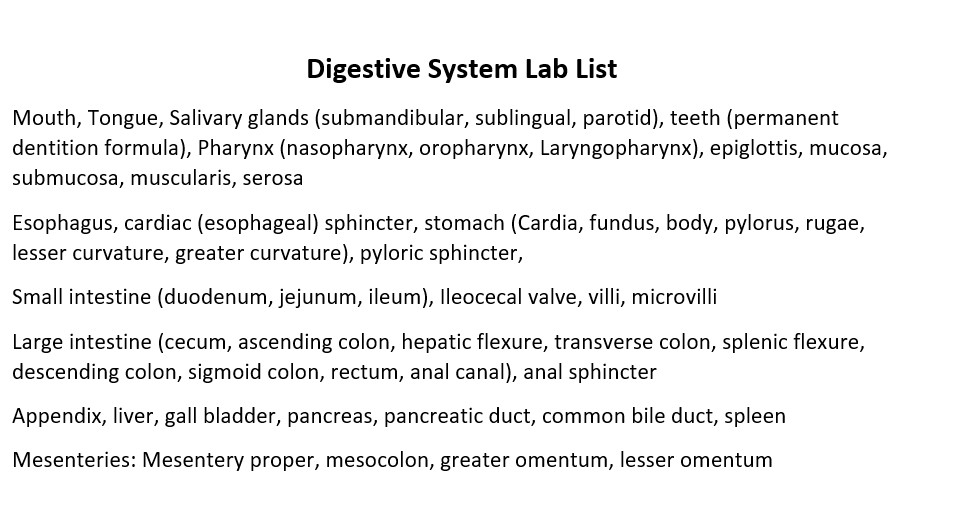
Digestive System Lab Study Guide
Study Guide - Smart Notes
 Tailored notes based on your materials, expanded with key definitions, examples, and context.
Digestive System Overview
Introduction
The digestive system is responsible for breaking down food, absorbing nutrients, and eliminating waste. It consists of a series of organs and accessory structures that work together to perform these functions.
Anatomy of the Digestive System
Mouth and Associated Structures
The mouth is the entry point for food and is involved in mechanical and chemical digestion.
Tongue: Muscular organ that manipulates food and contains taste buds.
Salivary glands: Produce saliva to moisten food and begin starch digestion. The three major pairs are:
Submandibular
Sublingual
Parotid
Teeth: Responsible for mechanical breakdown of food. The permanent dentition formula describes the number and types of teeth in adults: (incisors, canines, premolars, molars per quadrant).
Pharynx and Epiglottis
The pharynx is a muscular tube that connects the mouth to the esophagus and is divided into three regions:
Nasopharynx
Oropharynx
Laryngopharynx
The epiglottis is a flap that prevents food from entering the airway during swallowing.
Layers of the Digestive Tract
The wall of the digestive tract consists of four main layers:
Mucosa: Innermost layer, secretes mucus and enzymes.
Submucosa: Contains blood vessels, nerves, and glands.
Muscularis: Smooth muscle responsible for peristalsis.
Serosa: Outermost layer, reduces friction.
Esophagus and Sphincters
The esophagus is a muscular tube that transports food from the pharynx to the stomach.
Cardiac (esophageal) sphincter: Prevents reflux of stomach contents into the esophagus.
Stomach
The stomach is a muscular organ that mixes food with gastric juices. Its regions include:
Cardia: Entry region
Fundus: Upper curved part
Body: Main central region
Pylorus: Lower region leading to the small intestine
Other features:
Rugae: Folds in the stomach lining that allow expansion
Lesser curvature: Inner curve
Greater curvature: Outer curve
Pyloric sphincter: Controls passage of food into the duodenum
Small Intestine
The small intestine is the primary site for digestion and absorption. It is divided into three sections:
Duodenum: First section, receives chyme and digestive enzymes
Jejunum: Middle section, main site of nutrient absorption
Ileum: Last section, absorbs remaining nutrients
Ileocecal valve controls flow into the large intestine.
Villi: Finger-like projections that increase surface area
Microvilli: Microscopic extensions of villi for further absorption
Large Intestine
The large intestine absorbs water and forms feces. Its parts include:
Cecum: First part, receives material from ileum
Ascending colon
Hepatic flexure: Bend near the liver
Transverse colon
Splenic flexure: Bend near the spleen
Descending colon
Sigmoid colon
Rectum: Stores feces
Anal canal: Terminal part
Anal sphincter: Controls defecation
Accessory Organs
Appendix: Small tube attached to cecum
Liver: Produces bile, processes nutrients
Gall bladder: Stores bile
Pancreas: Produces digestive enzymes and hormones
Pancreatic duct: Transports enzymes to duodenum
Common bile duct: Transports bile to duodenum
Spleen: Not directly involved in digestion, but important for immune function
Mesenteries
Mesenteries are folds of the peritoneum that support and anchor digestive organs.
Mesentery proper: Supports small intestine
Mesocolon: Supports large intestine
Greater omentum: Fatty apron over intestines
Lesser omentum: Connects stomach to liver
Summary Table: Major Digestive System Structures
Structure | Main Function |
|---|---|
Mouth | Mechanical and chemical digestion |
Pharynx | Swallowing |
Esophagus | Transport food |
Stomach | Mixing and breakdown |
Small intestine | Digestion and absorption |
Large intestine | Water absorption, feces formation |
Liver | Bile production |
Gall bladder | Bile storage |
Pancreas | Enzyme and hormone production |
Mesenteries | Support and anchor organs |
Example: Pathway of Food Through the Digestive System
Food enters the mouth, is chewed and mixed with saliva, passes through the pharynx and esophagus, enters the stomach for further breakdown, moves into the small intestine for digestion and absorption, then into the large intestine for water absorption and waste formation, and finally exits through the anal canal.