 Back
Digestive System: Pharynx, Esophagus, and Stomach – Structure and Function
Study Guide - Smart Notes
 Tailored notes based on your materials, expanded with key definitions, examples, and context.
Pharynx and Esophagus
Structure and Function of the Pharynx
The pharynx serves as a passageway for food, fluids, and air, connecting the mouth to the esophagus. It is lined with stratified squamous epithelium and contains mucus-producing glands for lubrication. The external muscle layer consists of two skeletal muscle layers: an inner longitudinal layer and an outer layer of pharyngeal constrictors, which encircle the wall of the pharynx and aid in swallowing.
Structure and Function of the Esophagus
The esophagus is a flat, muscular tube that extends from the laryngopharynx to the stomach. It remains collapsed when not in use and passes through the diaphragm at the esophageal hiatus. The esophagus joins the stomach at the cardial orifice, which is surrounded by the gastroesophageal (cardiac) sphincter. This sphincter prevents acid reflux by keeping the orifice closed when food is not being swallowed. Mucus cells on both sides of the sphincter protect the esophagus from stomach acid.
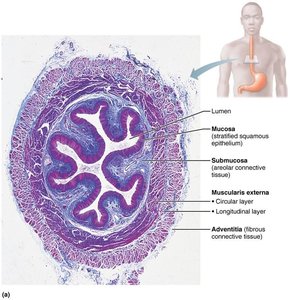
Layers of the Esophagus: The esophagus contains all four layers typical of the alimentary canal:
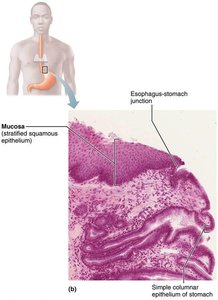
Mucosa: Stratified squamous epithelium (transitions to simple columnar at the stomach)
Submucosa: Areolar connective tissue with mucus-secreting glands
Muscularis externa: Skeletal muscle superiorly, mixed in the middle, smooth muscle inferiorly
Adventitia: Fibrous connective tissue (instead of serosa)
Deglutition (Swallowing)
Phases of Swallowing
Deglutition is the process of swallowing, involving the coordinated action of 22 muscle groups and two main phases:
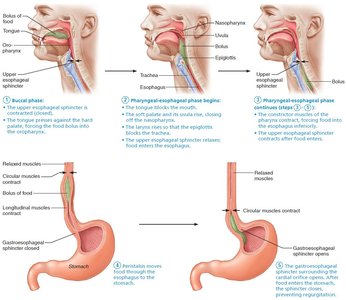
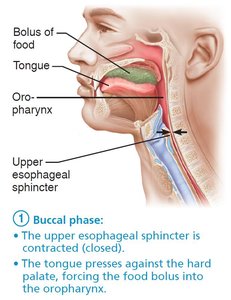
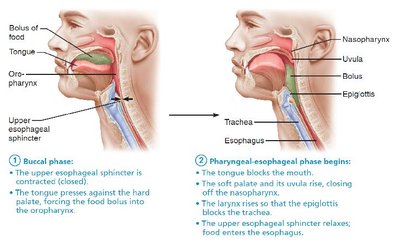
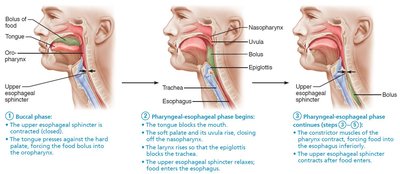
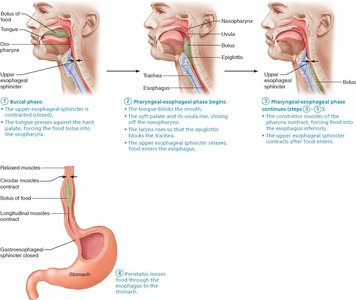
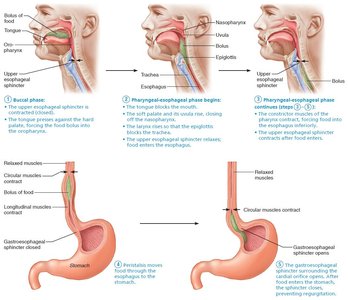
Buccal phase: Voluntary contraction of the tongue, which pushes the food bolus into the oropharynx.
Pharyngeal-esophageal phase: Involuntary phase controlled by the swallowing center in the medulla and lower pons, primarily involving the vagus nerve. This phase moves the bolus through the pharynx and esophagus to the stomach.
Buccal Phase
The upper esophageal sphincter is contracted (closed).
The tongue presses against the hard palate, forcing the food bolus into the oropharynx.
Pharyngeal-Esophageal Phase
The tongue blocks the mouth.
The soft palate and uvula rise, closing off the nasopharynx.
The larynx rises so the epiglottis blocks the trachea.
The upper esophageal sphincter relaxes, allowing food to enter the esophagus.
The constrictor muscles of the pharynx contract, forcing food into the esophagus inferiorly.
The upper esophageal sphincter contracts after food enters.
Peristalsis moves food through the esophagus to the stomach.
The gastroesophageal sphincter surrounding the cardial orifice opens, and food enters the stomach.
Microscopic Structure of the Esophagus
Histological Features
The esophagus is lined by stratified squamous epithelium for protection against abrasion. At the junction with the stomach, this changes to simple columnar epithelium specialized for secretion. The submucosa contains mucus-secreting glands to lubricate the passage of food. The muscularis externa transitions from skeletal muscle (upper third) to smooth muscle (lower third), reflecting the transition from voluntary to involuntary control of swallowing. The outermost layer is the adventitia, a connective tissue layer that anchors the esophagus in place.
Clinical Considerations
Heartburn and GERD
Heartburn is caused by stomach acid regurgitating into the esophagus, often due to a weakened gastroesophageal sphincter.
It is the first symptom of gastroesophageal reflux disease (GERD).
Risk factors include overeating, obesity, pregnancy, and hiatal hernia (where part of the stomach protrudes above the diaphragm).
Complications can include esophagitis, esophageal ulcers, or even esophageal cancer.
