 Back
BackDigestive System: Structure, Function, and Nutrient Absorption
Study Guide - Smart Notes
 Tailored notes based on your materials, expanded with key definitions, examples, and context.
Digestive System Overview
Pathway of Food Through the Digestive Tract
The digestive system is responsible for breaking down food, absorbing nutrients, and eliminating waste. Food follows a specific pathway through the digestive tract:
Mouth
Pharynx
Esophagus
Stomach
Small Intestine
Large Intestine
Rectum
Anus
Mechanical and Chemical Digestion
Digestion involves two main processes:
Mechanical Digestion: Physical breakdown of food into smaller pieces, primarily by teeth and smooth muscle contractions.
Chemical Digestion: Enzymatic breakdown of food into its monomers for absorption.
Motility in the Digestive Tract
Peristalsis and Segmentation
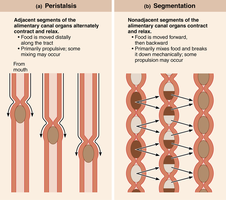
The movement of food through the digestive tract is accomplished by two types of muscle contractions:
Peristalsis: Coordinated contraction of longitudinal muscles propels food forward.
Segmentation: Circular muscles mix and churn food, pushing it against the epithelial lining for chemical breakdown and absorption.
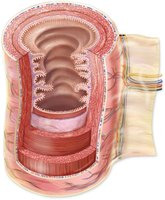
Stomach Structure and Function
Anatomy of the Stomach
The stomach is a J-shaped organ located in the left upper quadrant of the abdomen. It serves as a reservoir for food and initiates protein digestion. 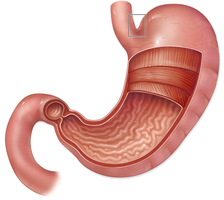
Gastric Secretions: Phases and Regulation
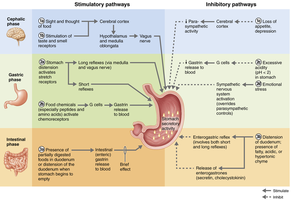
Gastric secretions occur in three phases:
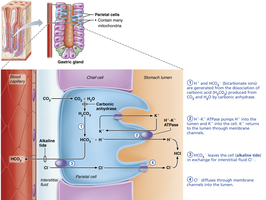
Cephalic Phase: Triggered by the sight, smell, taste, or thought of food. The vagus nerve stimulates the release of acetylcholine (AcH), activating gastric glands.
Gastric Phase: Initiated when food enters the stomach. Stretch receptors and chemoreceptors activate neural and hormonal responses, including the release of gastrin and histamine.
Intestinal Phase: Begins as chyme enters the duodenum, stimulating further secretions and motility.
Stimulation and Inhibition of Gastric Secretions
Stimulation: Physical distension and chemical signals (peptides, amino acids) activate stretch and chemoreceptors, leading to the release of AcH, gastrin, and histamine.
Inhibition: High acidity (pH < 2), decreased vagal stimulation, increased sympathetic input, and duodenal distension reduce gastric gland activity.
Gastric Emptying and Retropulsion
Peristalsis moves food toward the pylorus, where the pyloric sphincter opens to allow small amounts of chyme into the duodenum. Retropulsion occurs when the sphincter closes, forcing contents backward.
Hormonal Regulation of Digestion
Hormones and Paracrines in Digestion
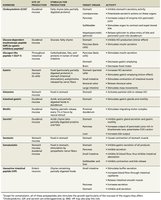
Several hormones and paracrines regulate digestive processes, including gastrin, secretin, cholecystokinin (CCK), and histamine.
Hormone/Paracrine | Site of Production | Stimulus | Target Organ | Activity |
|---|---|---|---|---|
Gastrin | Stomach | Food, AcH | Stomach | Stimulates gastric glands |
Secretin | Duodenum | Acidic chyme | Pancreas, liver | Stimulates bicarbonate secretion |
Cholecystokinin (CCK) | Duodenum | Fatty chyme | Pancreas, gallbladder | Stimulates enzyme and bile release |
Histamine | Stomach | Food | Stomach | Stimulates acid secretion |
Somatostatin | Stomach, duodenum | Food | Stomach, pancreas | Inhibits gastric secretion |
Additional info: Table is a summary of key hormones and their actions in digestion. |
Absorption of Nutrients by the Small Intestine
Carbohydrate Absorption
Carbohydrates are broken down into monosaccharides by brush border enzymes. Glucose is absorbed via sodium-glucose transport proteins (SGLT) and facilitated diffusion. Increased osmolarity draws water and dissolved nutrients into the extracellular fluid (ECF), which are then absorbed by blood capillaries and transported to the liver. 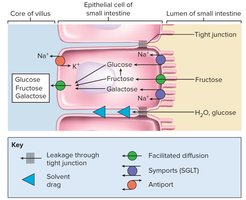
Protein Absorption
Proteins are denatured and hydrolyzed by pepsin in the stomach.
Pepsin is inactivated in the duodenum; trypsin and chymotrypsin continue hydrolysis.
Brush border enzymes (dipeptidase) further break down peptides.
Free amino acids are absorbed via sodium-dependent transport and facilitated diffusion into the bloodstream.
Lipid Absorption
Lipid digestion is complex due to their hydrophobic nature.
Begins in the mouth with lingual lipase, continues in the stomach with gastric lipase.
In the small intestine, pancreatic lipase and bile emulsify fats.
Micelles, aggregates of bile molecules, transport lipids to absorptive cells.
Inside cells, lipids are reassembled into triglycerides, packaged as chylomicrons, and absorbed into lymphatic lacteals.
Large Intestine and Defecation
Absorption and Elimination
Most digestion and absorption occur before the large intestine. The large intestine absorbs water and final nutrients.
Defecation Reflex
Stretching of rectal walls activates the parasympathetic spinal reflex.
Sigmoid colon and rectum contract; internal anal sphincter relaxes.
Voluntary relaxation of the external anal sphincter allows feces to exit the body.
Common Aliments of the GI System
Overview
Disorders of the gastrointestinal system can affect any part of the digestive tract, impacting digestion, absorption, and elimination. Additional info: Examples include gastritis, peptic ulcers, and irritable bowel syndrome.
