 Back
BackDirectional Terms and Body Regions – Study Guidance
Study Guide - Smart Notes
 Tailored notes based on your materials, expanded with key definitions, examples, and context.
Q1. Complete each sentence with the appropriate directional term.
Background
Topic: Anatomical Directional Terms
This question is testing your understanding of the standard directional terms used in human anatomy to describe the locations of structures relative to one another. Mastery of these terms is essential for clear communication in anatomy and physiology.
Key Terms and Definitions:
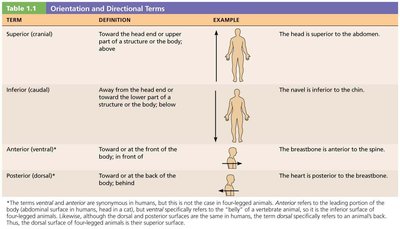
Superior (cranial): Toward the head end or upper part of a structure; above.
Inferior (caudal): Away from the head end or toward the lower part of a structure; below.
Anterior (ventral): Toward or at the front of the body; in front of.
Posterior (dorsal): Toward or at the back of the body; behind.
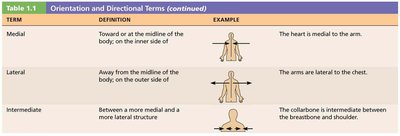
Medial: Toward or at the midline of the body; on the inner side of.
Lateral: Away from the midline of the body; on the outer side of.
Intermediate: Between a more medial and a more lateral structure.
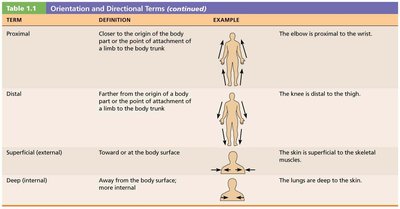
Proximal: Closer to the origin of the body part or the point of attachment of a limb to the body trunk.
Distal: Farther from the origin of a body part or the point of attachment of a limb to the body trunk.
Superficial (external): Toward or at the body surface.
Deep (internal): Away from the body surface; more internal.
Afferent: Conducting toward a center (e.g., afferent neurons carry signals to the CNS).
Efferent: Conducting away from a center (e.g., efferent neurons carry signals away from the CNS).
Step-by-Step Guidance
Read each sentence carefully and identify the two anatomical structures being compared.
Determine the relative position of the first structure to the second (e.g., is it above, below, in front, behind, closer to the trunk, etc.?).
Recall the correct directional term that describes this relationship based on the definitions above.
For terms like "proximal" and "distal," remember they are used primarily for limbs, while "superior/inferior" and "anterior/posterior" are used for the trunk and head.
For terms like "afferent" and "efferent," consider the direction of flow relative to a central point (such as the central nervous system).
Try solving on your own before revealing the answer!
Final Answer: (See below for sample completions)
1. Proximal 2. Medial 3. Superior 4. Inferior 5. Lateral 6. Distal 7. Superficial 8. Deep 9. Anterior 10. Posterior 11. Dorsal 12. Ventral 13. Afferent 14. Efferent
Each term is chosen based on the relative position or direction described in the sentence. Review the definitions and try to visualize the anatomical relationships as you practice!
