 Back
BackDrug Elimination and Renal Physiology: Mechanisms, Processes, and Clinical Applications
Study Guide - Smart Notes
 Tailored notes based on your materials, expanded with key definitions, examples, and context.
Drug Elimination: Overview
Definitions and Concepts
Drug elimination refers to the removal of the parent drug from the body, which can occur through two primary processes: excretion and metabolism. Excretion is the physical removal of the unchanged drug, while metabolism involves the conversion of the parent drug into metabolites via enzymatic biotransformation. The termination of drug activity may also occur by redistribution away from the site of action.
Parent drug: The original, unchanged form of the drug.
Metabolite: The product of drug metabolism after enzymatic transformation.
Elimination: Includes both excretion and metabolism.
Routes and Mechanisms of Excretion
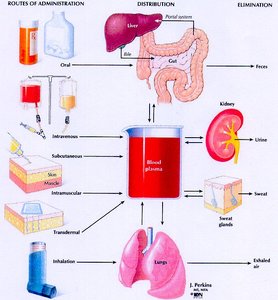
Drugs are eliminated from the body through several routes, each with distinct mechanisms and physiological relevance.
Fecal excretion: Drugs that are never absorbed act in the gut and are eliminated via passive diffusion or active transport.
Biliary excretion: Requires large molecular size and polar characteristics; may involve enterohepatic recycling, prolonging drug effect.
Sweat and milk: Minor routes for some drugs.
Urinary excretion: The primary route for most drugs, involving glomerular filtration, tubular secretion, and reabsorption.
Respiratory excretion: Important for inhalation anesthetics.
Key Organs in Drug Elimination
Renal and Hepatic Roles
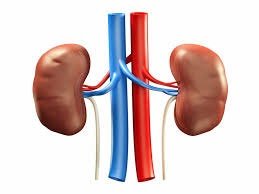
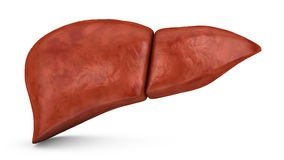
The kidney is the main organ for drug excretion, while the liver is central to drug metabolism. Enzymatic activity in the liver transforms drugs into metabolites, often increasing their polarity for easier excretion.
Kidney: Excretion of drugs via urine.
Liver: Metabolism of drugs via enzymatic biotransformation.
Renal Drug Elimination: Mechanisms
Nephron Structure and Function
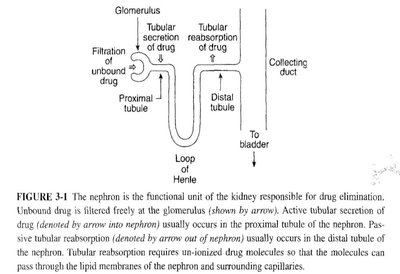
The nephron is the functional unit of the kidney responsible for drug elimination. It consists of the glomerulus, proximal tubule, loop of Henle, distal tubule, and collecting duct. Drug elimination involves filtration, secretion, and reabsorption processes.
Filtration: Unbound drug is filtered at the glomerulus.
Tubular secretion: Active transport of drugs (organic acids and bases) in the proximal tubule.
Tubular reabsorption: Passive diffusion of unionized drugs, mainly in the distal tubule.
Glomerular Filtration
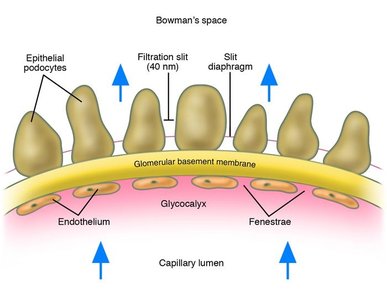
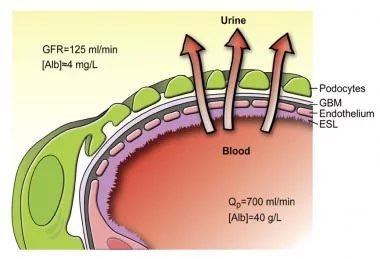
Glomerular filtration rate (GFR) and plasma drug concentration determine the rate of drug filtration. Only free (unbound) drug is filtered; protein binding reduces filtration and excretion. Protein displacement increases free drug levels and filtration.
Fenestrations: Pores in the glomerulus allow drug passage from blood to urine.
Protein binding: Limits filtration; only unbound drug is filtered.
Tubular Reabsorption
Reabsorption involves passive diffusion, driven by concentration gradients. Only unionized drugs are reabsorbed; ionized drugs are water-soluble and remain in the filtrate, increasing elimination. Urine pH affects drug ionization and reabsorption.
Endogenous substances: Glucose, amino acids, uric acid, ions.
Drug transporters: Some drugs reabsorbed via specific transporters.
Ion trapping: Ionized drugs are trapped in urine, promoting elimination.
Tubular Secretion
Active transport in the proximal tubule secretes drugs into urine. Separate transporters exist for organic acids (anions) and organic bases (cations). Drugs may compete for transporters, leading to drug interactions. Protein binding does not limit secretion.
Examples: Penicillin, thiazides, methotrexate.
Drug interaction: Competition for transporters can inhibit secretion and increase plasma concentration.
Urinary Excretion Rate and Ion Trapping
Excretion Rate Equation
The urinary excretion rate is determined by the sum of filtration and secretion rates minus the reabsorption rate:
Drug Filtration: Rate of filtration at the glomerulus.
Tubular Secretion: Rate of active secretion.
Tubular Reabsorption: Rate of passive reabsorption.
Equation:
Ion Trapping and Urine pH
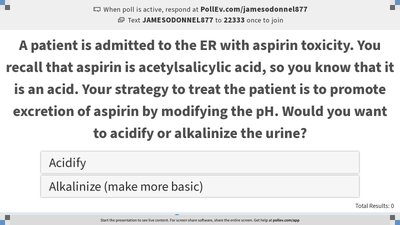
Ion trapping refers to shifting the equilibrium so a higher fraction of drug is ionized in urine, increasing elimination. Manipulating urine pH can promote excretion of acidic or basic drugs:
Alkalinize urine: Promotes excretion of weak acids (e.g., aspirin).
Acidify urine: Promotes excretion of weak bases.
Clinical Application: Aspirin Toxicity
In cases of aspirin (acetylsalicylic acid) toxicity, alkalinizing the urine increases ionization and excretion of the drug.
Pharmacokinetics: Clearance
Definition and Modeling
Clearance (Cl) is a pharmacokinetic parameter describing how fast the body removes a drug. It is defined as the volume of blood cleared of drug per unit time (volume/time). For most drugs, clearance is constant and proportional to the rate of elimination.
Rate of elimination: Mass of drug eliminated per unit time (not constant for most drugs).
Clearance: Preferred for pharmacokinetic equations due to its constancy.
Modeling Clearance
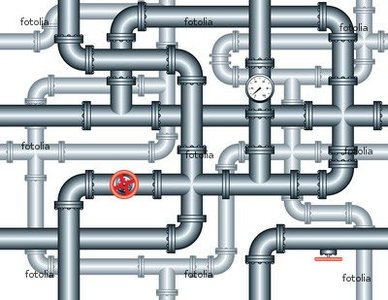
Clearance is often modeled as a system of pipes, where organs act as independent processing units. The total clearance is the sum of individual organ clearances:
Non-renal clearance: Includes hepatic, lung, and extrahepatic metabolism.

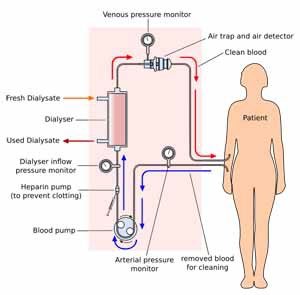
Dialysis Analogy
Clearance is modeled like dialysis, where blood is processed and a fraction is cleared of drug. This analogy helps visualize how elimination occurs in different organs.
Summary Table: Drug Elimination Mechanisms
Process | Location | Mechanism | Key Factors |
|---|---|---|---|
Filtration | Glomerulus | Passive filtration of unbound drug | GFR, protein binding |
Secretion | Proximal tubule | Active transport (anions/cations) | Transporter competition, drug interaction |
Reabsorption | Distal tubule | Passive diffusion of unionized drug | Urine pH, ionization |
Metabolism | Liver | Enzymatic biotransformation | Enzyme activity, drug structure |
Key Points for Exam Preparation
Understand the difference between excretion and metabolism in drug elimination.
Know the mechanisms and locations of drug excretion in the body.
Recognize the role of protein binding, GFR, secretion, and reabsorption in renal clearance.
Apply the concept of ion trapping and urine pH manipulation in clinical scenarios.
Use clearance as a key pharmacokinetic parameter for modeling drug elimination.
Additional info: Academic context was added to clarify nephron function, clinical application of ion trapping, and pharmacokinetic modeling of clearance.
