 Back
Early Embryonic Development: Cleavage and Blastocyst Formation
Study Guide - Smart Notes
 Tailored notes based on your materials, expanded with key definitions, examples, and context.
Embryonic Development: Cleavage and Blastocyst Formation
Introduction to Early Embryonic Development
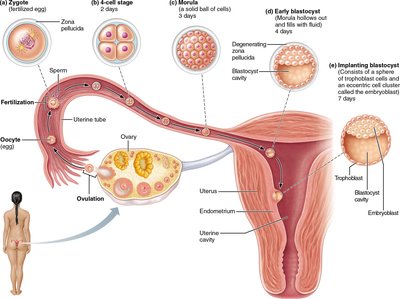
Early embryonic development begins with fertilization and encompasses the journey of the embryo through the uterine tube, its free-floating phase in the uterine cavity, and eventual implantation in the uterine wall. The primary events during this period are cleavage (a series of rapid mitotic divisions) and the formation and implantation of the blastocyst.
Cleavage: Rapid Mitotic Divisions
Definition and Purpose of Cleavage
Cleavage is a period of rapid mitotic divisions of the zygote without intervening growth. The main goal is to produce many small cells, called blastomeres, with a high surface-to-volume ratio. This adaptation enhances nutrient and oxygen uptake and waste disposal, and provides numerous building blocks for the developing embryo.
Blastomeres: The identical cells produced by cleavage divisions.
Morula: By approximately 72 hours after fertilization, the embryo is a solid ball of 16 or more cells, called a morula (Latin for "little mulberry").
Zona Pellucida: The embryo remains surrounded by this glycoprotein layer during early cleavage and transport toward the uterus.
Example: The zygote divides into two blastomeres, then four, then eight, and so on, forming the morula as it travels through the uterine tube.
Blastocyst Formation
Transition from Morula to Blastocyst
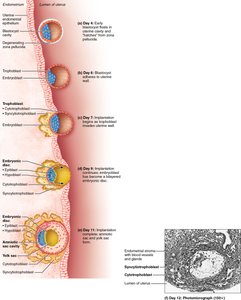
By day 4 or 5 after fertilization, the embryo consists of about 100 cells and begins to accumulate fluid within an internal cavity. The zona pellucida breaks down, allowing the embryo to "hatch" as a blastocyst.
Blastocyst: A fluid-filled hollow sphere composed of a single layer of large, flattened trophoblast cells and a small cluster of rounded cells called the embryoblast (inner cell mass).
Trophoblast: The outer cell layer that will contribute to the formation of the chorion (the embryo's portion of the placenta) and plays a key role in implantation.
Embryoblast: The inner cell mass that will become the embryo proper and most extraembryonic membranes (except the chorion).
Example: The blastocyst floats freely in the uterus before attaching to the endometrium for implantation.
Roles of the Trophoblast
Functions and Importance
Implantation: Trophoblast cells are essential for embedding the embryo into the uterine wall.
Placenta Formation: The trophoblast forms the chorion, which becomes a major part of the placenta, supporting fetal nourishment and waste exchange throughout pregnancy.
Immunosuppression: Trophoblast cells produce factors that protect the conceptus from attack by the pregnant person's immune system.
Example: The trophoblast's immunosuppressive properties are crucial for preventing maternal immune rejection of the embryo.
Key Questions for Review
Why is the multicellular blastocyst only slightly larger than the single-celled zygote? The blastocyst is only slightly larger because cleavage involves cell division without growth, so the total volume remains nearly the same as the original zygote.
Trophoblast cells contribute to a structure that lasts throughout pregnancy. What is this structure called? The trophoblast forms the chorion, which is the embryo's portion of the placenta.
Summary Table: Key Stages of Early Embryonic Development
Stage | Time After Fertilization | Main Features |
|---|---|---|
Zygote | 0 hours | Single cell, fertilized egg |
2-cell stage | ~24-30 hours | Two identical blastomeres |
Morula | ~72 hours | Solid ball of 16+ cells |
Blastocyst | 4-5 days | Fluid-filled sphere; trophoblast and embryoblast present |
Implantation | ~6-7 days | Blastocyst attaches to uterine wall |
Additional info: The blastocyst's formation and implantation are critical for establishing the placenta, which supports fetal development throughout pregnancy. The immunosuppressive role of the trophoblast is essential for maternal-fetal tolerance.
