 Back
BackElectrical Signaling in Neurons: Graded and Action Potentials
Study Guide - Smart Notes
 Tailored notes based on your materials, expanded with key definitions, examples, and context.
Electrical Signaling Through Changes in Membrane Potential
Introduction to Electrical Signaling
Neurons communicate via electrical signals generated by changes in membrane potential. These changes occur when gated ion channels open or close in response to specific stimuli, altering the membrane's permeability to certain ions and thus the movement of those ions across the plasma membrane.
Gated ion channels include voltage-gated, ligand-gated, and mechanically gated channels.
Opening sodium channels increases sodium influx, driving the membrane potential toward the sodium equilibrium potential.
Mechanically gated channels respond to mechanical forces and are often found in sensory receptors.
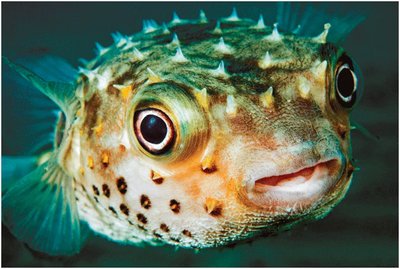
Many neurotoxins, such as tetrodotoxin (TTX) from puffer fish, exert their effects by interfering with ion channel function.
Clinical Connections: Neurotoxins
Tetrodotoxin (TTX) is a potent neurotoxin found in blowfish, certain salamanders, octopus, and goby. It blocks voltage-gated sodium channels, preventing action potential generation.
TTX is concentrated in the liver and gonads of blowfish and is not destroyed by cooking.
Saxitoxin (STX) is a similar toxin produced by marine dinoflagellates and cyanobacteria, accumulating in shellfish during red tides.
Both toxins can be fatal if ingested, as they block neural signaling.
Describing Changes in Membrane Potential
Types of Membrane Potential Changes
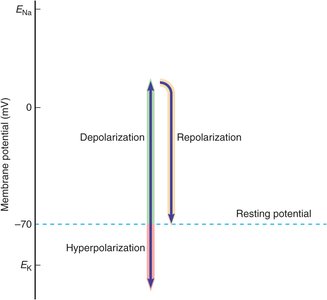
Changes in membrane potential are described relative to the resting membrane potential (approximately -70 mV in neurons):
Depolarization: Membrane potential becomes less negative (moves toward zero or positive values).
Hyperpolarization: Membrane potential becomes more negative than the resting potential.
Repolarization: Return of the membrane potential to the resting value after depolarization.
Graded Potentials
Properties of Graded Potentials
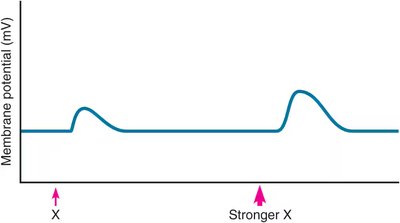
Graded potentials are small, variable changes in membrane potential that occur in response to stimuli such as neurotransmitter binding or sensory input.
The magnitude of the graded potential is proportional to the strength of the stimulus.
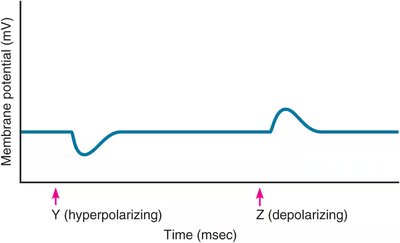
Graded potentials can be depolarizing or hyperpolarizing depending on the ion channels involved.
Decremental Conduction of Graded Potentials
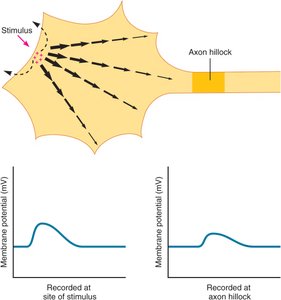
Graded potentials decrease in magnitude as they spread from the site of stimulation due to passive current leakage across the membrane (electrotonic conduction).
This decremental property limits their ability to transmit signals over long distances.
Depolarizing and Hyperpolarizing Graded Potentials
The direction of the graded potential depends on the type of stimulus and the ion channels activated:
Opening sodium channels typically causes depolarization.
Opening potassium channels typically causes hyperpolarization.
Summation of Graded Potentials
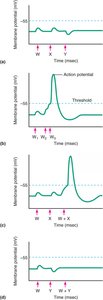
Graded potentials can sum to influence the likelihood of action potential generation:
Temporal summation: Multiple stimuli applied in rapid succession at the same location.
Spatial summation: Stimuli from different sources occurring close together in time.
Depolarizing and hyperpolarizing potentials can cancel each other out.
Action Potentials
Comparison of Graded and Action Potentials
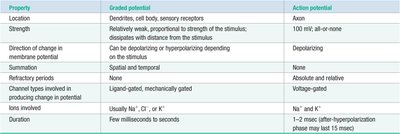
Action potentials are large, rapid, all-or-none changes in membrane potential that can propagate over long distances without decrement. They occur in excitable tissues such as neurons and muscle cells.
Property | Graded potential | Action potential |
|---|---|---|
Location | Dendrites, cell body, sensory receptors | Axon |
Strength | Variable, proportional to stimulus | 100 mV, all-or-none |
Direction of change | Depolarizing or hyperpolarizing | Depolarizing |
Summation | Spatial and temporal | None |
Refractory periods | None | Absolute and relative |
Channel types | Ligand-gated, mechanically gated | Voltage-gated |
Ions involved | Usually Na+, Cl-, or K+ | Na+ and K+ |
Duration | Few ms to seconds | 1–2 ms (after-hyperpolarization may last 15 ms) |
Phases and Ionic Basis of an Action Potential
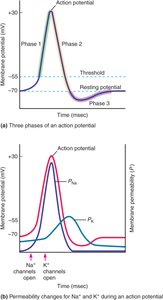
An action potential consists of three main phases:
Rapid Depolarization: Membrane potential rises from -70 mV to +30 mV due to increased sodium permeability and sodium influx.
Repolarization: Membrane potential returns toward resting levels as sodium permeability decreases and potassium permeability increases, allowing potassium efflux.
After-hyperpolarization: Membrane potential becomes more negative than resting due to continued potassium efflux.
Voltage-Gated Ion Channels in Action Potentials
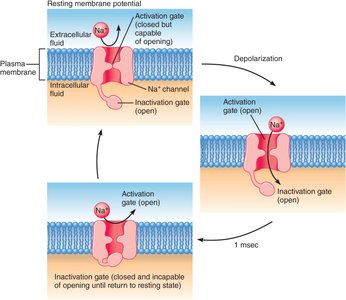
Voltage-gated sodium channels have two gates (activation and inactivation) and can exist in three states: closed but capable of opening, open, and closed and incapable of opening. Voltage-gated potassium channels have a single gate that opens more slowly.
Feedback Mechanisms in Action Potentials
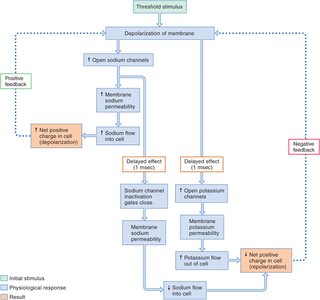
Sodium channel opening is a positive feedback loop, rapidly depolarizing the cell.
Potassium channel opening is a negative feedback loop, repolarizing the cell.
Channel States During Action Potential Phases
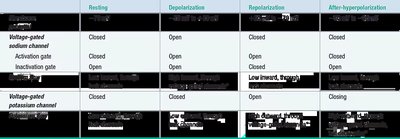
Phase | Voltage-gated sodium channel | Voltage-gated potassium channel |
|---|---|---|
Resting | Closed (activation gate closed, inactivation gate open) | Closed |
Depolarization | Open (both gates open) | Closed |
Repolarization | Closed (inactivation gate closed) | Open |
After-hyperpolarization | Closed (activation gate closed, inactivation gate open) | Closing |
The All-or-None Principle
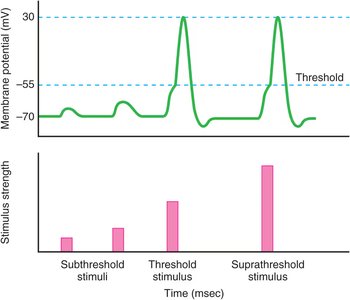
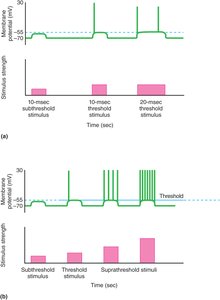
Action potentials are all-or-none events: a stimulus must reach threshold to trigger an action potential, and any stimulus above threshold produces an action potential of the same magnitude and duration.
Refractory Periods
Absolute and Relative Refractory Periods
After an action potential, the membrane enters a refractory period during which its excitability is reduced:
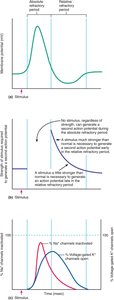
Absolute refractory period: No action potential can be generated, regardless of stimulus strength (due to inactivated sodium channels).
Relative refractory period: A stronger-than-normal stimulus can generate another action potential (due to continued potassium permeability and some sodium channels still inactivated).
Frequency Coding
Action potentials encode stimulus intensity by frequency, not amplitude. Stronger or longer-lasting graded potentials can generate higher frequencies of action potentials.
Propagation of Action Potentials
Propagation in Unmyelinated Axons
In unmyelinated axons, action potentials are propagated by electrotonic conduction. Local currents depolarize adjacent regions of the membrane to threshold, generating new action potentials in a sequential manner. The refractory period ensures unidirectional propagation.
Length Constant for Electrotonic Conduction
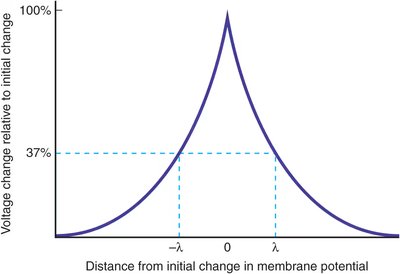
The length constant (λ) describes how far a voltage change spreads before decaying to 37% of its original value. It depends on membrane resistance and axon diameter:
Higher membrane resistance and larger diameter increase the length constant, allowing signals to travel further.
Equation:
Where is the voltage at distance , is the initial voltage, and is the length constant.
Propagation in Myelinated Axons (Saltatory Conduction)
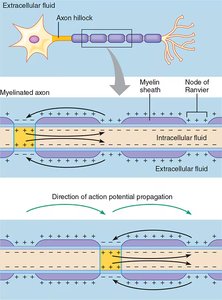
In myelinated axons, action potentials jump from node to node (nodes of Ranvier) in a process called saltatory conduction. Myelin increases membrane resistance, allowing rapid, efficient signal transmission.
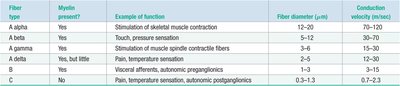
Conduction Velocities in Different Fiber Types
Fiber type | Myelin present? | Example of function | Fiber diameter (μm) | Conduction velocity (m/s) |
|---|---|---|---|---|
A alpha | Yes | Skeletal muscle contraction | 12–20 | 70–120 |
A beta | Yes | Touch, pressure sensation | 5–12 | 30–70 |
A gamma | Yes | Muscle spindle contraction | 3–6 | 15–30 |
A delta | Yes, but little | Pain, temperature sensation | 2–5 | 12–30 |
B | Yes | Visceral afferents, autonomic preganglionics | 1–3 | 3–15 |
C | No | Pain, temperature sensation, autonomic postganglionics | 0.3–1.3 | 0.7–2.3 |
Clinical Connections: Local Anesthetics
Local anesthetics such as Novocaine and lidocaine block voltage-gated sodium channels, preventing action potential generation in sensory neurons. This results in numbness, as the brain does not receive pain signals from the affected area.

Anesthetics block all sensory input, while analgesics specifically block pain signals.
Focus on Diabetes: Peripheral Neuropathy
Peripheral neuropathy is a disease affecting the peripheral nervous system, often associated with diabetes. Symptoms include numbness, tingling, and pain, especially in the hands and feet. Proper blood glucose regulation can reduce the risk of developing neuropathy, but there is currently no cure.
