 Back
BackEndocrine and Digestive Systems: ANP College Study Guide
Study Guide - Smart Notes
 Tailored notes based on your materials, expanded with key definitions, examples, and context.
Endocrine System
Introduction to the Endocrine System
The endocrine system is a major regulatory system of the body, responsible for maintaining homeostasis through the secretion of hormones. It works alongside the nervous system to coordinate and integrate the activity of body cells.
Endocrine glands release hormones directly into the bloodstream.
Hormones are chemical messengers that regulate physiological processes.
Regulation occurs via negative feedback and positive feedback mechanisms.
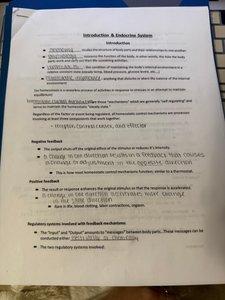
Regulatory Feedback Mechanisms
Feedback mechanisms are essential for maintaining stable internal conditions.
Negative Feedback: The response reduces or shuts off the original stimulus. Example: Regulation of blood glucose by insulin.
Positive Feedback: The response enhances the original stimulus. Example: Oxytocin release during childbirth.
Regulatory Systems and Body Communication
The endocrine and nervous systems communicate via input and output messages.
Input: Sensory information from the body.
Output: Motor or hormonal responses.
Endocrine System Overview
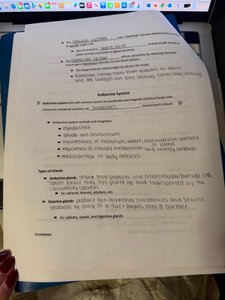
The endocrine system consists of glands that secrete hormones into the bloodstream.
Endocrine glands: Pituitary, thyroid, parathyroid, adrenal, pineal, and thymus.
Exocrine glands: Produce non-hormonal substances (e.g., sweat, saliva).
Mixed glands: Pancreas, gonads, and digestive glands.
Hormone Actions and Target Cells
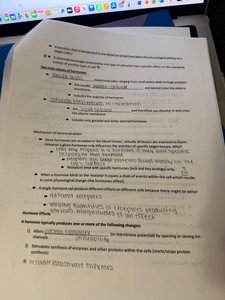
Hormones act on specific target cells by binding to receptors and triggering cellular responses.
Receptors: Proteins on or in target cells that bind hormones.
Mechanisms: Alter membrane permeability, stimulate protein synthesis, activate/deactivate enzymes, induce secretory activity, or stimulate mitosis.
Hormone Classes
Hormones are classified based on their chemical structure.
Amino acid-based hormones: Most hormones; water-soluble.
Steroid hormones: Derived from cholesterol; lipid-soluble.
Eicosanoids: Local hormones derived from fatty acids.
Endocrine Gland Stimuli
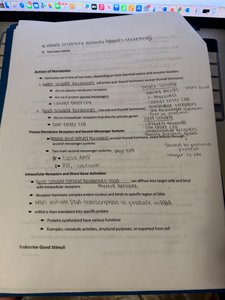
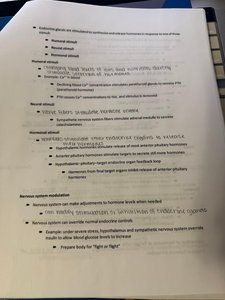
Endocrine glands are stimulated by three main types of stimuli:
Humoral: Changes in blood levels of ions and nutrients.
Neural: Nerve fibers stimulate hormone release.
Hormonal: Hormones stimulate other endocrine glands.
Endocrine Glands and Hormones
Pituitary Gland: Master gland; controls other endocrine glands.
Thyroid Gland: Regulates metabolism, growth, and development.
Parathyroid Gland: Regulates calcium levels.
Adrenal Gland: Produces corticosteroids and catecholamines.
Pineal Gland: Secretes melatonin.
Pancreas: Regulates blood glucose via insulin and glucagon.
Gonads: Produce sex hormones.
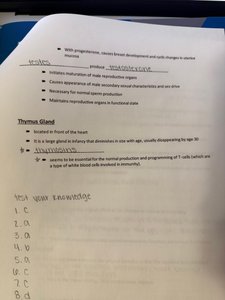
Thymus: Involved in immune function.
Hormone Regulation and Disorders
Hormone levels are tightly regulated; imbalances can lead to disorders.
Hypersecretion: Excess hormone production (e.g., hyperthyroidism).
Hyposecretion: Insufficient hormone production (e.g., hypothyroidism).
Digestive System
Functions of the Digestive System
The digestive system is responsible for breaking down food, absorbing nutrients, and eliminating waste.
Ingestion: Taking in food.
Digestion: Mechanical and chemical breakdown of food.
Absorption: Uptake of nutrients into the blood.
Defecation: Elimination of indigestible substances.
Digestive Processes
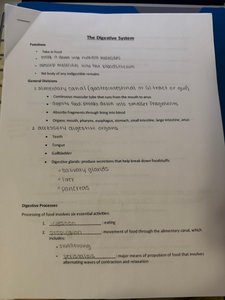
The digestive system performs several essential activities:
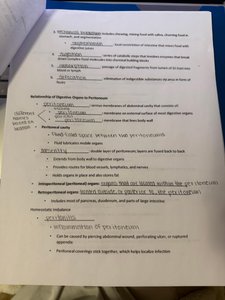
Propulsion: Movement of food through the alimentary canal.
Mechanical digestion: Physical breakdown of food.
Chemical digestion: Enzymatic breakdown of food.
Absorption: Passage of nutrients into the blood.
Defecation: Removal of waste.
Organs of the Digestive System
Alimentary canal: Mouth, pharynx, esophagus, stomach, small intestine, large intestine.
Accessory organs: Teeth, tongue, salivary glands, liver, pancreas, gallbladder.
Histology of the Alimentary Canal
The alimentary canal consists of four basic layers:
Mucosa: Innermost layer; secretes mucus and absorbs nutrients.
Submucosa: Contains blood vessels, nerves, and glands.
Muscularis externa: Responsible for segmentation and peristalsis.
Serosa: Outermost layer; reduces friction.
Digestive Processes in the Mouth
Mechanical digestion: Chewing (mastication).
Chemical digestion: Salivary amylase breaks down starch.
Swallowing: Coordinated by the pharynx and esophagus.
Stomach and Small Intestine
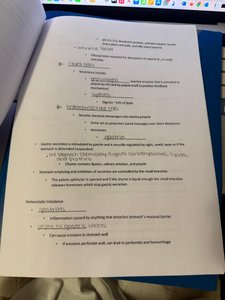
Stomach: Stores and mixes food; begins protein digestion.
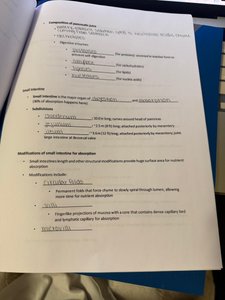
Small intestine: Major site of digestion and absorption.
Duodenum, jejunum, ileum: Subdivisions of the small intestine.
Large Intestine
Absorbs water and electrolytes.
Forms and eliminates feces.
Subdivisions: Cecum, colon, rectum, anal canal.
Metabolism and Energy Balance
Metabolism Overview
Metabolism refers to all chemical reactions that occur in the body to maintain life.
Anabolism: Building up molecules.
Catabolism: Breaking down molecules.
ATP: Main energy currency of the cell.
Cellular Respiration
Cellular respiration is the process by which cells generate ATP from nutrients.
Glycolysis: Breakdown of glucose to pyruvate.
Krebs cycle: Further breakdown of pyruvate.
Electron transport chain: Produces most ATP.
Metabolic Rate
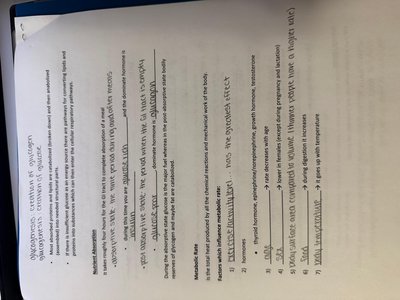
Metabolic rate is the rate at which the body uses energy.
Basal metabolic rate (BMR): Energy used at rest.
Total metabolic rate (TMR): Energy used during activity.
Summary Table: Endocrine Glands and Their Hormones
Gland | Hormone(s) | Main Function |
|---|---|---|
Pituitary | GH, TSH, ACTH, FSH, LH, PRL | Growth, metabolism, reproduction |
Thyroid | T3, T4, Calcitonin | Metabolism, calcium regulation |
Parathyroid | PTH | Calcium regulation |
Adrenal | Cortisol, Aldosterone, Epinephrine | Stress response, metabolism |
Pancreas | Insulin, Glucagon | Blood glucose regulation |
Gonads | Estrogen, Testosterone | Reproduction |
Pineal | Melatonin | Sleep regulation |
Thymus | Thymosin | Immune function |
Summary Table: Digestive System Organs and Functions
Organ | Main Function |
|---|---|
Mouth | Mechanical and chemical digestion |
Pharynx | Swallowing |
Esophagus | Transport food |
Stomach | Protein digestion, food storage |
Small Intestine | Digestion and absorption |
Large Intestine | Water absorption, feces formation |
Liver | Bile production |
Pancreas | Enzyme and hormone secretion |
Key Equations
ATP Production:
Metabolic Rate:
Additional info:
Some explanations and tables were expanded for academic completeness and clarity.
