 Back
Endocrine Physiology and Homeostatic Regulation of Bone and Muscle
Study Guide - Smart Notes
 Tailored notes based on your materials, expanded with key definitions, examples, and context.
Endocrine Physiology
Chemical Classification of Hormones
The endocrine system produces hormones that are classified based on their molecular structure. Understanding these classifications is essential for predicting their function and mechanism of action.
Amino acid-derived hormones: Includes catecholamines (e.g., epinephrine) and thyroid hormones. These are typically water-soluble except for thyroid hormones.
Peptide/protein hormones: Composed of chains of amino acids (e.g., insulin, growth hormone). Most are water-soluble and act via membrane-bound receptors.
Steroid hormones: Derived from cholesterol (e.g., cortisol, estrogen, testosterone). These are lipid-soluble and act via intracellular receptors.
Example: Insulin is a peptide hormone, while testosterone is a steroid hormone.
Functional Relationship Between CNS and Endocrine System
The central nervous system (CNS) and endocrine system interact closely to regulate physiological processes. The hypothalamus acts as a bridge, integrating neural and hormonal signals.
Hypothalamus: Produces releasing and inhibiting hormones that control pituitary gland function.
Pituitary gland: Releases hormones that affect various target organs.
Feedback loops: Maintain homeostasis by adjusting hormone levels based on CNS input.
Hormone Half-Life
The half-life of a hormone is the time required for its concentration in the blood to decrease by half. This property affects how long a hormone exerts its effects.
Short half-life: Peptide hormones (minutes to hours).
Long half-life: Steroid hormones (hours to days).
Equation:
where is the rate constant for hormone degradation.
Metabolism and Excretion of Hormones
Hormones are metabolized primarily in the liver and excreted via the kidneys. Their breakdown ensures that hormone levels remain within physiological limits.
Liver: Modifies hormones for excretion.
Kidneys: Filter and remove hormone metabolites.
Sensitivity of Target Tissues to Hormones
Target tissue sensitivity depends on receptor density, hormone concentration, and physiological state.
Upregulation: Increase in receptor number enhances sensitivity.
Downregulation: Decrease in receptor number reduces sensitivity.
Hormone Action: Membrane-Bound vs. Intracellular Receptors
Hormones act via two main receptor types:
Membrane-bound receptors: Used by water-soluble hormones (e.g., peptides). Activate second messenger systems (e.g., cAMP).
Intracellular receptors: Used by lipid-soluble hormones (e.g., steroids). Directly regulate gene expression.
Homeostatic Regulation of Plasma Calcium and Bone Tissue
Parathyroid Hormone (PTH)
PTH is produced by the parathyroid glands and regulates plasma calcium levels.
Molecular structure: Peptide hormone.
Target tissues: Bone, kidneys, and intestines.
Function: Increases blood calcium by stimulating osteoclasts, increasing renal calcium reabsorption, and promoting intestinal calcium absorption.
Calcitonin
Calcitonin is produced by the thyroid gland and lowers plasma calcium levels.
Molecular structure: Peptide hormone.
Target tissues: Bone and kidneys.
Function: Inhibits osteoclast activity, reducing bone resorption and lowering blood calcium.
Osteoclasts and Osteoblasts
Osteoclasts: Cells that break down bone tissue, releasing calcium into the bloodstream.
Osteoblasts: Cells that build new bone tissue, incorporating calcium into bone.
Hormonal Actions and Negative Feedback
PTH: Increases blood calcium; secretion is inhibited by high plasma calcium (negative feedback).
Calcitonin: Decreases blood calcium; secretion is stimulated by high plasma calcium (negative feedback).
Homeostatic Regulation of the Posterior Pituitary (Neurohypophysis)
Posterior Pituitary Hormones
Antidiuretic hormone (ADH): Peptide hormone; targets kidneys to promote water reabsorption.
Oxytocin: Peptide hormone; targets uterus and mammary glands to stimulate contractions and milk ejection.
Actions and Negative Feedback
ADH: Regulates water balance; secretion is controlled by plasma osmolality.
Oxytocin: Facilitates childbirth and lactation; secretion is controlled by neural feedback from stretch receptors and suckling.
Homeostatic Regulation of the Anterior Pituitary (Adenohypophysis)
Anterior Pituitary Hormones
Growth hormone (GH): Protein hormone; targets liver, muscle, bone.
Thyroid-stimulating hormone (TSH): Glycoprotein; targets thyroid gland.
Adrenocorticotropic hormone (ACTH): Peptide; targets adrenal cortex.
Follicle-stimulating hormone (FSH) & Luteinizing hormone (LH): Glycoproteins; target gonads.
Prolactin: Protein; targets mammary glands.
Actions and Negative Feedback
GH: Stimulates growth and metabolism; feedback via IGF-1.
TSH: Stimulates thyroid hormone release; feedback via T3/T4.
ACTH: Stimulates cortisol release; feedback via cortisol.
FSH/LH: Regulate reproductive function; feedback via sex hormones.
Prolactin: Stimulates milk production; feedback via dopamine.
HPA Response to Eustress and Distress
The hypothalamic-pituitary-adrenal (HPA) axis responds to stress:
Eustress: Positive stress; adaptive response.
Distress: Negative stress; maladaptive response.
Hormonal response: CRH (hypothalamus) → ACTH (anterior pituitary) → cortisol (adrenal cortex).
Bone and Skeletal Muscle Maintenance Through the Lifespan
Factors Affecting Musculoskeletal Homeostasis
Bone and muscle health are influenced by hormones, age, diet, exercise, and lifestyle choices. The graph below illustrates changes in bone mass across the lifespan for males and females.
Hormones: Calcitonin, Calcitriol, Estrogen, Growth Hormone (GH), Parathyroid Hormone (PTH), Thyroxine (T4), Testosterone.
Age: Peak bone mass is reached in early adulthood; bone mass declines with age, especially after menopause in females.
Diet: Adequate intake of vitamin D, vitamin K, calcium, and protein is essential for bone health.
Exercise: Weight-bearing activities stimulate bone formation and muscle maintenance.
Lifestyle choices: Smoking, alcohol, and sedentary behavior negatively impact bone and muscle health.
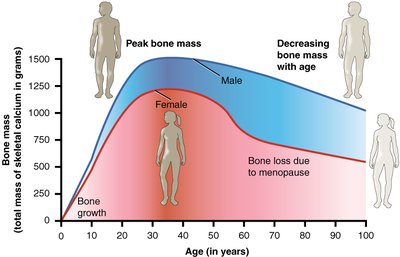
Example: The graph demonstrates that males generally achieve higher peak bone mass than females, and bone loss accelerates in females after menopause due to decreased estrogen levels.
Summary Table: Hormones and Their Effects on Bone
Hormone | Source | Effect on Bone |
|---|---|---|
Calcitonin | Thyroid gland | Decreases blood calcium; inhibits osteoclasts |
Parathyroid Hormone (PTH) | Parathyroid gland | Increases blood calcium; stimulates osteoclasts |
Estrogen | Ovaries | Promotes bone formation; inhibits bone resorption |
Testosterone | Testes | Promotes bone formation |
Growth Hormone (GH) | Anterior pituitary | Stimulates bone growth |
Calcitriol | Kidneys | Increases calcium absorption from intestines |
Thyroxine (T4) | Thyroid gland | Stimulates bone growth |
Additional info: Table entries inferred from standard physiology textbooks.
