 Back
BackEndocrine System and Blood: ANP Study Guidance with Relevant Images
Study Guide - Smart Notes
 Tailored notes based on your materials, expanded with key definitions, examples, and context.
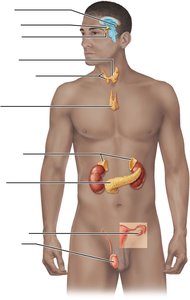
Q1. Name the endocrine organs labeled A–J in the diagram.
Background
Topic: Endocrine System Anatomy
This question tests your knowledge of the locations and names of the major endocrine glands in the human body.
Key Terms:
Endocrine glands: Organs that secrete hormones directly into the bloodstream.
Hormones: Chemical messengers that regulate various physiological processes.
Step-by-Step Guidance
Examine the diagram and identify the anatomical locations of each labeled structure (A–J).
Recall the names and functions of the major endocrine glands: pineal gland, hypothalamus, pituitary gland, thyroid gland, parathyroid glands, thymus, adrenal glands, pancreas, ovary (female), and testis (male).
Match each label to the correct gland based on its position in the body (e.g., A is at the top of the brain, B is below A, etc.).
Review the functions of each gland to reinforce your understanding of their roles in the endocrine system.
Try solving on your own before revealing the answer!
Final Answer:
A. Pineal gland B. Hypothalamus C. Pituitary gland D. Thyroid gland E. Parathyroid glands F. Thymus G. Adrenal glands H. Pancreas I. Ovary (female) J. Testis (male)
Each gland is responsible for producing specific hormones that regulate various bodily functions.
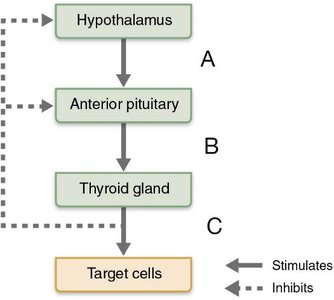
Q2. Identify the hormones labeled A–C in the diagram showing regulation of thyroid hormone secretion.
Background
Topic: Endocrine Regulation and Feedback
This question tests your understanding of the hormonal control and feedback mechanisms involved in thyroid hormone secretion.
Key Terms and Concepts:
Hypothalamus: Releases thyrotropin-releasing hormone (TRH).
Anterior pituitary: Releases thyroid-stimulating hormone (TSH).
Thyroid gland: Releases thyroid hormones (T3 and T4).
Negative feedback: Rising levels of thyroid hormones inhibit further release of TRH and TSH.
Step-by-Step Guidance
Observe the flow of stimulation and inhibition in the diagram: Hypothalamus → Anterior pituitary → Thyroid gland → Target cells.
Recall the sequence of hormone release: TRH from hypothalamus, TSH from anterior pituitary, thyroid hormones from thyroid gland.
Identify which hormone corresponds to each label (A, B, C) based on their position in the pathway.
Consider how negative feedback from thyroid hormones regulates the pathway.
Try solving on your own before revealing the answer!
Final Answer:
A. Thyrotropin-releasing hormone (TRH) B. Thyroid-stimulating hormone (TSH) C. Thyroid hormones (T3 and T4)
This pathway is regulated by negative feedback, where increased thyroid hormone levels inhibit further release of TRH and TSH.
Q3. Explain why a goiter results from inadequate dietary iodine.
Background
Topic: Thyroid Disorders and Hormone Synthesis
This question tests your understanding of the relationship between iodine intake and thyroid gland function.
Key Terms:
Goiter: An enlarged thyroid gland.
Iodine: Essential for synthesis of thyroid hormones.
Thyroid-stimulating hormone (TSH): Stimulates thyroid hormone production.
Step-by-Step Guidance
Recall that iodine is required for the synthesis of thyroid hormones (T3 and T4).
Consider what happens when dietary iodine is insufficient: the thyroid cannot produce enough hormones.
Understand that low thyroid hormone levels lead to increased TSH secretion from the anterior pituitary.
Think about how increased TSH causes the thyroid gland to enlarge, forming a goiter.

Try solving on your own before revealing the answer!
Final Answer:
Iodine deficiency prevents the thyroid from synthesizing functional hormones. The pituitary increases TSH secretion, causing the thyroid to enlarge and form a goiter.
This is a classic example of negative feedback disruption due to a lack of essential substrate (iodine).
