 Back
BackEndocrine System and Blood Physiology Study Guide
Study Guide - Smart Notes
 Tailored notes based on your materials, expanded with key definitions, examples, and context.
Q1. Which gland produces the hormones that promote the development of female secondary sexual characteristics at puberty?
Background
Topic: Endocrine System – Female Sex Hormones
This question tests your knowledge of the glands responsible for producing hormones that influence female secondary sexual characteristics, such as breast development and wider hips, which occur during puberty.
Key Terms and Concepts:
Ovaries: The primary female reproductive organs that produce estrogen and progesterone.
Estrogen: Hormone responsible for the development of female secondary sexual characteristics.
Secondary Sexual Characteristics: Features that appear during puberty, not directly involved in reproduction.
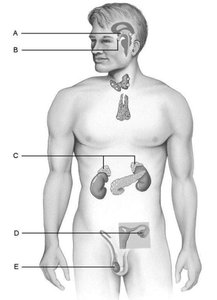
Step-by-Step Guidance
Identify the location of the ovaries on the provided diagram (look for the label near the lower abdomen/pelvic region).
Recall which hormones are produced by the ovaries (estrogen and progesterone).
Connect the function of estrogen to the development of female secondary sexual characteristics.
Try solving on your own before revealing the answer!
Q2. Which gland serves as a storehouse for hormones produced by the hypothalamus?
Background
Topic: Endocrine System – Hormone Storage and Release
This question focuses on the gland that stores and releases hormones made by the hypothalamus, rather than producing them itself.
Key Terms and Concepts:
Hypothalamus: Brain region that produces hormones regulating the pituitary gland.
Posterior Pituitary: Stores and releases hormones (like ADH and oxytocin) made by the hypothalamus.
Step-by-Step Guidance
Locate the pituitary gland on the diagram (just below the brain).
Recall the relationship between the hypothalamus and the posterior pituitary.
Identify which part of the pituitary stores hypothalamic hormones.
Try solving on your own before revealing the answer!
Q3. Which gland produces the hormones that direct the production of secondary male sex characteristics?
Background
Topic: Endocrine System – Male Sex Hormones
This question tests your understanding of the gland responsible for producing hormones that lead to male secondary sexual characteristics, such as facial hair and deeper voice.
Key Terms and Concepts:
Testes: Male reproductive glands that produce testosterone.
Testosterone: Hormone responsible for male secondary sexual characteristics.
Step-by-Step Guidance
Identify the location of the testes on the diagram (scrotal region).
Recall which hormone is produced by the testes and its role in male development.
Connect testosterone to the development of male secondary sexual characteristics.
Try solving on your own before revealing the answer!
Q4. Which gland produces hormones involved in electrolyte balance and the stress response?
Background
Topic: Endocrine System – Adrenal Glands
This question is about the gland that produces hormones like aldosterone (electrolyte balance) and cortisol (stress response).
Key Terms and Concepts:
Adrenal Glands: Located above the kidneys; produce aldosterone and cortisol.
Aldosterone: Regulates sodium and potassium balance.
Cortisol: Involved in the stress response and metabolism.
Step-by-Step Guidance
Locate the adrenal glands on the diagram (on top of the kidneys).
Recall the main hormones produced by the adrenal cortex.
Connect these hormones to their physiological roles in electrolyte balance and stress response.
Try solving on your own before revealing the answer!
Q5. Which gland produces hormones and is considered a neuroendocrine organ?
Background
Topic: Neuroendocrine Integration
This question asks you to identify the organ that acts as both a neural and endocrine structure, integrating signals from the nervous system and releasing hormones.
Key Terms and Concepts:
Neuroendocrine Organ: An organ that has both neural and endocrine functions.
Hypothalamus: The classic neuroendocrine organ, controlling the pituitary gland and releasing hormones.
Step-by-Step Guidance
Identify the hypothalamus on the diagram (just above the pituitary gland in the brain).
Recall the dual role of the hypothalamus in neural signaling and hormone production.
Connect the hypothalamus to its control over the pituitary gland and its neuroendocrine function.
Try solving on your own before revealing the answer!
