 Back
BackEndocrine System: Hormones, Glands, and Regulation
Study Guide - Smart Notes
 Tailored notes based on your materials, expanded with key definitions, examples, and context.
Thyroid Gland and Hormones
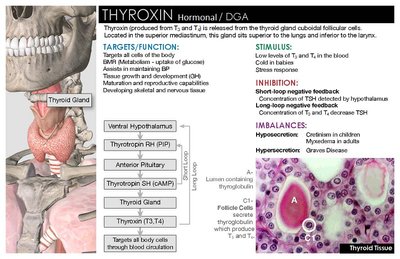
Thyroxin (T3 and T4)
The thyroid gland, located in the anterior neck, produces thyroxin (T3 and T4), which plays a critical role in regulating metabolism, growth, and development. Thyroxin is released from thyroid follicular cells and is regulated by the hypothalamic-pituitary-thyroid axis.
Targets/Function: Increases metabolic rate, stimulates protein synthesis, and is essential for normal growth and development.
Stimulus: Low levels of T3 and T4 in the blood stimulate release.
Inhibition: Short-loop negative feedback via TSH from the anterior pituitary, which is regulated by TRH from the hypothalamus.
Imbalances: Hyposecretion causes cretinism in children and myxedema in adults; hypersecretion leads to Graves disease.
Calcitonin
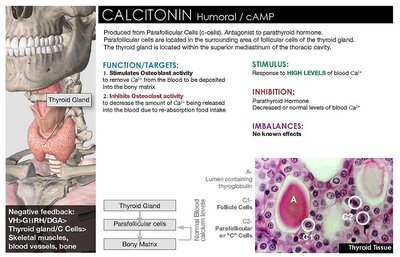
Calcitonin is produced by parafollicular (C) cells of the thyroid gland and acts as an antagonist to parathyroid hormone. It helps regulate calcium homeostasis by lowering blood calcium levels.
Function/Targets: Stimulates osteoblast activity to increase bone calcium deposition and inhibits osteoclast activity to reduce bone resorption.
Stimulus: High levels of blood Ca2+.
Inhibition: Parathyroid hormone and decreased blood Ca2+ levels.
Imbalances: No known significant effects in humans.
Parathyroid Gland and Hormone
Parathyroid Hormone (PTH)
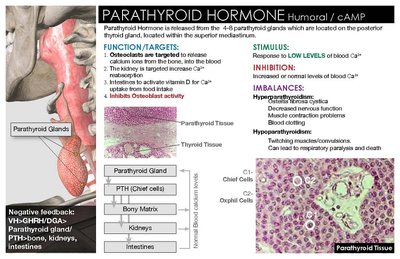
PTH is secreted by the chief cells of the parathyroid glands, located on the posterior surface of the thyroid gland. It is the primary regulator of blood calcium levels.
Function/Targets: Increases osteoclast activity to release Ca2+ from bone, enhances Ca2+ reabsorption in the kidneys, and stimulates activation of vitamin D to increase intestinal absorption of Ca2+.
Stimulus: Low blood Ca2+ levels.
Inhibition: Increased or normal blood Ca2+ levels.
Imbalances: Hyposecretion causes tetany and convulsions; hypersecretion leads to bone resorption and kidney stones.
Adrenal Glands
Overview
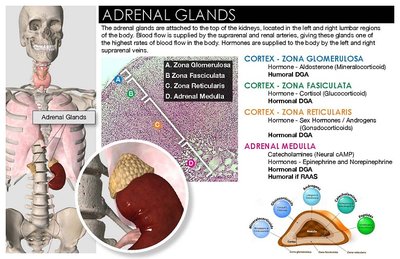
The adrenal glands are located atop the kidneys and consist of two main regions: the cortex and the medulla. Each region produces distinct hormones essential for homeostasis.
Cortex: Produces mineralocorticoids, glucocorticoids, and androgens.
Medulla: Produces catecholamines (epinephrine and norepinephrine).
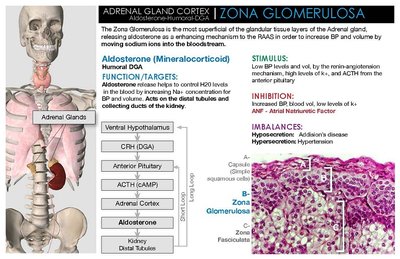
Adrenal Cortex: Zona Glomerulosa
The zona glomerulosa is the outermost layer of the adrenal cortex and secretes aldosterone, a mineralocorticoid that regulates sodium and potassium balance.
Function/Targets: Increases sodium reabsorption and potassium excretion in the kidneys, thus regulating blood volume and pressure.
Stimulus: Low blood pressure, high potassium, and activation of the renin-angiotensin-aldosterone system (RAAS).
Inhibition: High blood pressure, low potassium, and ACTH from the anterior pituitary.
Imbalances: Hyposecretion causes Addison's disease; hypersecretion leads to hypertension.
Adrenal Cortex: Zona Fasciculata
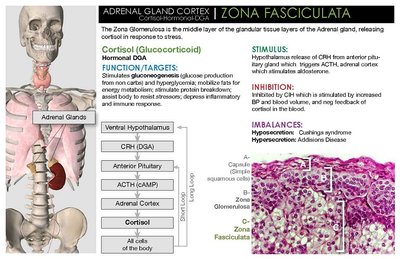
The zona fasciculata is the middle layer of the adrenal cortex and secretes cortisol, a glucocorticoid involved in stress response and metabolism regulation.
Function/Targets: Stimulates gluconeogenesis, increases blood glucose, suppresses immune response, and reduces inflammation.
Stimulus: ACTH from the anterior pituitary, especially during stress.
Inhibition: Negative feedback by cortisol on CRH and ACTH secretion.
Imbalances: Hyposecretion causes Addison's disease; hypersecretion leads to Cushing's syndrome.
Adrenal Cortex: Zona Reticularis
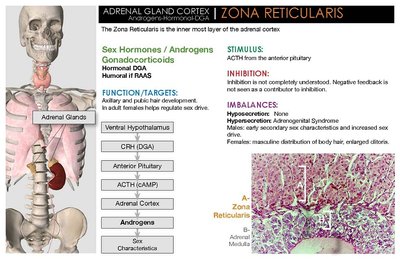
The zona reticularis is the innermost layer of the adrenal cortex and produces androgens (sex hormones).
Function/Targets: Contributes to the development of secondary sex characteristics and libido.
Stimulus: ACTH from the anterior pituitary.
Inhibition: Not fully understood; negative feedback is less significant than for other adrenal hormones.
Imbalances: Hypersecretion causes adrenogenital syndrome; hyposecretion has minimal effects.
Adrenal Medulla
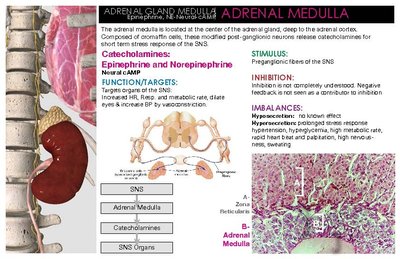
The adrenal medulla is the inner region of the adrenal gland and secretes catecholamines (epinephrine and norepinephrine) in response to sympathetic nervous system stimulation.
Function/Targets: Increases heart rate, blood pressure, and metabolic rate; prepares the body for 'fight or flight' response.
Stimulus: Preganglionic sympathetic fibers.
Inhibition: Not completely understood; negative feedback is minimal.
Imbalances: Hypersecretion causes hypertension and rapid heart rate; hyposecretion has no known significant effects.
Pancreas: Insulin and Glucagon
Insulin
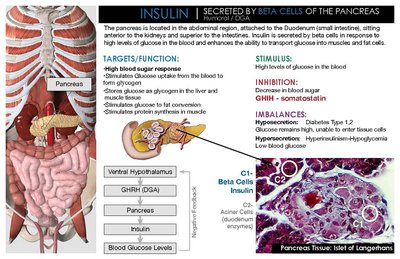
Insulin is secreted by beta cells of the pancreatic islets in response to high blood glucose. It is essential for glucose uptake and metabolism.
Targets/Function: Lowers blood glucose by promoting cellular uptake, glycogen synthesis, and fat storage; inhibits gluconeogenesis.
Stimulus: High blood glucose levels.
Inhibition: Low blood glucose and somatostatin.
Imbalances: Hyposecretion causes diabetes mellitus; hypersecretion leads to hypoglycemia.
Glucagon
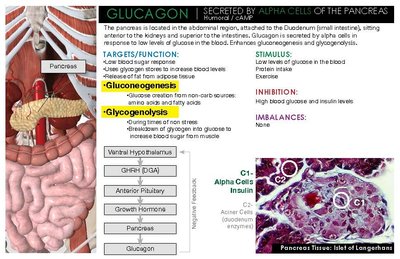
Glucagon is secreted by alpha cells of the pancreatic islets in response to low blood glucose. It acts antagonistically to insulin.
Targets/Function: Raises blood glucose by stimulating glycogenolysis and gluconeogenesis in the liver.
Stimulus: Low blood glucose and high insulin levels.
Inhibition: High blood glucose and insulin levels.
Imbalances: No major clinical syndromes directly related to glucagon imbalance.
Additional info: The above notes integrate the structure, function, regulation, and clinical relevance of major endocrine glands and their hormones, as covered in chapters on the endocrine system, metabolism, and homeostasis.
