 Back
BackEndocrine System: Major Glands, Hormone Regulation, and Disorders
Study Guide - Smart Notes
 Tailored notes based on your materials, expanded with key definitions, examples, and context.
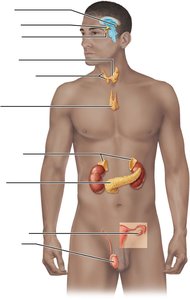
Q1. Name the endocrine organs labeled A–J in the human body diagram.
Background
Topic: Endocrine System Anatomy
This question tests your knowledge of the major endocrine glands, their anatomical locations, and their roles in hormone secretion.
Key Terms:
Endocrine glands: Ductless glands that secrete hormones directly into the bloodstream.
Hormones: Chemical messengers that regulate physiological processes.
Step-by-Step Guidance
Start at the top of the diagram and identify the gland located in the brain region (A). Consider the pineal gland and hypothalamus as possible options.
Move downward to the next labeled structure (B), which is also in the brain. Think about the hypothalamus and pituitary gland and their relative positions.
Continue to the gland in the neck region (D). This is typically the thyroid gland, with smaller glands on its dorsal side (E) that are important for calcium regulation.
Identify the gland in the upper chest (F), which is prominent in children and involved in immune function.
Locate the glands above the kidneys (G), which are responsible for stress and electrolyte balance.
Find the gland near the stomach and intestines (H), which has both endocrine and exocrine functions.
Finally, identify the reproductive glands (I and J) in the lower abdomen and pelvic region, noting the differences between male and female anatomy.
Try solving on your own before revealing the answer!
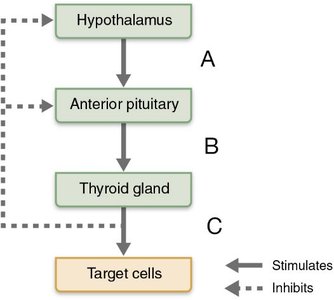
Q2. Identify the hormones labeled A–C in the thyroid hormone regulation pathway diagram.
Background
Topic: Hormonal Regulation and Feedback Mechanisms
This question focuses on the hypothalamic-pituitary-thyroid axis and the hormones involved in regulating thyroid function.
Key Terms and Pathway:
Thyrotropin-releasing hormone (TRH): Released from the hypothalamus.
Thyroid-stimulating hormone (TSH): Released from the anterior pituitary.
Thyroid hormones (T3 and T4): Released from the thyroid gland.
Step-by-Step Guidance
Examine the flow of the diagram: the hypothalamus releases a hormone (A) that acts on the anterior pituitary.
The anterior pituitary then releases a hormone (B) that stimulates the thyroid gland.
The thyroid gland releases hormones (C) that act on target cells and provide feedback to the hypothalamus and pituitary.
Use the arrows and feedback loops to help match each hormone to its correct label.
Try solving on your own before revealing the answer!
Q3. Explain why a goiter (enlarged thyroid gland) results from inadequate dietary iodine.
Background
Topic: Thyroid Disorders and Iodine Deficiency
This question examines the physiological consequences of iodine deficiency and its impact on thyroid hormone synthesis and gland size.
Key Concepts:
Goiter: An abnormal enlargement of the thyroid gland.
Iodine: An essential element required for the synthesis of thyroid hormones.
Negative feedback: A regulatory mechanism that maintains hormone levels within a normal range.
Step-by-Step Guidance
Recall that thyroid hormones (T3 and T4) require iodine for their synthesis in the thyroid gland.
Consider what happens when dietary iodine is insufficient: the gland cannot produce enough thyroid hormones.
Think about how the pituitary gland responds to low thyroid hormone levels—what hormone does it secrete more of, and what effect does this have on the thyroid gland?
Relate this process to the physical enlargement of the gland seen in goiter.

Try solving on your own before revealing the answer!
