 Back
Endocrine System Regulation: Thyroid Hormone Secretion and Disorders
Study Guide - Smart Notes
 Tailored notes based on your materials, expanded with key definitions, examples, and context.
Q1. Identify the hormones labeled A–C in the figure showing the regulation of thyroid hormone secretion.
Background
Topic: Endocrine Regulation – Hypothalamic-Pituitary-Thyroid Axis
This question tests your understanding of how the hypothalamus, anterior pituitary, and thyroid gland interact to regulate thyroid hormone secretion through a feedback loop.
Key Terms and Concepts:
Hypothalamus: Brain region that releases hormones to control the pituitary gland.
Anterior Pituitary: Gland that releases hormones in response to hypothalamic signals.
Thyroid Gland: Endocrine gland that produces thyroid hormones affecting metabolism.
Negative Feedback: A process where increased hormone levels inhibit further hormone release.
Step-by-Step Guidance
Examine the diagram: The arrows show the direction of hormone signaling and feedback inhibition between the hypothalamus, anterior pituitary, thyroid gland, and target cells.
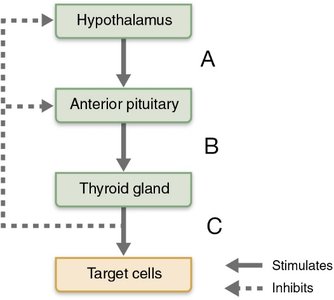
Recall the sequence of hormone release: The hypothalamus releases a hormone (A) that stimulates the anterior pituitary to release another hormone (B), which then stimulates the thyroid gland to release thyroid hormones (C).
Match each label (A, B, C) to the correct hormone based on their source and target:
A: Hormone from hypothalamus to anterior pituitary
B: Hormone from anterior pituitary to thyroid gland
C: Hormones from thyroid gland to target cells
Consider the feedback mechanism: Increased levels of hormone C inhibit the release of hormones A and B, maintaining homeostasis.
Try solving on your own before revealing the answer!
Q2. Is the regulation of thyroid hormone secretion an example of a negative feedback or positive feedback mechanism? Explain your answer.
Background
Topic: Feedback Mechanisms in Endocrine Regulation
This question assesses your understanding of how hormone levels are regulated to maintain homeostasis, specifically whether the process is controlled by negative or positive feedback.
Key Terms and Concepts:
Negative Feedback: A control mechanism where the output of a system suppresses or inhibits its own production.
Positive Feedback: A mechanism where the output enhances or amplifies the process.
Step-by-Step Guidance
Review the diagram and note the dashed arrows indicating inhibition from the thyroid hormones back to the hypothalamus and anterior pituitary.
Recall the definition of negative feedback: When the end product (thyroid hormones) inhibits the initial steps (release of hypothalamic and pituitary hormones), this is negative feedback.
Think about why this is important: Negative feedback helps maintain stable levels of thyroid hormones in the blood, preventing overproduction or underproduction.
Try solving on your own before revealing the answer!
Q3. Explain why a goiter (enlarged, protruding thyroid gland) results from inadequate dietary iodine.
Background
Topic: Thyroid Disorders – Goiter Formation
This question tests your understanding of the physiological consequences of iodine deficiency on thyroid hormone synthesis and gland size.
Key Terms and Concepts:
Iodine: Essential element required for the synthesis of thyroid hormones (T3 and T4).
Thyroid-Stimulating Hormone (TSH): Hormone from the anterior pituitary that stimulates the thyroid gland.
Colloid: Substance in thyroid follicles where thyroid hormone precursors are stored.
Goiter: Enlargement of the thyroid gland due to overstimulation or inability to produce hormones.
Step-by-Step Guidance
Recall that iodine is necessary for the synthesis of thyroid hormones (T3 and T4).
Consider what happens when dietary iodine is insufficient: The thyroid gland cannot produce adequate amounts of T3 and T4.
Think about the feedback loop: Low thyroid hormone levels lead to increased secretion of TSH from the anterior pituitary.
TSH stimulates the thyroid gland to grow and produce more colloid, but without iodine, functional hormones cannot be made, resulting in gland enlargement (goiter).

Try solving on your own before revealing the answer!
Final Answers
Q1: A = Thyrotropin-releasing hormone (TRH), B = Thyroid-stimulating hormone (TSH), C = Thyroid hormones (T3 and T4)
Q2: The regulation is an example of negative feedback because rising thyroid hormone levels inhibit the release of TRH and TSH, maintaining homeostasis.
Q3: A goiter results from iodine deficiency because the thyroid gland cannot synthesize enough thyroid hormones, leading to increased TSH stimulation and gland enlargement.
