 Back
BackEndocrine System: Structure, Function, and Hormonal Regulation
Study Guide - Smart Notes
 Tailored notes based on your materials, expanded with key definitions, examples, and context.
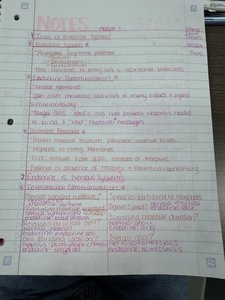
Endocrine System Overview
Endocrine Communication
The endocrine system is a major regulatory system in the human body, responsible for maintaining homeostasis through the secretion of hormones. Hormones are chemical messengers released by endocrine glands directly into the bloodstream, affecting distant target organs.
Endocrine glands: Ductless glands that secrete hormones into the blood.
Hormones: Chemical messengers that regulate physiological processes.
Functions: Growth, metabolism, reproduction, and stress response.
Examples: Pituitary gland, thyroid gland, adrenal glands.
Endocrine vs. Nervous System
The endocrine and nervous systems both regulate body functions, but differ in their mechanisms and speed of action.
Endocrine system: Uses hormones, slower but longer-lasting effects.
Nervous system: Uses electrical impulses and neurotransmitters, rapid and short-lived effects.
Comparison Table:
Feature | Endocrine System | Nervous System |
|---|---|---|
Messenger | Hormones | Neurotransmitters |
Speed | Slow | Fast |
Duration | Long-lasting | Short-lived |
Specificity | Broad | Specific |
Hormone Types and Mechanisms
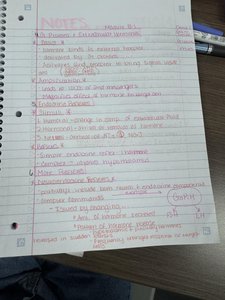
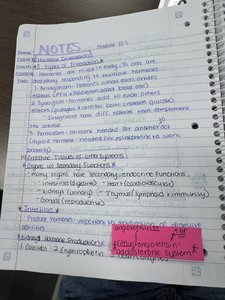
Types of Hormones
Hormones are classified based on their chemical structure and solubility.
Amino acid-based hormones: Includes peptides, proteins, and amines; generally water-soluble.
Steroid hormones: Derived from cholesterol; lipid-soluble.
Eicosanoids: Derived from fatty acids; act locally.
Hormone Action
Hormones exert their effects by binding to specific receptors on target cells, initiating a cascade of cellular responses.
Water-soluble hormones: Bind to membrane receptors, activate second messenger systems (e.g., cAMP).
Lipid-soluble hormones: Pass through cell membranes, bind to intracellular receptors, and directly influence gene expression.
Regulation of Hormone Secretion
Hormone release is regulated by feedback mechanisms, primarily negative feedback, to maintain homeostasis.
Negative feedback: Increased hormone levels inhibit further secretion.
Positive feedback: Rare; hormone release stimulates further secretion (e.g., oxytocin during childbirth).
Major Endocrine Organs and Hormones
Pituitary Gland
The pituitary gland, often called the "master gland," regulates other endocrine glands through its hormones.
Anterior pituitary: Produces growth hormone (GH), thyroid-stimulating hormone (TSH), adrenocorticotropic hormone (ACTH), follicle-stimulating hormone (FSH), luteinizing hormone (LH), and prolactin.
Posterior pituitary: Releases antidiuretic hormone (ADH) and oxytocin.
Thyroid Gland
The thyroid gland regulates metabolism, growth, and development through the secretion of thyroid hormones.
Thyroxine (T4) and triiodothyronine (T3): Increase metabolic rate.
Calcitonin: Lowers blood calcium levels.
Parathyroid Glands
Parathyroid glands regulate calcium homeostasis.
Parathyroid hormone (PTH): Increases blood calcium levels by stimulating bone resorption and increasing calcium reabsorption in kidneys.
Adrenal Glands
The adrenal glands produce hormones involved in stress response, metabolism, and electrolyte balance.
Adrenal cortex: Produces corticosteroids (glucocorticoids, mineralocorticoids, and androgens).
Adrenal medulla: Produces catecholamines (epinephrine and norepinephrine).
Pancreas
The pancreas has both endocrine and exocrine functions, regulating blood glucose levels.
Insulin: Lowers blood glucose by promoting cellular uptake.
Glucagon: Raises blood glucose by stimulating glycogen breakdown.
Gonads
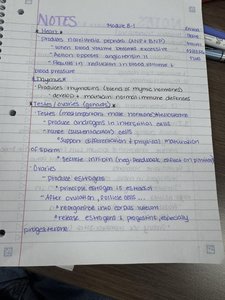
The gonads (ovaries and testes) produce sex hormones that regulate reproductive functions and secondary sexual characteristics.
Ovaries: Produce estrogen and progesterone.
Testes: Produce testosterone.
Hormonal Disorders and Regulation
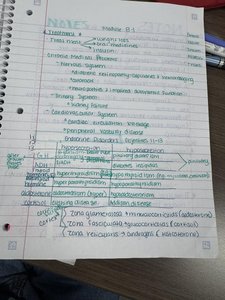
Common Endocrine Disorders
Disorders of the endocrine system result from hypo- or hypersecretion of hormones.
Diabetes mellitus: Insulin deficiency or resistance, leading to high blood glucose.
Hypothyroidism: Low thyroid hormone production, causing slow metabolism.
Hyperthyroidism: Excess thyroid hormone, causing increased metabolism.
Cushing's syndrome: Excess cortisol production.
Addison's disease: Insufficient adrenal cortex hormones.
Stress Response
The body responds to stress through the General Adaptation Syndrome (GAS), involving the adrenal glands and the release of stress hormones.
Alarm phase: Immediate response via sympathetic nervous system and adrenal medulla (epinephrine/norepinephrine).
Resistance phase: Sustained response via adrenal cortex (cortisol).
Exhaustion phase: Prolonged stress leads to depletion of resources and potential health consequences.
Hormonal Regulation of Growth and Development
Growth and Development
Hormones play a crucial role in regulating growth, development, and sexual differentiation.
Growth hormone (GH): Stimulates growth of bones and tissues.
Thyroid hormones: Essential for normal development of the nervous system and metabolism.
Sex hormones: Regulate development of secondary sexual characteristics and reproductive organs.
Summary Table: Major Endocrine Glands and Hormones
Gland | Hormone(s) | Main Function |
|---|---|---|
Pituitary | GH, TSH, ACTH, FSH, LH, Prolactin, ADH, Oxytocin | Growth, metabolism, reproduction, water balance |
Thyroid | T3, T4, Calcitonin | Metabolism, calcium regulation |
Parathyroid | PTH | Calcium homeostasis |
Adrenal | Cortisol, Aldosterone, Epinephrine, Norepinephrine | Stress response, metabolism, electrolyte balance |
Pancreas | Insulin, Glucagon | Blood glucose regulation |
Ovaries | Estrogen, Progesterone | Female reproductive functions |
Testes | Testosterone | Male reproductive functions |
Key Equations and Concepts
Hormone-Receptor Interaction:
Negative Feedback Example:
Blood Glucose Regulation:
Relevant Images





Additional info: Academic context and expanded explanations have been added to ensure completeness and clarity for college-level study.
