 Back
BackEndocrine System Study Guidance – ANP College Course
Study Guide - Smart Notes
 Tailored notes based on your materials, expanded with key definitions, examples, and context.
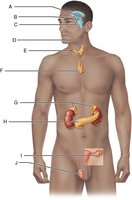
Q1. Name the endocrine organs labeled A–J in the diagram.
Background
Topic: Endocrine System Anatomy
This question tests your knowledge of the major endocrine glands in the human body and their anatomical locations. Understanding these locations is essential for identifying the source of various hormones and their physiological effects.
Key Terms:
Endocrine gland: A gland that secretes hormones directly into the bloodstream.
Hormone: A chemical messenger produced by endocrine glands that regulates physiological processes.
Step-by-Step Guidance
Observe the diagram and note the anatomical locations of each labeled structure (A–J).
Recall the major endocrine glands and match each label to the correct gland based on its position in the body (e.g., brain, neck, abdomen, pelvis).
Use your textbook or class notes to confirm the names and locations of each gland if you are unsure.
Write the name of each gland next to its corresponding label (A–J) on your worksheet.
Try solving on your own before revealing the answer!
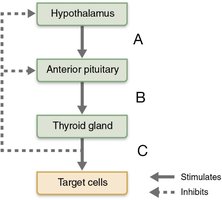
Q2. Identify the hormones labeled A–C in the thyroid hormone regulation flowchart.
Background
Topic: Hormonal Regulation and Feedback Mechanisms
This question focuses on the hormonal control of thyroid hormone secretion, specifically the roles of the hypothalamus, anterior pituitary, and thyroid gland. Understanding this pathway is crucial for grasping how hormone levels are regulated in the body.
Key Terms and Concepts:
TRH: Thyrotropin-releasing hormone (from hypothalamus)
TSH: Thyroid-stimulating hormone (from anterior pituitary)
Thyroid hormones: T3 and T4 (from thyroid gland)
Negative feedback: A process where the end product inhibits its own production pathway.
Step-by-Step Guidance
Examine the flowchart and identify the direction of hormone release from the hypothalamus to the anterior pituitary, then to the thyroid gland.
Recall which hormone is released by the hypothalamus to stimulate the anterior pituitary (label A).
Determine which hormone is released by the anterior pituitary to stimulate the thyroid gland (label B).
Identify the hormone(s) released by the thyroid gland that act on target cells and provide feedback inhibition (label C).
Try solving on your own before revealing the answer!
Q3. Explain why a goiter (enlarged, protruding thyroid gland) results from inadequate dietary iodine.
Background
Topic: Thyroid Gland Physiology and Disorders
This question examines your understanding of the relationship between iodine intake and thyroid gland function. Iodine is essential for the synthesis of thyroid hormones, and its deficiency can lead to glandular enlargement (goiter).

Key Terms:
Goiter: An abnormal enlargement of the thyroid gland.
Iodine: A trace element required for the synthesis of thyroid hormones.
Thyroid-stimulating hormone (TSH): A hormone that stimulates the thyroid gland to produce thyroid hormones.
Step-by-Step Guidance
Recall the role of iodine in the synthesis of thyroid hormones (T3 and T4).
Consider what happens to thyroid hormone production when dietary iodine is insufficient.
Think about how the pituitary gland responds to low thyroid hormone levels (hint: TSH secretion).
Explain how increased TSH affects the thyroid gland over time.
Try solving on your own before revealing the answer!
