 Back
BackEndocrine System Study Guide – Key Concepts and Visuals
Study Guide - Smart Notes
 Tailored notes based on your materials, expanded with key definitions, examples, and context.
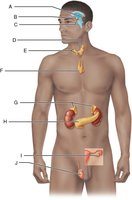
Q1. Name the endocrine organs labeled A–J in the diagram.
Background
Topic: Endocrine Organs and Their Locations
This question tests your knowledge of the major endocrine glands in the human body and their anatomical locations. Understanding these locations is essential for recognizing how hormones are distributed and function throughout the body.
Key Terms:
Endocrine gland: A gland that secretes hormones directly into the bloodstream.
Hormone: A chemical messenger produced by endocrine glands that regulates physiological processes.
Step-by-Step Guidance
Start by identifying the general location of each label (A–J) on the diagram. For example, A is in the brain, D is in the neck, G is above the kidneys, etc.
Recall the major endocrine glands: pineal gland, pituitary gland, hypothalamus, thyroid gland, parathyroid glands, thymus, adrenal glands, pancreas, ovaries (female), and testes (male).
Match each label to the gland based on its anatomical position. For example, the gland at the base of the brain is likely the pituitary gland.
Use your textbook or class notes to confirm the specific locations if you are unsure.
Try solving on your own before revealing the answer!
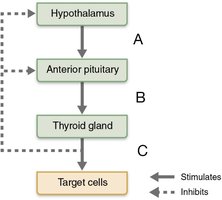
Q2. Identify the hormones labeled A–C in the regulation of thyroid hormone secretion.
Background
Topic: Hormonal Regulation and Feedback Mechanisms
This question focuses on the hormonal control of thyroid hormone secretion, specifically the hypothalamic-pituitary-thyroid (HPT) axis. Understanding this axis is crucial for grasping how hormone levels are regulated in the body.
Key Terms and Pathway:
Hypothalamus: Releases hormones that control the pituitary gland.
Anterior pituitary: Releases hormones that stimulate other endocrine glands.
Thyroid gland: Produces thyroid hormones that regulate metabolism.
Step-by-Step Guidance
Recall the sequence of hormone release: the hypothalamus releases a hormone that stimulates the anterior pituitary, which then releases a hormone that stimulates the thyroid gland.
Identify the names of the hormones at each step (A, B, and C) in the pathway. Think about which hormone each gland produces in this axis.
Consider the feedback mechanism: the hormone from the thyroid gland inhibits the hypothalamus and anterior pituitary to maintain balance.
Try solving on your own before revealing the answer!
Q3. Explain why a goiter (enlarged, protruding thyroid gland) results from inadequate dietary iodine.
Background
Topic: Thyroid Gland Disorders and Iodine Deficiency
This question examines the relationship between iodine intake and thyroid gland function. Iodine is essential for the synthesis of thyroid hormones, and its deficiency can lead to gland enlargement (goiter).
Key Concepts:
Thyroid hormone synthesis: Requires iodine as a key component.
Negative feedback: Low thyroid hormone levels stimulate the pituitary to release more TSH, causing the thyroid to grow.

Step-by-Step Guidance
Recall that the thyroid gland needs iodine to produce thyroid hormones (T3 and T4).
Consider what happens when there is not enough iodine in the diet: the thyroid cannot make enough hormone.
Think about how the pituitary gland responds to low thyroid hormone levels (increased TSH secretion).
Explain how this increased stimulation causes the thyroid gland to enlarge, resulting in a goiter.
Try solving on your own before revealing the answer!
