 Back
BackEnergy and Cellular Metabolism: Aerobic and Anaerobic Pathways
Study Guide - Smart Notes
 Tailored notes based on your materials, expanded with key definitions, examples, and context.
Energy and Cellular Metabolism
Overview of Metabolic Pathways
Cellular metabolism encompasses the biochemical processes that allow cells to extract energy from nutrients and produce ATP, the universal energy currency. The main pathways include glycolysis, the citric acid cycle, and the electron transport system, which together enable both aerobic and anaerobic ATP production.
Aerobic metabolism: Utilizes oxygen and yields 30–32 ATP per glucose molecule.
Anaerobic metabolism: Occurs without oxygen, yielding only 2 ATP per glucose molecule.
ATP-PC system: Provides immediate ATP through phosphocreatine breakdown.
Key Steps in Aerobic ATP Production
Aerobic ATP production involves four main steps, each contributing to the efficient extraction of energy from carbohydrates, lipids, and proteins.
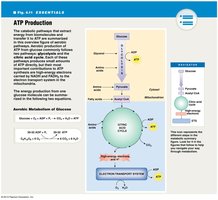
Glycolysis: Breakdown of glucose or glycogen to pyruvate in the cytosol.
Conversion of Pyruvate to Acetyl-CoA: Pyruvate enters mitochondria and is converted to acetyl-CoA.
Citric Acid Cycle (TCA/Krebs Cycle): Acetyl-CoA is oxidized, producing NADH, FADH2, ATP, and CO2.
Electron Transport System (ETS): High-energy electrons from NADH and FADH2 drive ATP synthesis.
Glycolysis
Glycolysis is a series of enzymatic reactions that convert one molecule of glucose into two molecules of pyruvate, generating energy in the form of ATP and NADH. It is the common pathway for both aerobic and anaerobic metabolism.
Starting with glucose: Produces 2 pyruvate, 2 NADH, and 2 net ATP.
Starting with glycogen: Produces 2 pyruvate, 2 NADH, and 3 net ATP.
Location: Cytosol of the cell.
Oxygen requirement: None; glycolysis can proceed in both aerobic and anaerobic conditions.
Key Features of Glycolysis
Two ATP are consumed in early steps; four ATP are produced in later steps (net gain: 2 ATP).
NADH is generated, storing high-energy electrons for later use.
Pyruvate is the branch point for further metabolism.
Glycolysis End-Products Table
Starting Substrate | End Products |
|---|---|
Glucose | 2 Pyruvate, 2 NADH, 2 ATP |
Glycogen | 2 Pyruvate, 2 NADH, 3 ATP |
Fate of Pyruvate: Aerobic vs. Anaerobic Metabolism
The fate of pyruvate depends on the cellular environment, particularly oxygen availability and mitochondrial capacity.
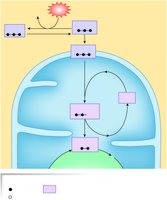
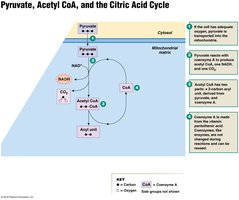
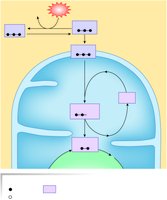
Aerobic conditions: Pyruvate is transported into mitochondria and converted to acetyl-CoA.
Anaerobic conditions: Pyruvate is converted to lactate by lactate dehydrogenase (LDH), regenerating NAD+ for glycolysis.
Conditions Determining Pyruvate Fate
Aerobic: Sufficient oxygen, adequate mitochondria, energy demand met by aerobic metabolism.
Anaerobic: Lack of oxygen, limited mitochondria, high energy demand.
Conversion of Pyruvate to Acetyl-CoA
Pyruvate reacts with coenzyme A in the mitochondrial matrix, producing acetyl-CoA, CO2, and NADH. This reaction is catalyzed by pyruvate dehydrogenase.
Equation:
Location: Mitochondrial matrix
Citric Acid Cycle (Krebs Cycle)
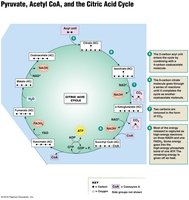
The citric acid cycle is a series of reactions in the mitochondrial matrix that oxidize acetyl-CoA, producing NADH, FADH2, ATP, and CO2. Each acetyl-CoA yields:
3 NADH
1 FADH2
1 ATP
2 CO2
Citric Acid Cycle End-Products Table
Input | Output per Acetyl-CoA |
|---|---|
Acetyl-CoA | 3 NADH, 1 FADH2, 1 ATP, 2 CO2 |
Electron Transport System (ETS)
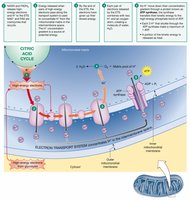
The electron transport system is located in the inner mitochondrial membrane. It uses high-energy electrons from NADH and FADH2 to generate ATP via oxidative phosphorylation.
NADH: Each yields 2.5 ATP (1.5 if from cytosol).
FADH2: Each yields 1.5 ATP.
Oxygen: Final electron acceptor, forming water.
ATP synthase: Enzyme that synthesizes ATP using the proton gradient.
Roles of Key Molecules in ETS
NADH/FADH2: Donate electrons to ETS.
H+: Pumped across membrane, creating gradient.
Electrons: Passed through protein complexes.
Oxygen: Accepts electrons, forms water.
ATP synthase: Uses gradient to produce ATP.
ATP: Main energy product.
Summary of Aerobic Metabolism of Glucose
Aerobic metabolism of one glucose molecule produces:
30–32 ATP
10 NADH
2 FADH2
6 CO2
Summary Table: Energy Production from Glucose
Pathway | ATP | NADH | FADH2 | CO2 |
|---|---|---|---|---|
Glycolysis | 2 | 2 | 0 | 0 |
Pyruvate to Acetyl-CoA | 0 | 2 | 0 | 2 |
Citric Acid Cycle | 2 | 6 | 2 | 4 |
ETS (from NADH/FADH2) | ~28 | 0 | 0 | 0 |
Total | 30–32 | 10 | 2 | 6 |
Interaction of Lipids and Proteins with Metabolic Pathways
Breakdown products of lipids and proteins enter metabolic pathways at various points:
Fatty acids: Enter via β-oxidation, producing acetyl-CoA.
Amino acids: Can be converted to pyruvate, acetyl-CoA, or citric acid cycle intermediates.
Glycerol: Enters glycolysis.
Anaerobic Forms of ATP Production
Anaerobic metabolism occurs when oxygen is limited, relying on glycolysis and the ATP-PC system for energy.
ATP-PC system: Immediate ATP source via phosphocreatine breakdown.
Anaerobic glycolysis: Pyruvate is converted to lactate, yielding 2 ATP per glucose.
Location: Cytosol
Key enzyme: Lactate dehydrogenase (LDH)
Summary Table: Anaerobic ATP Production
Pathway | ATP Yield | Key Features |
|---|---|---|
ATP-PC System | Immediate, low yield | Uses phosphocreatine |
Anaerobic Glycolysis | 2 ATP/glucose | Pyruvate to lactate |
Additional info:
Glycolysis is the only pathway that can operate in both aerobic and anaerobic conditions.
Regeneration of NAD+ during lactate formation allows glycolysis to continue in the absence of oxygen.
