 Back
BackEpithelial and Connective Tissues: Structure, Classification, and Function
Study Guide - Smart Notes
 Tailored notes based on your materials, expanded with key definitions, examples, and context.
Covering and Lining Epithelium
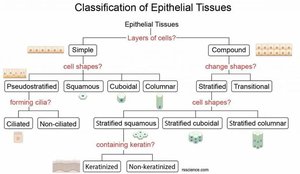
Classification of Epithelial Tissues
Epithelial tissues are classified based on the number of cell layers and the shape of the cells. These tissues cover body surfaces, line cavities, and form glands.
Simple epithelium: Single layer of cells; specialized for absorption, secretion, and filtration.
Stratified epithelium: Multiple layers; provides protection against abrasion.
Cell shapes: Squamous (flat), cuboidal (cube-shaped), columnar (tall), transitional (changes shape).
Specializations: Ciliated (with cilia), keratinized (with keratin for waterproofing).
Glandular Epithelium
Types and Classification of Glands
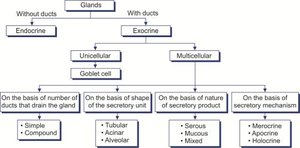
Glandular epithelia are specialized for secretion. Glands are classified by the presence or absence of ducts, cell number, and type of secretion.
Endocrine glands: Ductless; secrete hormones directly into the bloodstream; effects are widespread.
Exocrine glands: Have ducts; secrete onto body surfaces or into organ lumens; effects are local.
Unicellular glands: Single cells (e.g., goblet cells) scattered in epithelia; secrete mucin.
Multicellular glands: Composed of many cells; can be simple or compound, tubular or alveolar, and secrete serous, mucous, or mixed products.
Structure of Glandular Epithelium
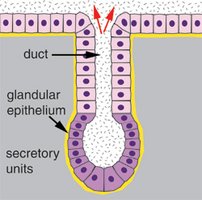
Glandular epithelium consists of secretory units and ducts. The arrangement of these structures determines the gland's classification.
Major Endocrine Glands
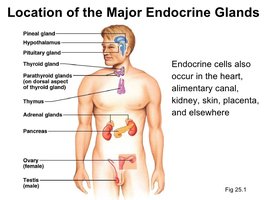
Endocrine glands are distributed throughout the body and include the pituitary, thyroid, adrenal glands, and others. They regulate various physiological processes by releasing hormones.
Types of Exocrine Gland Secretion
Exocrine glands secrete their products by different mechanisms:
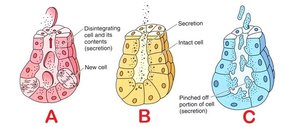
Merocrine: Secretion by exocytosis (e.g., salivary glands, most sweat glands).
Holocrine: Entire cell disintegrates to release its product (e.g., sebaceous glands).
Apocrine: Apex of cell pinches off with secretion (e.g., mammary glands).
Goblet Cells
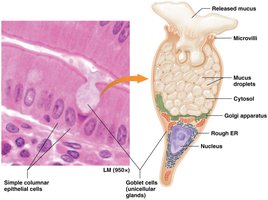
Goblet cells are the most common unicellular exocrine glands. They are found in the digestive and respiratory tracts and secrete mucus to protect underlying epithelium.
Connective Tissue
Overview and Classification
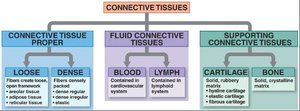
Connective tissue is the most abundant tissue type in the body. It supports, connects, and protects other tissues and organs. It is classified into three main types:
Connective tissue proper: Loose and dense types; provides support and structure.
Fluid connective tissue: Blood and lymph; transports cells and dissolved substances.
Supporting connective tissue: Cartilage and bone; provides strong framework.
Characteristics of Connective Tissues
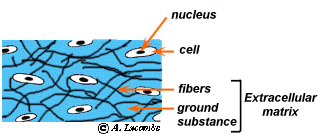
Connective tissues are characterized by specialized cells and an abundant extracellular matrix (ECM), which consists of ground substance and protein fibers (collagen, elastic, reticular).
Functions of Connective Tissue
Establishes structural framework for the body
Transports fluids and dissolved materials
Protects delicate organs
Supports, surrounds, and interconnects other tissues
Stores energy reserves (as fat)
Defends the body from microorganisms
Connective Tissue Proper
Loose Connective Tissue
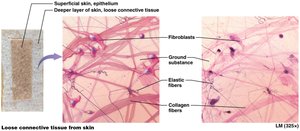
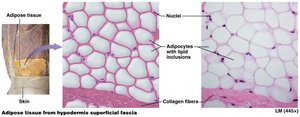
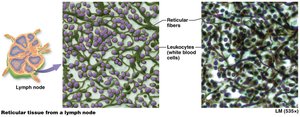
Loose connective tissue has a loose arrangement of fibers and cells, providing cushioning and support. Types include areolar, adipose, and reticular tissue.
Areolar tissue: Cushions organs, provides flexible support, and contains phagocytic cells for defense. Found under skin, around blood vessels, nerves, and organs.
Adipose tissue: Composed mainly of adipocytes; stores energy, insulates, and provides padding. Located under skin, around kidneys, behind eyeballs, and in bones.
Reticular tissue: Forms a network of reticular fibers supporting small structures like blood and lymphatic vessels. Found in liver, kidney, lymph nodes, spleen, and bone marrow.
Dense Connective Tissue
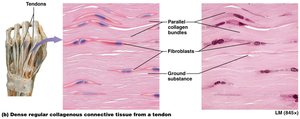
Dense connective tissue contains more fibers and provides greater strength. It is divided into:
Dense regular connective tissue: Collagen fibers arranged in parallel bundles; provides firm attachment and resists tension in one direction. Found in tendons and ligaments.
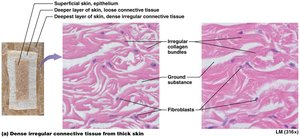
Dense irregular connective tissue: Collagen fibers arranged in a disorganized manner; resists forces from multiple directions. Found in dermis and organ capsules.
Comparison: Epithelial vs. Connective Tissue
Similarities and Differences
Similarities: Both are fundamental tissue types essential for body structure and function.
Differences: Epithelial tissue covers surfaces and lines cavities, is avascular, and has tightly packed cells; connective tissue supports, connects, and protects, is highly vascular (except cartilage), and has abundant ECM.
Review and Self-Assessment
What are the two types of epithelial tissue?
What are the four main functions of epithelial tissue?
What are the five characteristics of epithelial tissue?
How do you classify epithelium?
Which epithelia line body cavities and blood vessels?
What is a gland with no ducts that secretes into blood called?
Which terms are mismatched? (e.g., stratified columnar epithelium/small intestine)
