 Back
BackEstablishment of the Resting Membrane Potential in Neurons
Study Guide - Smart Notes
 Tailored notes based on your materials, expanded with key definitions, examples, and context.
Establishment of the Resting Membrane Potential
Introduction to Membrane Potentials
The resting membrane potential is a fundamental property of all cells, especially neurons and muscle cells, which are excitable tissues. It represents the electrical potential difference across the plasma membrane when the cell is not actively sending signals. Understanding how this potential is established and maintained is crucial for comprehending neural signaling and muscle contraction.
Key Electrical Concepts in Biology
Electrical Potential (Voltage): The energy stored by separating opposite charges across a membrane. The greater the separation, the higher the potential.
Current (I): The movement of electrical charges (ions) across the membrane, measured in amperes (A).
Resistance (R): The hindrance to charge movement; high resistance means ions move less easily.
Conductance (g): The inverse of resistance, representing how easily ions can cross the membrane:
Ohm’s Law: The relationship between potential, current, and resistance:
Neuronal membranes have high resistance due to low ion permeability, while intracellular and extracellular fluids have low resistance due to their ionic content.
Types of Electrical Potentials in Biological Systems
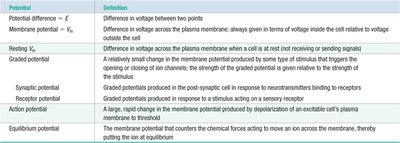
Different types of membrane potentials are involved in neural signaling. The table below summarizes these key potentials:
Potential | Definition |
|---|---|
Potential difference (E) | Difference in voltage between two points |
Membrane potential (Vm) | Difference in voltage across the plasma membrane; always given as voltage inside relative to outside |
Resting Vm | Voltage across the plasma membrane when a cell is at rest (not receiving or sending signals) |
Graded potential | Small change in membrane potential produced by a stimulus; strength varies with stimulus |
Synaptic potential | Graded potential in the post-synaptic cell in response to neurotransmitters |
Receptor potential | Graded potential in response to a sensory stimulus |
Action potential | Large, rapid change in membrane potential due to depolarization of an excitable cell's plasma membrane |
Equilibrium potential | Membrane potential that counters the chemical forces acting to move an ion across the membrane, putting the ion at equilibrium |
Equilibrium Potentials for Potassium and Sodium Ions
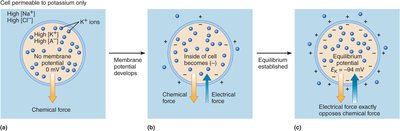
Potassium Equilibrium Potential
When a cell is permeable only to potassium ions (K+), potassium diffuses out of the cell due to its concentration gradient. As K+ leaves, the inside of the cell becomes more negative, creating an electrical force that opposes further K+ efflux. Equilibrium is reached when the electrical force exactly balances the chemical force, resulting in the potassium equilibrium potential (EK), approximately -94 mV in neurons.
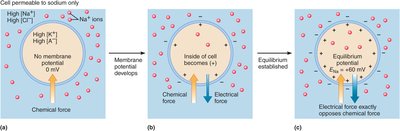
Sodium Equilibrium Potential
In a cell permeable only to sodium ions (Na+), sodium diffuses into the cell, making the inside more positive. The resulting electrical force opposes further Na+ influx. Equilibrium is achieved when the electrical force balances the chemical force, resulting in the sodium equilibrium potential (ENa), approximately +60 mV in neurons.
Resting Membrane Potential of Neurons
Establishment and Maintenance
Neurons are permeable to both K+ and Na+, but much more to K+ (about 25 times greater). At rest, K+ moves out and Na+ moves in, but the net movement of positive charge is outward, making the inside of the cell negative. As the membrane potential becomes more negative, K+ efflux slows and Na+ influx increases until their flows balance, stabilizing the membrane potential at about -70 mV. The Na+/K+ pump maintains these gradients by actively transporting Na+ out and K+ in, using ATP.
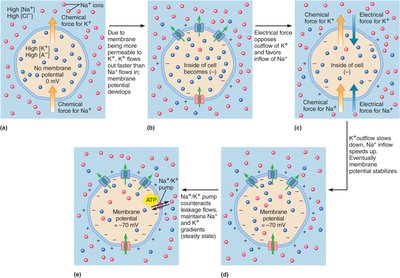
Resting membrane potential (Vm): Typically -70 mV in neurons, closer to EK due to higher K+ permeability.
Na+/K+ pump: Maintains ion gradients and contributes minimally to the negative charge inside the cell (electrogenic effect).
Steady state: The cell is not at equilibrium but at a steady state, as energy is required to maintain the gradients.
Mathematical Description: The GHK Equation
The membrane potential when more than one ion is permeant is calculated using the Goldman–Hodgkin–Katz (GHK) equation:
Where PNa and PK are the permeabilities of the membrane to sodium and potassium, respectively, and the subscripts o and i refer to outside and inside the cell. If PK is much greater than PNa, Vm is closer to EK.
Ion Currents and Leak Channels
The actual movement of ions across the membrane is described as current (I):
Where g is conductance, Vm is membrane potential, and E is the equilibrium potential for the ion. Leak channels (always open) are responsible for the resting membrane potential, while gated channels are involved in signaling.
Summary Table: Key Points of Resting Membrane Potential
Ion | Direction of Chemical Force | Direction of Electrical Force | Net Movement at Rest |
|---|---|---|---|
K+ | Out of cell | Into cell | Out (but slowed by electrical force) |
Na+ | Into cell | Out of cell | In (but slowed by electrical force) |
Additional info:
The Nernst equation is used to calculate the equilibrium potential for a single ion, while the GHK equation is used when multiple ions are permeant.
Changes in membrane permeability (e.g., opening more Na+ channels) will shift the membrane potential toward the equilibrium potential of that ion.
