 Back
BackEvolutionary Conservation of Sleep and Circadian Rhythms in Animals: Insights from Cnidarians and Cavefish
Study Guide - Smart Notes
 Tailored notes based on your materials, expanded with key definitions, examples, and context.
Evolutionary Conservation of Circadian Rhythms and Sleep
Introduction to Circadian Rhythms and Sleep
Circadian rhythms (CRs) are endogenous, approximately 24-hour cycles in biochemical, physiological, or behavioral processes. Sleep is a fundamental biological process observed across the animal kingdom, even in organisms lacking a centralized nervous system. This section explores the evolutionary conservation of these processes, focusing on basal metazoans such as cnidarians and the evolutionary loss of sleep in cavefish.
Circadian Clock Genes Across Animal Evolution
Conservation of Molecular Clock Components
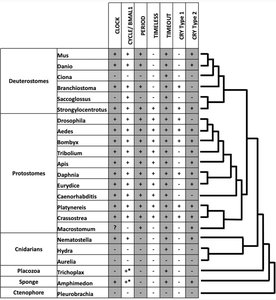
Many animals possess conserved molecular components of the circadian clock, including CLOCK, CYCLE/BMAL1, PERIOD, CRYPTOCHROME, and others. These genes regulate rhythmic gene expression and behavior.
Deuterostomes (e.g., mammals, fish) and protostomes (e.g., insects, worms) generally retain a full complement of clock genes.
Cnidarians (e.g., sea anemones, jellyfish) often possess CLOCK and CRY genes but may lack PER orthologues.
Some lineages, such as sponges, have light-sensing cryptochromes but lack other core clock genes.
Example: The sea anemone expresses rhythmically regulated CLOCK and CRY genes, but not PER. Despite gene loss, behavioral circadian rhythms persist in some cnidarians and sponges.
Sleep-like States in Cnidarians
Behavioral Evidence for Sleep in Jellyfish
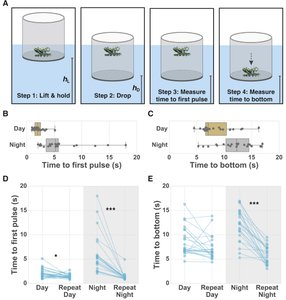
Cnidarians, such as the upside-down jellyfish (Cassiopea spp.), exhibit periods of behavioral quiescence analogous to sleep. These states are characterized by reduced activity, increased arousal threshold, and homeostatic regulation.
Quiescence at Night: Jellyfish display reduced pulsing and rest on the substrate during the night.
Increased Response Latency: At night, jellyfish respond more slowly to mechanical perturbations, indicating a sleep-like state.
Homeostatic Regulation: Sleep deprivation at night leads to compensatory decreases in activity, a hallmark of sleep homeostasis.
Example: In experimental setups, jellyfish dropped from a height during the night take longer to initiate movement and reach the bottom compared to daytime trials, demonstrating increased arousal threshold during sleep-like states.
Sleep Regulation and Melatonin in Cnidarians
Melatonin, a molecule involved in sleep regulation in vertebrates, is also present in cnidarians. Application of melatonin decreases jellyfish activity during the day, suggesting evolutionary conservation of sleep-regulating molecules.
Melatonin: Induces quiescence in Cassiopea jellyfish, supporting its role as a sleep-promoting molecule across metazoans.
Additional info: The presence of sleep-like states in animals lacking a central nervous system suggests that sleep evolved before the emergence of complex brains.
Evolutionary Loss of Sleep in Cavefish
Convergent Evolution of Sleep Loss
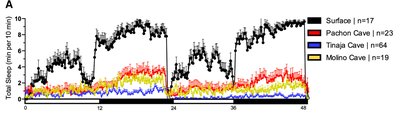
Some populations of the Mexican cavefish (Astyanax mexicanus) have independently evolved reduced sleep compared to their surface-dwelling relatives. This phenomenon is an example of evolutionary convergence, where similar traits evolve independently in different populations.
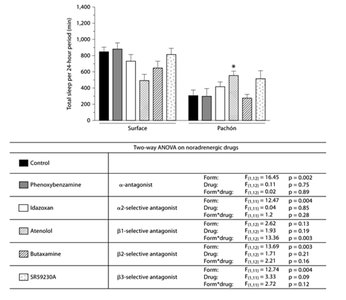
Reduced Sleep Duration: Cave populations sleep significantly less than surface populations, with shorter sleep bouts.
Genetic Basis: Crosses between surface and cave populations show that sleep loss is genetically determined and dominant.
Neurochemical Regulation of Sleep in Cavefish
Pharmacological studies reveal that sleep loss in cavefish can be rescued by drugs targeting the adrenergic and hypocretin/orexin systems.
Beta Blockers (e.g., Propranolol): Increase sleep in cavefish, indicating a role for adrenergic signaling in sleep regulation.
Hypocretin/Orexin System: Cavefish have increased expression of hypocretin (HCRT), a neuropeptide that promotes wakefulness. Inhibition of HCRTR2 (hypocretin receptor 2) restores sleep in cavefish.
Summary Table: Conservation of Circadian Clock Genes
The following table summarizes the presence (+) or absence (–) of key circadian clock genes across major animal groups, illustrating evolutionary conservation and divergence.
Taxon | CLOCK | CYCLE/BMAL1 | PERIOD | CRY | TIMELESS |
|---|---|---|---|---|---|
Mus (mouse) | + | + | + | + | + |
Danio (zebrafish) | + | + | + | + | + |
Drosophila (fruit fly) | + | + | + | + | + |
Hydra (cnidarian) | + | + | – | + | – |
Amphimedon (sponge) | – | – | – | + | – |
Pleurobrachia (ctenophore) | – | – | – | – | – |
Additional info: | Table adapted and simplified from phylogenetic analysis of clock gene conservation. | ||||
Conclusion
The study of sleep and circadian rhythms in basal metazoans and cavefish reveals that these processes are deeply rooted in animal evolution. Sleep-like states and molecular clock components are present even in animals lacking centralized nervous systems, while evolutionary pressures can lead to the reduction or loss of sleep in specialized environments. These findings highlight the fundamental and adaptive nature of sleep and circadian regulation across the animal kingdom.
