 Back
Exam 1 Review: Introduction to Anatomy and Physiology (Chapters 1–4)
Study Guide - Smart Notes
 Tailored notes based on your materials, expanded with key definitions, examples, and context.
Body Directions, Planes, and Anatomical Position
Anatomical Terms and Body Planes
The study of anatomy uses specific terms to describe locations and directions on the human body. Understanding these terms is essential for clear communication in health sciences.
Directional Terms: Proximal (closer to the point of attachment), Distal (farther from the point of attachment), Lateral (away from the midline), Medial (toward the midline), Superior (above), Inferior (below), Anterior (front), Posterior (back).
Body Planes: Frontal (coronal) divides the body into anterior and posterior parts; Sagittal divides into right and left; Transverse divides into superior and inferior.
Anatomical Position: The body stands upright, facing forward, arms at the sides with palms facing forward. This is the reference position for all anatomical terminology.
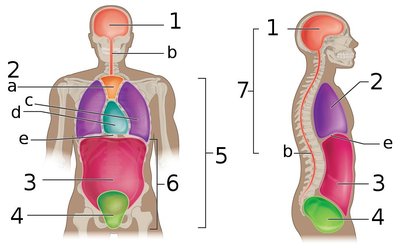
Structural Organization of the Human Body
Levels of Organization
The human body is organized into hierarchical levels, each with increasing complexity:
Chemical Level: Atoms and molecules
Cellular Level: Cells and their organelles
Tissue Level: Groups of similar cells
Organ Level: Structures composed of two or more tissue types
Organ System Level: Organs working together
Organismal Level: The complete individual
Organ Systems: There are 11 major organ systems, each with specific functions (e.g., integumentary, skeletal, muscular, nervous, endocrine, cardiovascular, lymphatic, respiratory, digestive, urinary, reproductive).
Homeostasis and Feedback Systems
Maintaining Internal Balance
Homeostasis is the maintenance of a stable internal environment. The body uses feedback systems to regulate variables such as temperature, pH, and blood glucose.
Negative Feedback: Reverses a change to maintain balance (e.g., body temperature regulation).
Positive Feedback: Enhances a change (e.g., blood clotting, labor contractions).
Components of Feedback Systems: Receptor (detects change), Control Center (processes information), Effector (produces response).
Metabolism and Chemical Reactions
Types of Metabolic Reactions
Metabolism is the sum of all chemical reactions in the body. It includes:
Anabolism: Building complex molecules from simpler ones (requires energy).
Catabolism: Breaking down complex molecules into simpler ones (releases energy).
Redox Reactions: Involve the transfer of electrons; oxidation (loss of electrons), reduction (gain of electrons).
Chemical Bonds and Enzymes
Chemical Bonds: Ionic (transfer of electrons), Covalent (sharing electrons), Hydrogen bonds (weak attractions between polar molecules).
Enzymes: Biological catalysts that speed up reactions by lowering activation energy. They are specific to substrates and can be affected by temperature, pH, and concentration.
Factors Affecting Reaction Rates
Temperature, concentration of reactants, presence of catalysts (enzymes), and surface area.
Types of Body Energy
Chemical Energy: Stored in bonds of molecules (e.g., ATP).
Electrical Energy: Movement of charged particles (e.g., nerve impulses).
Mechanical Energy: Directly involved in moving matter (e.g., muscle contraction).
Radiant Energy: Energy that travels in waves (e.g., light).
pH, Acids, and Bases
pH Scale: Measures hydrogen ion concentration; ranges from 0 (acidic) to 14 (basic), with 7 as neutral.
Acids: Release H+ ions in solution.
Bases: Accept H+ ions or release OH- ions.
The Cell Cycle and Mitosis
Phases of the Cell Cycle
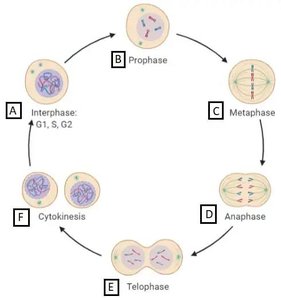
The cell cycle consists of interphase (G1, S, G2) and mitosis (prophase, metaphase, anaphase, telophase), followed by cytokinesis.
Interphase: Cell grows and DNA replicates.
Mitosis: Division of the nucleus into two identical nuclei.
Cytokinesis: Division of the cytoplasm, forming two daughter cells.
DNA, RNA, ATP, and Protein Synthesis
Genetic Material and Protein Synthesis
DNA: Double helix structure; contains genes (segments coding for proteins). Chromosomes are condensed DNA; chromatin is uncondensed; chromatids are duplicated chromosomes.
RNA: Single-stranded; involved in protein synthesis (mRNA, tRNA, rRNA).
ATP (Adenosine Triphosphate): Main energy currency of the cell.
Protein Synthesis: Involves transcription (DNA to mRNA) and translation (mRNA to protein). The genetic code is read in triplets called codons.
Cell Organelles and Functions
Major Cell Structures
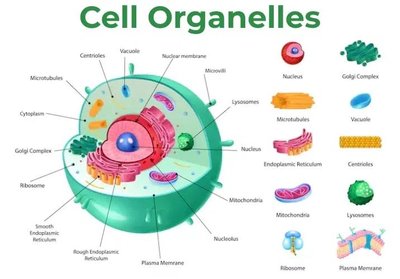
Cells contain specialized structures called organelles, each with unique functions:
Nucleus: Contains genetic material and controls cell activities.
Mitochondria: Site of ATP production (cellular respiration).
Endoplasmic Reticulum (ER): Rough ER synthesizes proteins; Smooth ER synthesizes lipids and detoxifies.
Golgi Apparatus: Modifies, sorts, and packages proteins and lipids.
Lysosomes: Digest cellular waste.
Ribosomes: Sites of protein synthesis.
Centrioles: Involved in cell division.
The Plasma Membrane
Structure and Composition
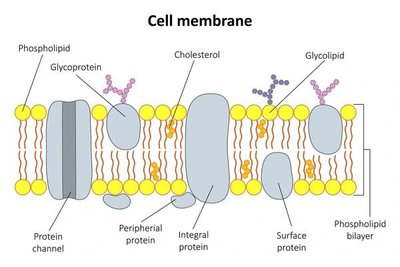
The plasma membrane is a selectively permeable barrier composed of a phospholipid bilayer with embedded proteins, cholesterol, and carbohydrates.
Phospholipid Bilayer: Hydrophilic heads face outward; hydrophobic tails face inward.
Proteins: Integral (span the membrane) and peripheral (attached to surface); function as channels, receptors, enzymes.
Carbohydrates: Glycoproteins and glycolipids involved in cell recognition.
Cholesterol: Stabilizes membrane fluidity.
Body Solutions, Tonicity, and Transport
Types of Body Solutions and Tonicity
Isotonic: Same solute concentration as the cell; no net water movement.
Hypotonic: Lower solute concentration than the cell; water enters cell (may burst).
Hypertonic: Higher solute concentration than the cell; water leaves cell (shrinks).
Transport Mechanisms
Passive Transport: No energy required; includes diffusion (movement from high to low concentration), osmosis (diffusion of water), and facilitated diffusion (via protein channels).
Active Transport: Requires energy (ATP); moves substances against concentration gradient (e.g., sodium-potassium pump).
Cell Shapes, Tissues, Glands, and Membranes
Cell Shapes
Cells vary in shape: squamous (flat), cuboidal (cube-shaped), columnar (tall), etc.
Four Types of Tissues
Epithelial Tissue: Covers surfaces, lines cavities, forms glands.
Connective Tissue: Supports, binds, and protects organs (e.g., bone, blood, fat).
Muscle Tissue: Produces movement (skeletal, cardiac, smooth).
Nervous Tissue: Conducts electrical impulses (neurons and neuroglia).
Locations: Epithelial (skin, lining of GI tract), Connective (tendons, fat), Muscle (heart, skeletal muscles), Nervous (brain, nerves).
Glands
Exocrine Glands: Secrete products into ducts (e.g., sweat, salivary glands).
Endocrine Glands: Secrete hormones into the bloodstream (e.g., thyroid, pituitary).
Body Membranes
True Membranes: Serous, mucous, cutaneous, synovial membranes.
Membrane-like Structures: Meninges, periosteum, perichondrium.
