 Back
Exam 1 Review: Introduction to Anatomy, Physiology, Chemistry of Life, Cells, and Histology
Study Guide - Smart Notes
 Tailored notes based on your materials, expanded with key definitions, examples, and context.
Body Directions, Planes, and Anatomical Terms
Anatomical Position and Terminology
The anatomical position is a standardized posture used to describe locations and directions on the human body. Understanding anatomical terms is essential for accurately describing body parts and their relationships.
Anatomical Position: Standing upright, facing forward, arms at sides, palms facing forward.
Directional Terms:
Proximal: Closer to the point of attachment or origin.
Distal: Farther from the point of attachment or origin.
Lateral: Away from the midline of the body.
Medial: Toward the midline of the body.
Superior: Above or toward the head.
Inferior: Below or toward the feet.
Body Planes:
Frontal (Coronal) Plane: Divides the body into anterior and posterior sections.
Sagittal Plane: Divides the body into left and right sections.
Transverse Plane: Divides the body into superior and inferior sections.
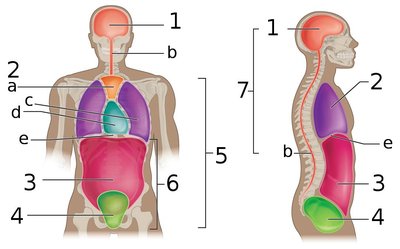
Structural Organization of the Human Body
Levels of Organization
The human body is organized into hierarchical levels, each with increasing complexity.
Chemical Level: Atoms and molecules (e.g., water, proteins).
Cellular Level: Cells are the basic unit of life.
Tissue Level: Groups of similar cells performing a common function.
Organ Level: Structures composed of two or more tissue types.
Organ System Level: Groups of organs working together (e.g., digestive system).
Organism Level: The complete living being.
Homeostasis and Feedback Systems
Maintaining Internal Balance
Homeostasis is the process by which the body maintains a stable internal environment. Feedback systems regulate physiological processes.
Negative Feedback: Reverses a change to maintain equilibrium (e.g., temperature regulation).
Positive Feedback: Enhances a change (e.g., blood clotting).
Components:
Receptor: Detects changes.
Control Center: Processes information and directs response.
Effector: Carries out the response.
Systems of the Human Body and Their Functions
Overview of Organ Systems
The human body consists of several organ systems, each with specific functions.
Integumentary System: Protects the body, regulates temperature.
Skeletal System: Supports and protects organs, enables movement.
Muscular System: Produces movement, maintains posture.
Nervous System: Controls responses, processes information.
Endocrine System: Regulates processes via hormones.
Cardiovascular System: Transports blood, nutrients, gases.
Lymphatic System: Defends against infection.
Respiratory System: Facilitates gas exchange.
Digestive System: Breaks down food, absorbs nutrients.
Urinary System: Removes waste, regulates water balance.
Reproductive System: Produces offspring.
The Chemistry of Life
Metabolism: Catabolic and Anabolic Reactions
Metabolism encompasses all chemical reactions in the body, divided into catabolic and anabolic processes.
Catabolic Reactions: Break down molecules, releasing energy.
Anabolic Reactions: Build complex molecules, requiring energy.
Redox Reactions: Involve transfer of electrons; oxidation (loss), reduction (gain).
Types of Chemical Bonds
Chemical bonds hold atoms together in molecules.
Ionic Bonds: Transfer of electrons between atoms.
Covalent Bonds: Sharing of electrons.
Hydrogen Bonds: Weak attraction between hydrogen and electronegative atoms.
Enzymes and Reaction Rates
Enzymes are biological catalysts that speed up chemical reactions by lowering activation energy.
Function: Facilitate reactions without being consumed.
Rate-Limiting Factors:
Temperature
pH
Substrate concentration
Enzyme concentration
Types of Body Energy
The body uses various forms of energy for physiological processes.
Chemical Energy: Stored in bonds of molecules.
Electrical Energy: Movement of charged particles.
Mechanical Energy: Physical movement.
Thermal Energy: Heat produced by metabolism.
pH, Acids, and Bases
pH measures the concentration of hydrogen ions in a solution.
Acids: Release H+ ions; pH < 7.
Bases: Accept H+ ions; pH > 7.
Neutral: pH = 7.
The Cell
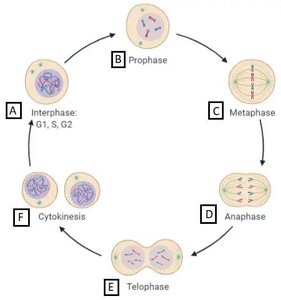
Cell Cycle and Mitotic Phases
The cell cycle describes the sequence of events in cell growth and division, including mitosis.
Interphase: Cell grows and replicates DNA (G1, S, G2).
Prophase: Chromosomes condense, spindle forms.
Metaphase: Chromosomes align at the cell equator.
Anaphase: Sister chromatids separate.
Telophase: Nuclear membranes reform.
Cytokinesis: Cytoplasm divides, forming two cells.
DNA, Chromosomes, Chromatin, Chromatid
DNA is the genetic material organized into chromosomes, chromatin, and chromatids.
DNA: Double helix structure, stores genetic information.
Chromosomes: Condensed DNA during cell division.
Chromatin: Loosely packed DNA in the nucleus.
Chromatid: One half of a duplicated chromosome.
RNA and ATP
RNA and ATP are essential molecules for cellular function.
RNA: Single-stranded, involved in protein synthesis.
ATP (Adenosine Triphosphate): Main energy carrier in cells.
Genes and Protein Synthesis
Genes encode instructions for protein synthesis, which occurs in two main phases.
Transcription: DNA is copied into mRNA.
Translation: mRNA is decoded to build proteins.
Genetic Code: Codons (three-base sequences) specify amino acids.
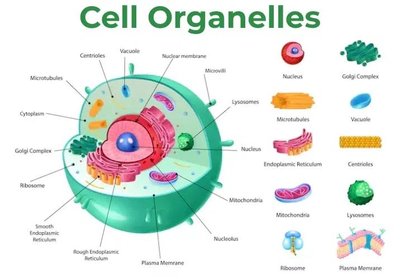
Cell Organelles and Their Functions
Cell organelles perform specialized functions necessary for cell survival.
Nucleus: Contains genetic material.
Mitochondria: Produce ATP via cellular respiration.
Ribosomes: Synthesize proteins.
Endoplasmic Reticulum (ER):
Rough ER: Protein synthesis.
Smooth ER: Lipid synthesis.
Golgi Apparatus: Modifies, sorts, and packages proteins.
Lysosomes: Digest cellular waste.
Centrioles: Organize cell division.
Vacuoles: Store substances.
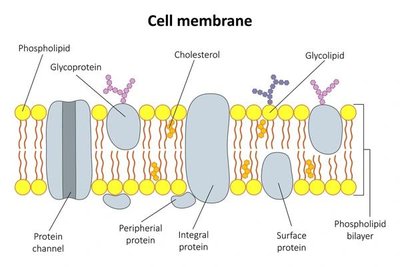
The Plasma Membrane
Composition and Structure
The plasma membrane is a selectively permeable barrier composed of lipids and proteins.
Phospholipid Bilayer: Provides structural foundation.
Proteins: Channels, carriers, receptors, enzymes.
Cholesterol: Stabilizes membrane fluidity.
Glycoproteins and Glycolipids: Cell recognition and signaling.
Types of Body Solutions and Tonicity
Solution Types and Effects on Cells
Body solutions are classified based on solute concentration relative to cells.
Isotonic: Equal solute concentration; no net water movement.
Hypertonic: Higher solute concentration; cells lose water.
Hypotonic: Lower solute concentration; cells gain water.
Tonicity and Transport Mechanisms
Tonicity affects cell volume and function. Transport across membranes occurs via passive and active mechanisms.
Passive Transport: No energy required (diffusion, osmosis).
Active Transport: Requires energy (ATP) to move substances against concentration gradients.
Diffusion: Movement of molecules from high to low concentration.
Osmosis: Movement of water across a membrane.
Cell Shapes and Types of Tissues
Cell Shapes
Cells vary in shape depending on their function (e.g., squamous, cuboidal, columnar).
Four Types of Tissues
The human body contains four primary tissue types, each with distinct locations and functions.
Epithelial Tissue: Covers surfaces, lines cavities, forms glands.
Connective Tissue: Supports, protects, binds other tissues.
Muscle Tissue: Produces movement.
Nervous Tissue: Conducts electrical impulses.
Tissue Type | Location | Function |
|---|---|---|
Epithelial | Skin, lining of organs | Protection, absorption |
Connective | Bone, blood, cartilage | Support, transport |
Muscle | Muscles, heart | Movement |
Nervous | Brain, nerves | Communication |
Glands and Body Membranes
Types of Glands
Glands are specialized epithelial structures that secrete substances.
Exocrine Glands: Secrete into ducts (e.g., sweat, salivary glands).
Endocrine Glands: Secrete hormones directly into the bloodstream.
Body Membranes
Body membranes cover surfaces, line cavities, and form protective barriers.
True Membranes:
Mucous Membranes: Line cavities open to exterior.
Serous Membranes: Line closed cavities, secrete fluid.
Cutaneous Membrane: Skin.
Membrane-like Structures:
Synovial Membranes: Line joint cavities.
Key Equations and Concepts
Sample Equations
ATP Hydrolysis:
Diffusion Rate:
pH Calculation:
Additional info: Academic context and examples were added to clarify and expand brief points from the original review sheet.
