 Back
Exam 1 Study Guide – ANP College Course Step-by-Step Guidance
Study Guide - Smart Notes
 Tailored notes based on your materials, expanded with key definitions, examples, and context.
Q5. List the components of a feedback loop and explain the function of each.
Background
Topic: Homeostasis and Feedback Mechanisms
This question tests your understanding of how the body maintains stable internal conditions (homeostasis) through feedback loops, which are fundamental in physiology.
Key Terms:
Feedback loop: A system that helps maintain homeostasis by monitoring and adjusting physiological variables.
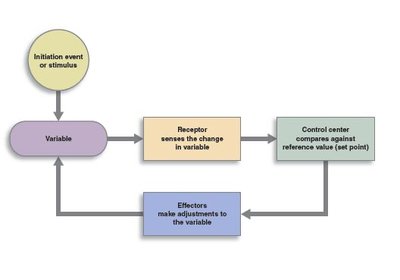
Components: Stimulus, Variable, Receptor, Control Center, Effector.
Key Concept:
Feedback loops can be negative (counteract changes) or positive (amplify changes).
Step-by-Step Guidance
Identify the stimulus or initiation event that triggers a change in a regulated variable (e.g., temperature, blood glucose).
Recognize the variable being regulated (such as body temperature or blood pressure).
Describe the role of the receptor: it senses the change in the variable and sends information to the control center.
Explain the function of the control center: it compares the information from the receptor to a reference value (set point) and determines the appropriate response.
Discuss the effector: it receives instructions from the control center and makes adjustments to the variable to restore balance.
Try solving on your own before revealing the answer!
Final Answer:
The components of a feedback loop are: stimulus, variable, receptor, control center, and effector. Each plays a distinct role in detecting changes, processing information, and making adjustments to maintain homeostasis.
The diagram above visually represents these steps, showing how information flows and adjustments are made.
Q6. Compare and contrast positive and negative feedback utilizing examples (body temperature, blood glucose, blood pressure, childbirth, breastfeeding, blood clotting).
Background
Topic: Types of Feedback Mechanisms
This question assesses your ability to distinguish between positive and negative feedback, and to apply these concepts to physiological examples.
Key Terms:
Negative feedback: A process that counteracts deviations from a set point, restoring balance.
Positive feedback: A process that amplifies a change, moving the variable further from the set point.
Key Examples:
Negative feedback: Body temperature regulation, blood glucose control, blood pressure regulation.
Positive feedback: Childbirth, breastfeeding, blood clotting.
Step-by-Step Guidance
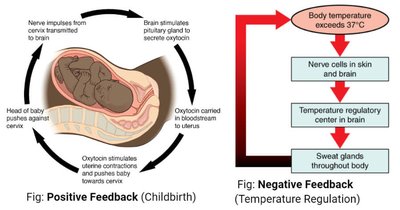
Define negative feedback and describe how it works to maintain homeostasis (e.g., temperature regulation: when body temperature rises, mechanisms activate to lower it).
Define positive feedback and explain how it amplifies a response (e.g., childbirth: contractions lead to more oxytocin release, which causes stronger contractions).
Compare the outcomes: negative feedback restores balance, positive feedback drives a process to completion.
Provide specific examples for each type, focusing on the physiological processes listed in the question.
Try solving on your own before revealing the answer!
Final Answer:
Negative feedback mechanisms (like temperature regulation and blood glucose control) counteract changes to maintain homeostasis, while positive feedback mechanisms (such as childbirth and blood clotting) amplify changes until a specific outcome is achieved.
The provided image illustrates both feedback types with clear physiological examples.
Q8. Describe the processes involved in carbohydrate metabolism.
Background
Topic: Carbohydrate Metabolism
This question tests your understanding of how carbohydrates are broken down and utilized in the body to produce energy.
Key Terms and Pathways:
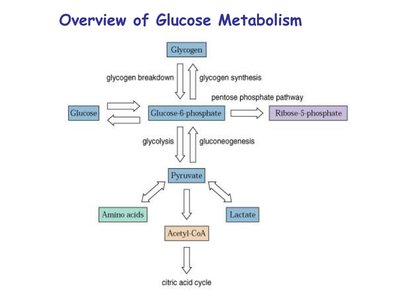
Glycolysis: Breakdown of glucose to pyruvate.
Glycogenolysis: Breakdown of glycogen to glucose.
Gluconeogenesis: Formation of glucose from non-carbohydrate sources.
Citric acid cycle (Krebs cycle): Further breakdown of pyruvate to produce ATP.
Electron transport chain: Final stage of energy production.
Step-by-Step Guidance
Start with the intake of carbohydrates and their conversion to glucose in the digestive system.
Describe how glucose enters cells and is metabolized via glycolysis to produce pyruvate.
Explain the fate of pyruvate: it can enter the citric acid cycle or be converted to lactate under anaerobic conditions.
Discuss how glycogen stores are mobilized (glycogenolysis) and how new glucose can be synthesized (gluconeogenesis).
Try solving on your own before revealing the answer!
Final Answer:
Carbohydrate metabolism involves glycolysis, glycogenolysis, gluconeogenesis, the citric acid cycle, and the electron transport chain. These processes collectively convert carbohydrates into usable energy for the body.
The diagram above summarizes the key pathways and intermediates involved.
Q2. List the four major tissue types.
Background
Topic: Histology – Tissue Types
This question tests your knowledge of the basic structural categories of tissues in the human body.
Key Terms:
Histology: The study of tissues.
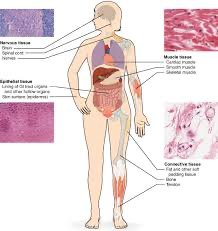
Major tissue types: Epithelial, connective, muscle, nervous.
Step-by-Step Guidance
Recall the four major tissue types found in the human body.
Briefly describe the primary function of each tissue type.
Identify where each tissue type is commonly found in the body.
Try solving on your own before revealing the answer!
Final Answer:
The four major tissue types are epithelial, connective, muscle, and nervous tissue. Each has distinct functions and locations in the body, as shown in the image.
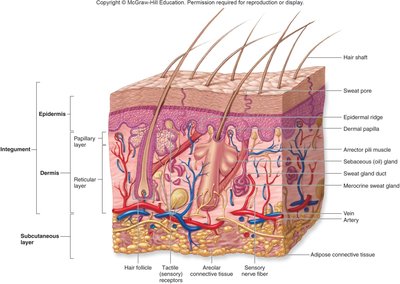
Q3. Identify and describe the dermis and its layers, including the tissue types making up each dermal layer.
Background
Topic: Integumentary System – Dermis Structure
This question tests your understanding of the anatomy and physiology of the dermis, a key layer of the skin.
Key Terms:
Dermis: The middle layer of the skin, beneath the epidermis.
Papillary layer: Superficial layer of the dermis, composed of loose connective tissue.
Reticular layer: Deeper layer of the dermis, composed of dense irregular connective tissue.
Step-by-Step Guidance
Identify the two main layers of the dermis: papillary and reticular.
Describe the tissue types found in each layer (papillary: areolar connective tissue; reticular: dense irregular connective tissue).
Explain the functions of each layer and how they contribute to skin structure and function.
Try solving on your own before revealing the answer!
Final Answer:
The dermis consists of the papillary layer (areolar connective tissue) and the reticular layer (dense irregular connective tissue). Each layer has distinct structural and functional roles, as illustrated in the image.
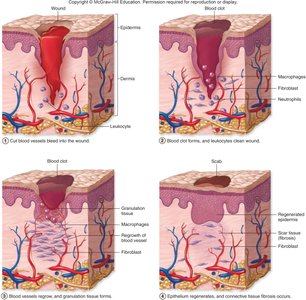
Q17. Steps in wound healing – repair vs regeneration, fibrosis.
Background
Topic: Integumentary System – Wound Healing
This question tests your understanding of the processes involved in skin repair, including regeneration and fibrosis.
Key Terms:
Repair: Restoration of tissue structure and function after injury.
Regeneration: Replacement of damaged cells with identical cells.
Fibrosis: Formation of scar tissue.
Step-by-Step Guidance
Describe the initial response to injury (blood clot formation and inflammation).
Explain the process of tissue regeneration and the role of epithelial cells.
Discuss the formation of granulation tissue and the involvement of fibroblasts.
Contrast regeneration (restoring original tissue) with fibrosis (scar formation).
Try solving on your own before revealing the answer!
Final Answer:
Wound healing involves repair (restoring function), regeneration (replacing cells), and fibrosis (scar formation). The image shows the sequence of events in wound healing.
