 Back
Exam Practice: Survey of Anatomy and Physiology – Step-by-Step Guidance
Study Guide - Smart Notes
 Tailored notes based on your materials, expanded with key definitions, examples, and context.
Q1. Produces the hormones that promote the development of the female secondary sexual characteristics at puberty.
Background
Topic: Endocrine System – Hormones and Glands
This question tests your understanding of the endocrine glands responsible for sexual development, specifically those that secrete hormones influencing female secondary sexual characteristics.
Key Terms and Concepts:
Secondary sexual characteristics: Features that appear during puberty, such as breast development and wider hips in females.
Estrogen: The primary hormone responsible for female secondary sexual characteristics.
Ovaries: The glands that produce estrogen in females.
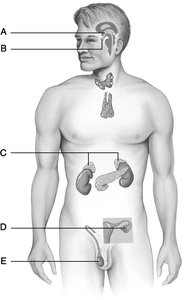
Step-by-Step Guidance
Examine the labeled diagram and identify the location of the female reproductive organs.
Recall which gland in the female reproductive system produces estrogen.
Match the correct label from the diagram to the gland responsible for estrogen production.
Try solving on your own before revealing the answer!
Q2. Produces the hormones that direct the production of the secondary male sex characteristics.
Background
Topic: Endocrine System – Hormones and Glands
This question focuses on the gland responsible for producing hormones that lead to male secondary sexual characteristics, such as facial hair and a deeper voice.
Key Terms and Concepts:
Secondary male sex characteristics: Traits like increased muscle mass, body hair, and voice changes.
Testosterone: The main hormone responsible for these changes.
Testes: The glands that produce testosterone in males.
Step-by-Step Guidance
Look at the diagram and locate the male reproductive organs.
Recall which gland produces testosterone.
Match the correct label from the diagram to the gland responsible for testosterone production.
Try solving on your own before revealing the answer!
Q3. Neutrophil (Using Figure)
Background
Topic: Blood Cells – Types and Functions
This question tests your ability to identify different types of white blood cells based on their appearance under a microscope.
Key Terms and Concepts:
Neutrophil: The most abundant type of white blood cell, characterized by a multi-lobed nucleus and fine granules.
Granulocytes: White blood cells with granules in their cytoplasm, including neutrophils, eosinophils, and basophils.
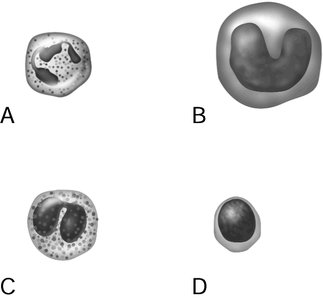
Step-by-Step Guidance
Examine the four cell images labeled A–D.
Recall the distinguishing features of a neutrophil (multi-lobed nucleus, fine granules).
Match the correct letter to the cell that fits the description of a neutrophil.
Try solving on your own before revealing the answer!
Q4. Eosinophil (Using Figure)
Background
Topic: Blood Cells – Types and Functions
This question asks you to identify an eosinophil, a type of white blood cell involved in allergic responses and parasitic infections.
Key Terms and Concepts:
Eosinophil: A white blood cell with a bi-lobed nucleus and large, red-orange granules in the cytoplasm.
Step-by-Step Guidance
Review the cell images labeled A–D.
Recall the appearance of an eosinophil (bi-lobed nucleus, prominent granules).
Match the correct letter to the cell that fits the description of an eosinophil.
Try solving on your own before revealing the answer!
