 Back
Female Reproductive System: Oogenesis, Ovarian and Uterine Cycles, and Hormonal Regulation
Study Guide - Smart Notes
 Tailored notes based on your materials, expanded with key definitions, examples, and context.
Female Reproductive System
Overview
The female reproductive system is responsible for the production of female gametes (oocytes), the secretion of sex hormones, and the support of embryonic and fetal development. This system undergoes complex cycles of development, maturation, and hormonal regulation throughout a woman's life.
Oogenesis and Follicle Development
Oogenesis: Formation of Female Gametes
Oogenesis is the process by which female gametes, or ova, are produced in the ovaries. This process begins before birth and continues until menopause, involving several stages of cell division and differentiation.
Oogonia undergo mitosis during fetal development, producing primary oocytes.
Primary oocytes begin meiosis I but arrest in prophase I until puberty.
At birth, each ovary contains 2-4 million primary oocytes, but many degenerate before puberty.
Only about 400-500 oocytes are ovulated during a woman's reproductive years.

Stages of Oogenesis
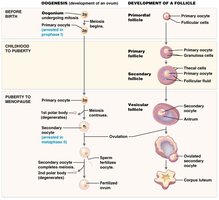
Before Birth: Oogonia undergo mitosis and become primary oocytes, which are arrested in prophase I of meiosis.
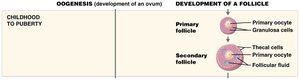
Childhood to Puberty: Primary oocytes remain arrested in prophase I. Follicular development continues, forming primary and secondary follicles.
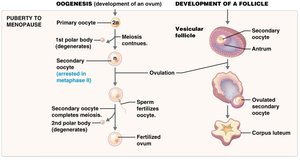
Puberty to Menopause: Each month, a cohort of primary oocytes resumes meiosis. One typically completes meiosis I, forming a secondary oocyte and a first polar body. The secondary oocyte arrests in metaphase II and is ovulated. Meiosis II is completed only if fertilization occurs.
Follicle Development
Oocytes develop within ovarian follicles, which mature through several stages:
Primordial Follicle: Formed before birth, consists of a primary oocyte surrounded by a single layer of squamous follicular cells.
Primary Follicle: Follicular cells become cuboidal granulosa cells; zona pellucida forms.
Secondary Follicle: Multiple layers of granulosa cells, formation of thecal cells, and secretion of follicular fluid.
Vesicular (Tertiary) Follicle: Large antrum forms; primary oocyte completes meiosis I to become a secondary oocyte.
Spermatogenesis vs. Oogenesis
The processes of gamete formation in males and females differ significantly:
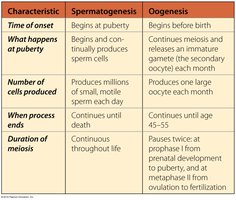
Characteristic | Spermatogenesis | Oogenesis |
|---|---|---|
Time of onset | Begins at puberty | Begins before birth |
What happens at puberty | Continual sperm production | Meiosis resumes, one oocyte matures each month |
Number of cells produced | Millions of sperm daily | One large oocyte per cycle |
When process ends | Continues until death | Ends at menopause (age 45-55) |
Duration of meiosis | Continuous | Pauses twice: at prophase I (before birth) and metaphase II (until fertilization) |
Ovarian Cycle
Phases of the Ovarian Cycle
The ovarian cycle describes the monthly changes in the ovary associated with oocyte maturation and follicle development. It is divided into three main phases:
Follicular Phase (Days 1-14): Follicles grow and mature; primary oocyte completes meiosis I.
Ovulation (Day 14): Vesicular follicle ruptures, releasing the secondary oocyte surrounded by the corona radiata.
Luteal Phase (Days 15-28): Ruptured follicle becomes the corpus luteum, which secretes progesterone and estrogen. If no fertilization, it degenerates into the corpus albicans.
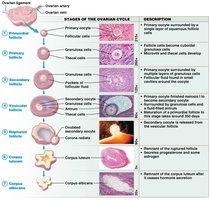
Stages of Follicular Development
Stage 1: Primordial Follicle – Primary oocyte with squamous follicular cells.
Stage 2: Primary Follicle – Granulosa cells become cuboidal; zona pellucida forms.
Stage 3: Secondary Follicle – Multiple granulosa layers, thecal cells, and follicular fluid.
Stage 4: Vesicular Follicle – Large antrum, oocyte completes meiosis I.
Stage 5: Ruptured Follicle – Ovulation occurs, releasing the secondary oocyte.
Stage 6: Corpus Luteum – Secretes hormones to maintain pregnancy if fertilization occurs.
Stage 7: Corpus Albicans – Scar tissue forms if no pregnancy.
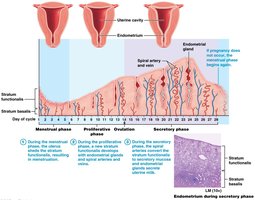
Hormonal Regulation of the Ovarian Cycle
Hormonal Interactions
The ovarian cycle is regulated by a complex interplay of hormones from the hypothalamus, anterior pituitary, and ovaries:
First Tier: Hypothalamus releases gonadotropin-releasing hormone (GnRH).
Second Tier: Anterior pituitary releases follicle-stimulating hormone (FSH) and luteinizing hormone (LH).
Third Tier: Ovarian follicles secrete estrogens and inhibin; corpus luteum secretes progesterone.
Feedback: Estrogen and progesterone exert negative and positive feedback on the hypothalamus and pituitary to regulate the cycle.
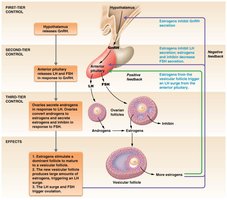
Uterine (Menstrual) Cycle
Phases of the Uterine Cycle
The uterine cycle describes the cyclic changes in the endometrium in response to ovarian hormones. It consists of three phases:
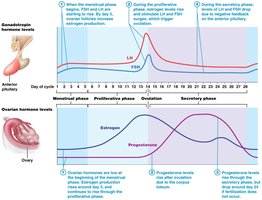
Menstrual Phase (Days 1-5): Shedding of the stratum functionalis layer of the endometrium.
Proliferative (Pre-ovulatory) Phase (Days 6-14): Regeneration and thickening of the endometrium; endometrial glands and blood vessels proliferate.
Secretory (Post-ovulatory) Phase (Days 15-28): Endometrial glands secrete glycogen-rich fluid (uterine milk) to nourish a potential embryo. If no pregnancy, the stratum functionalis degenerates, leading to menstruation.
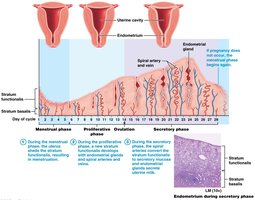
Hormonal Regulation of the Uterine Cycle
Hormonal fluctuations coordinate the uterine cycle with the ovarian cycle:
FSH and LH rise at the start of the menstrual phase, stimulating follicular development and estrogen production.
Estrogen promotes proliferation of the endometrium and triggers the LH surge for ovulation.
Progesterone from the corpus luteum maintains the secretory phase; its decline triggers menstruation if no pregnancy occurs.
If fertilization occurs, human chorionic gonadotropin (hCG) maintains the corpus luteum and progesterone production.
Female Sexual Response and Puberty
Female Sexual Response
Engorgement of vaginal mucosa, vestibule, and breasts with blood.
Clitoris and nipples become erect; lubrication of the vestibule occurs.
No ejaculation or refractory period as in males; uterine and cervical contractions assist sperm movement.
Puberty and Secondary Sex Characteristics
Puberty begins between ages 9 and 11, marked by increased GnRH secretion.
Development of breasts, pubic and axillary hair, increased adipose tissue, and widening of the pelvis.
Menarche (first menstruation) requires adequate body fat and leptin secretion.
Effects of Aging: Menopause
Menopause and Climacteric
Menopause is defined as the cessation of menstruation for more than one year, typically occurring in the late 40s or early 50s.
The climacteric is the transitional period of irregular cycles leading up to menopause.
Major Reproductive Hormones
Summary Table of Key Hormones
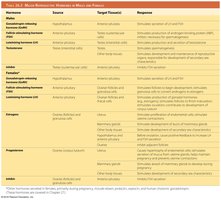
Hormone | Source | Target Tissue(s) | Response |
|---|---|---|---|
GnRH | Hypothalamus | Anterior pituitary | Stimulates release of FSH and LH |
FSH | Anterior pituitary | Ovarian follicles | Stimulates follicle growth and estrogen production |
LH | Anterior pituitary | Ovarian follicles, corpus luteum | Triggers ovulation and corpus luteum formation |
Estrogen | Ovarian follicles, corpus luteum | Uterus, breasts, other tissues | Promotes endometrial growth, secondary sex characteristics |
Progesterone | Corpus luteum | Uterus, breasts | Maintains endometrium, prepares breasts for lactation |
hCG | Embryo (if fertilization) | Corpus luteum | Maintains corpus luteum and progesterone production |
Additional info: The above notes integrate and expand upon the provided lecture content, ensuring a comprehensive and academically robust overview suitable for ANP college students.
