Back
Female Reproductive System: Oogenesis, Ovarian and Uterine Cycles, and Hormonal Regulation
Study Guide - Smart Notes
 Tailored notes based on your materials, expanded with key definitions, examples, and context.
Female Reproductive System
Overview
The female reproductive system is responsible for the production of female gametes (oocytes), the secretion of sex hormones, and the support of embryonic and fetal development. This system undergoes complex cycles of development, maturation, and hormonal regulation throughout a woman's life.
Oogenesis and Follicle Development
Oogenesis: Formation of Female Gametes
Oogenesis is the process by which female gametes, or ova, are produced in the ovaries. This process begins before birth and continues until menopause, involving several stages of cell division and differentiation.
Oogonia: Stem cells that undergo mitosis during fetal development to produce primary oocytes.
Primary Oocytes: Enter meiosis I and become arrested in prophase I before birth. At birth, each ovary contains 2-4 million primary oocytes, but many degenerate before puberty.
Meiotic Arrest: Primary oocytes remain in prophase I until puberty.
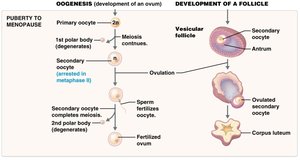
Ovulation: Each month after puberty, a cohort of primary oocytes resumes meiosis. Only one typically completes the first meiotic division, producing a secondary oocyte and a polar body.
Secondary Oocyte: Begins meiosis II and is arrested in metaphase II. Meiosis II is completed only if fertilization occurs, resulting in a second polar body and a fertilized ovum.

Follicle Development
Oocytes develop within ovarian follicles, which mature through several stages:
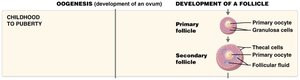
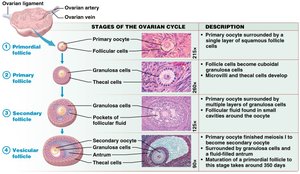
Primordial Follicle: Formed before birth, consists of a primary oocyte surrounded by a single layer of squamous follicular cells.
Primary Follicle: Follicular cells become cuboidal granulosa cells; microvilli and the zona pellucida form.
Secondary Follicle: Follicle wall thickens, granulosa cells secrete follicular fluid, and thecal cells develop to produce estrogen.
Vesicular (Tertiary) Follicle: Contains a large antrum; the primary oocyte completes meiosis I to become a secondary oocyte, which is arrested in metaphase II.
Ovarian Cycle
The ovarian cycle describes the monthly changes in the ovary associated with oocyte and follicle maturation. It is divided into three phases:
Follicular Phase (Stages 1-4): Growth and development of follicles from primordial to vesicular stage.
Ovulation (Stage 5): Release of the secondary oocyte from the vesicular follicle.
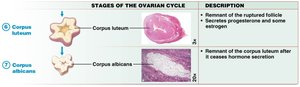
Luteal Phase (Stages 6-7): Formation of the corpus luteum, which secretes hormones, and its eventual degeneration into the corpus albicans if fertilization does not occur.

Spermatogenesis versus Oogenesis
Comparison Table
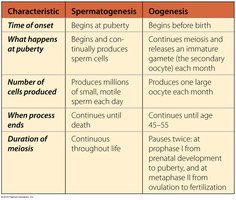
Spermatogenesis and oogenesis are both forms of gametogenesis but differ in timing, process, and outcomes.
Characteristic | Spermatogenesis | Oogenesis |
|---|---|---|
Time of onset | Begins at puberty | Begins before birth |
What happens at puberty | Begins and continually produces sperm cells | Continues meiosis and releases an immature gamete (secondary oocyte) each month |
Number of cells produced | Produces millions of small, motile sperm each day | Produces one large oocyte each month |
When process ends | Continues until death | Continues until age 45-55 |
Duration of meiosis | Continuous throughout life | Pauses twice: at prophase I from prenatal development to ovulation, and at metaphase II from ovulation to fertilization |
Hormonal Regulation of the Ovarian Cycle
Hormonal Interactions
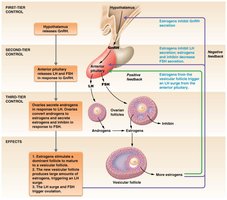
The ovarian cycle is regulated by a complex interplay of hormones from the hypothalamus, anterior pituitary, and ovaries:
First Tier: Hypothalamus releases gonadotropin-releasing hormone (GnRH).
Second Tier: Anterior pituitary releases follicle-stimulating hormone (FSH) and luteinizing hormone (LH).
Third Tier: Ovarian follicles secrete estrogens and inhibin; the corpus luteum secretes progesterone and estrogen.
Feedback Mechanisms: Estrogen and inhibin exert negative feedback on the hypothalamus and pituitary; high estrogen levels trigger a positive feedback loop leading to the LH surge and ovulation.
Uterine (Menstrual) Cycle
Phases of the Uterine Cycle
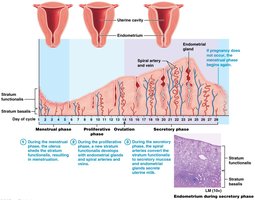
The uterine cycle describes the cyclic changes in the endometrial lining of the uterus, preparing it for possible implantation of an embryo. It consists of three main phases:
Menstrual Phase (Days 1-5): Shedding of the stratum functionalis, resulting in menstrual bleeding.
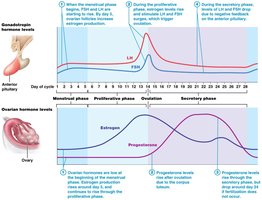
Proliferative (Pre-ovulatory) Phase (Days 6-14): Regeneration and thickening of the stratum functionalis under the influence of estrogen; endometrial glands and blood vessels proliferate.
Secretory (Post-ovulatory) Phase (Days 15-28): Stratum functionalis becomes secretory mucosa; endometrial glands secrete glycogen-rich uterine milk to nourish a potential embryo. If no pregnancy occurs, the cycle restarts.
Hormonal Regulation of the Uterine Cycle
Hormonal fluctuations coordinate the uterine cycle with the ovarian cycle:
FSH and LH rise at the start of the menstrual phase, stimulating follicular development and estrogen production.
Estrogen induces proliferation of the endometrium and triggers the LH surge for ovulation.
Progesterone from the corpus luteum maintains the secretory phase and inhibits FSH and LH release.
If fertilization does not occur, progesterone levels fall, leading to the breakdown of the endometrium and onset of menstruation.
If fertilization occurs, human chorionic gonadotropin (hCG) from the embryo maintains the corpus luteum and progesterone production.
Female Sexual Response and Puberty
Sexual Response
Engorgement of vaginal mucosa, vestibule, and breasts with blood.
Clitoris and nipples become erect; lubrication of the vestibule occurs.
No ejaculation or refractory period as in males; uterine and cervical contractions help move semen deeper into the vagina.
Puberty and Secondary Sex Characteristics
Puberty begins between ages 9 and 11, marked by increased GnRH secretion.
Development of breasts, pubic and axillary hair, increased adipose tissue, and widening of the pelvis.
Menarche (first menstrual bleeding) requires sufficient body fat and leptin secretion.
Effects of Aging: Menopause
Menopause and Climacteric
Menopause is defined as the cessation of menstruation for more than one year, typically occurring in the late 40s or early 50s.
The period of irregular cycles leading up to menopause is called the female climacteric.
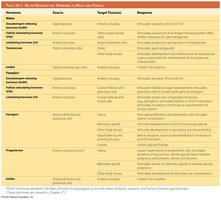
Major Reproductive Hormones
Summary Table of Key Hormones
Hormone | Source | Target Tissue(s) | Response |
|---|---|---|---|
Gonadotropin-releasing hormone (GnRH) | Hypothalamus | Anterior pituitary | Stimulates release of FSH and LH |
Follicle-stimulating hormone (FSH) | Anterior pituitary | Ovarian follicles | Stimulates follicle growth and estrogen production |
Luteinizing hormone (LH) | Anterior pituitary | Ovarian follicles | Triggers ovulation and corpus luteum formation |
Estrogen | Ovarian follicles, corpus luteum | Uterus, breasts, other tissues | Stimulates endometrial growth, secondary sex characteristics |
Progesterone | Corpus luteum | Uterus, breasts | Maintains secretory endometrium, supports pregnancy |
Inhibin | Ovarian follicles | Anterior pituitary | Inhibits FSH secretion |
Human chorionic gonadotropin (hCG) | Embryo (if fertilization occurs) | Corpus luteum | Maintains corpus luteum and progesterone production |