 Back
Fertilization: Mechanisms and Cellular Events
Study Guide - Smart Notes
 Tailored notes based on your materials, expanded with key definitions, examples, and context.
Fertilization and the Formation of the Zygote
Introduction to Fertilization
Fertilization is the process by which the chromosomes of a sperm and an egg combine to form a zygote, the first cell of a new individual. This process involves several tightly regulated steps to ensure that only one sperm fertilizes the oocyte, maintaining the correct chromosome number in the resulting embryo.
Sperm Transport and Capacitation
Journey of the Sperm
Sperm Transport: Millions of sperm are deposited in the vagina during intercourse, but only a small fraction reach the oocyte due to barriers such as the acidic vaginal environment, cervical mucus, and immune defenses in the uterus.
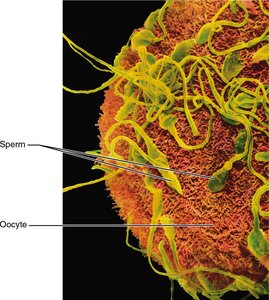
Capacitation: Before sperm can fertilize the oocyte, they must undergo capacitation, a process that enhances their motility and makes their membranes fragile enough to release acrosomal enzymes. This process takes several hours and is facilitated by secretions in the female reproductive tract that remove protective proteins and cholesterol from the sperm membrane.
Guidance Mechanisms: Sperm are guided toward the oocyte by sensing fluid flow, temperature gradients, and chemical signals released by the oocyte and its surrounding cells.
Acrosomal Reaction and Sperm Penetration
Penetrating the Oocyte
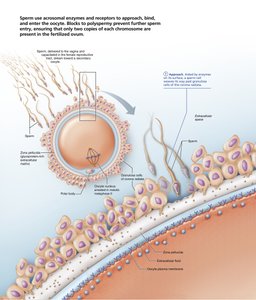
Oocyte Barriers: The oocyte is surrounded by the corona radiata and the zona pellucida, both of which must be breached for fertilization to occur.
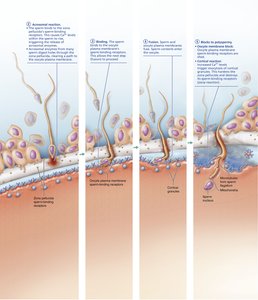
Acrosomal Reaction: When sperm reach the zona pellucida, the acrosomal reaction is triggered, releasing hydrolytic enzymes that digest a path through the zona pellucida, allowing a single sperm to reach the oocyte membrane.
Sperm Binding: The first sperm to bind to the oocyte membrane fuses with it, allowing the sperm's contents to enter the oocyte.
Blocks to Polyspermy
Ensuring Monospermy
In humans, only one sperm is allowed to fertilize the oocyte, a condition known as monospermy. If multiple sperm enter (polyspermy), the resulting embryo is not viable. Two main mechanisms prevent polyspermy:
Oocyte Membrane Block: After the first sperm fuses with the oocyte membrane, the oocyte sheds remaining sperm-binding receptors, preventing additional sperm from binding.
Cortical Reaction (Zona Reaction): Calcium waves in the oocyte trigger exocytosis of cortical granules, which release enzymes that destroy sperm-binding receptors and harden the zona pellucida, blocking further sperm entry.
Completion of Meiosis II and Pronucleus Formation
Final Steps to Zygote Formation
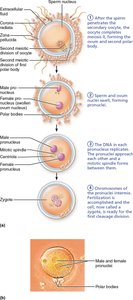
Meiosis II Completion: The entry of the sperm triggers the oocyte to complete meiosis II, forming the ovum nucleus and a second polar body.
Pronuclei Formation: The sperm nucleus swells to form the male pronucleus, while the oocyte nucleus becomes the female pronucleus. Both pronuclei replicate their DNA as they approach each other.
Fusion of Genetic Material: The membranes of the pronuclei rupture, and the chromosomes combine, forming the diploid zygote, which is now ready for its first mitotic division.
Key Terms and Concepts
Fertilization: The fusion of sperm and egg chromosomes to form a zygote.
Capacitation: The process that prepares sperm for fertilization by enhancing motility and membrane fragility.
Acrosomal Reaction: The release of enzymes from the sperm's acrosome to penetrate the oocyte's protective layers.
Monospermy: The entry of only one sperm into the oocyte, ensuring the correct chromosome number.
Polyspermy: The entry of multiple sperm, which is prevented by the oocyte membrane block and cortical reaction.
Pronucleus: The nucleus of the sperm or egg after fertilization but before fusion of their genetic material.
Zygote: The diploid cell resulting from the fusion of male and female pronuclei.
Summary Table: Steps of Fertilization
Step | Description |
|---|---|
Sperm Transport | Sperm travel through the female reproductive tract, with only a few reaching the oocyte. |
Capacitation | Sperm undergo biochemical changes to become capable of fertilizing the oocyte. |
Acrosomal Reaction | Release of enzymes to penetrate the zona pellucida. |
Sperm-Oocyte Fusion | The first sperm to reach the oocyte membrane fuses with it, delivering its genetic material. |
Blocks to Polyspermy | Mechanisms prevent additional sperm from entering the oocyte. |
Completion of Meiosis II | The oocyte completes meiosis II, forming the ovum and second polar body. |
Pronucleus Formation | Male and female pronuclei form and replicate DNA. |
Zygote Formation | Pronuclei membranes rupture, chromosomes combine, and the diploid zygote is formed. |
