 Back
Fluid, Electrolyte, and Acid-Base Balance: Structured Study Notes
Study Guide - Smart Notes
 Tailored notes based on your materials, expanded with key definitions, examples, and context.
Fluid, Electrolyte, and Acid-Base Balance
Introduction
Fluid, electrolyte, and acid-base balance are essential for maintaining homeostasis in the human body. These processes ensure that the internal environment remains stable, supporting cellular function and overall health. This chapter explores the distribution and regulation of body fluids, the roles of key electrolytes, and the mechanisms that maintain acid-base balance.
Body Fluids and Compartments
Body Water Content
Total body water varies with age, body mass, and fat content.
Infants have the highest percentage of body water due to low fat and bone mass; this declines with age.
Adult males generally have more water than females due to higher muscle mass.
Adipose tissue contains less water than other tissues.
Fluid Compartments
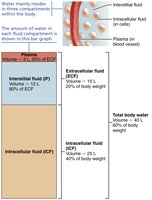
Water is distributed in two main compartments:
Intracellular fluid (ICF): Fluid within cells; about 2/3 of total body water.
Extracellular fluid (ECF): Fluid outside cells; about 1/3 of total body water.
ECF is further divided into plasma (fluid part of blood) and interstitial fluid (IF) (fluid between cells).
Composition of Body Fluids
Water is the universal solvent; solutes are classified as electrolytes or nonelectrolytes.
Electrolytes dissociate into ions in water (e.g., NaCl → Na+ + Cl-), conducting electricity and having greater osmotic power.
Nonelectrolytes (e.g., glucose, urea) do not dissociate in water.
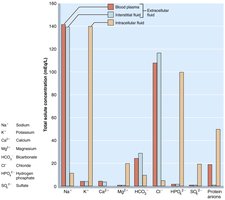
Electrolyte concentrations are expressed in milliequivalents per liter (mEq/L).
Each compartment has a unique electrolyte composition, maintained by active transport mechanisms (e.g., sodium-potassium pump).
Fluid Movement Among Compartments
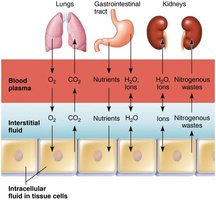
Water moves freely between compartments via osmotic gradients; solutes may be restricted by size or charge.
Exchanges between plasma and IF occur across capillary walls; exchanges between IF and ICF occur across cell membranes.
Any difference in solute concentration causes net water movement until equilibrium is restored.
Water Balance and Regulation
Water Intake and Output
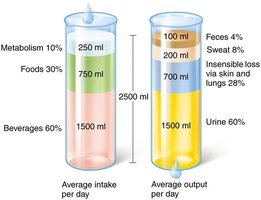
Water intake must equal water output to maintain homeostasis.
Major sources of intake: beverages, food, and metabolic water (from cellular respiration).
Major routes of output: urine, insensible loss (skin and lungs), sweat, and feces.
Regulation of Water Intake
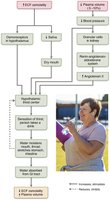
The hypothalamic thirst center controls the urge to drink, stimulated by:
Increased plasma osmolality (detected by osmoreceptors)
Dry mouth
Decreased blood volume or pressure (via angiotensin II or baroreceptor input)
Drinking water relieves thirst through feedback from the mouth and GI tract.
Regulation of Water Output
Obligatory water losses (urine, insensible loss) cannot be avoided.
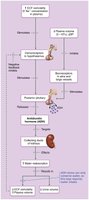
Volume and concentration of urine are regulated by antidiuretic hormone (ADH).
ADH increases water reabsorption in the kidneys, reducing urine output.
ADH release is stimulated by increased ECF osmolality or decreased blood volume/pressure.
Disorders of Water Balance
Dehydration
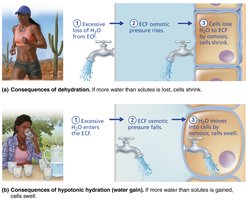
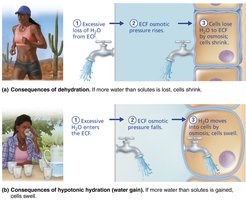
Caused by excessive loss of ECF (e.g., hemorrhage, burns, vomiting, diarrhea, sweating, water deprivation).
Symptoms: thirst, dry mouth, decreased urine output, weight loss, confusion, hypovolemic shock.
Hypotonic Hydration (Water Intoxication)
Occurs with renal insufficiency or rapid water intake.
Results in hyponatremia (low sodium), causing water to move into cells (cell swelling).
Symptoms: nausea, vomiting, muscle cramps, cerebral edema.
Edema
Accumulation of IF, causing tissue swelling (not cell swelling).
Can impair tissue function by increasing diffusion distance for nutrients and oxygen.
Electrolyte Balance
Key Electrolytes: Sodium, Potassium, Calcium, and Phosphate
Sodium (Na+): Most abundant ECF cation; regulates ECF volume, blood pressure, and water distribution.
Potassium (K+): Most abundant ICF cation; essential for membrane potential and cell excitability.
Calcium (Ca2+): Important for blood clotting, membrane permeability, and neuromuscular function.
Phosphate (HPO42-): Major ICF anion; important for buffering and bone mineralization.
Regulation of Sodium Balance
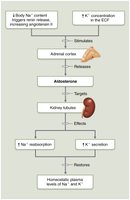
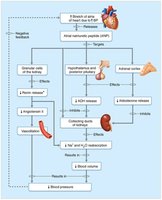
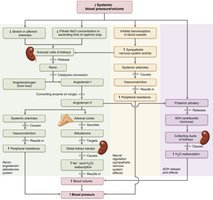
Sodium concentration is regulated by thirst and ADH (short-term) and by aldosterone and atrial natriuretic peptide (ANP) (long-term).
Aldosterone increases Na+ reabsorption in the kidneys; ANP decreases it.
Baroreceptors and hormones adjust renal handling of sodium to maintain blood pressure and volume.
Regulation of Potassium Balance
Potassium balance is regulated in the distal convoluted tubule (DCT) and collecting duct of the nephron.
High ECF K+ increases secretion; low ECF K+ decreases secretion.
Aldosterone stimulates K+ secretion and Na+ reabsorption.
Regulation of Calcium and Phosphate Balance
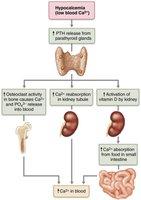
Parathyroid hormone (PTH) increases ECF Ca2+ by stimulating bone resorption, increasing renal reabsorption, and activating vitamin D for increased intestinal absorption.
PTH decreases phosphate reabsorption in the kidneys.
Acid-Base Balance
pH and Buffer Systems
Normal arterial blood pH: 7.35–7.45.
Acidosis: pH < 7.35; Alkalosis: pH > 7.45.
Buffer systems resist changes in pH:
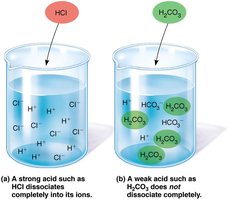
Bicarbonate buffer system: Main ECF buffer; involves H2CO3 and HCO3-.
Phosphate buffer system: Important in urine and ICF.
Protein buffer system: Most abundant in ICF; proteins act as weak acids or bases.
Respiratory Regulation of Acid-Base Balance
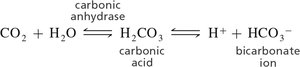
The respiratory system regulates blood pH by controlling CO2 exhalation.
CO2 + H2O ↔ H2CO3 ↔ H+ + HCO3-
Increased ventilation removes CO2, raising pH; decreased ventilation retains CO2, lowering pH.
Renal Regulation of Acid-Base Balance
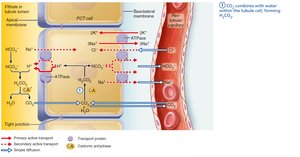
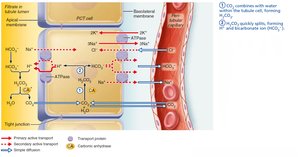
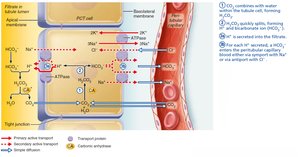
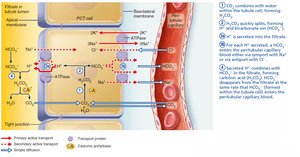
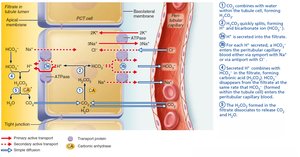
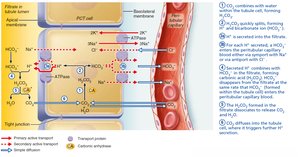
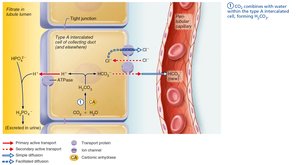
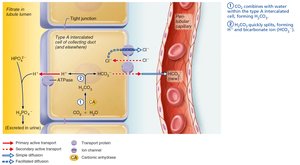
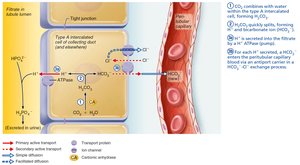
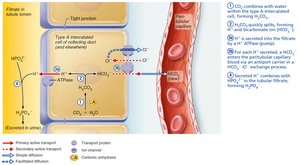
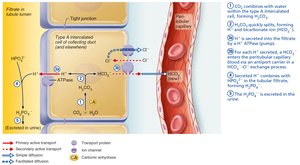
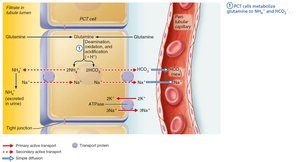
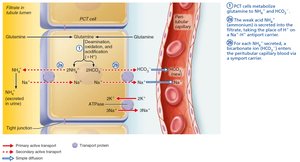
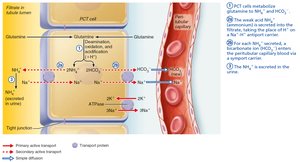
The kidneys regulate acid-base balance by reabsorbing or generating new bicarbonate (HCO3-) and excreting H+.
Filtered HCO3- is reabsorbed in exchange for H+ secretion.
New HCO3- is generated by excreting H+ buffered by phosphate or by ammonium (NH4+) from glutamine metabolism.
Acid-Base Imbalances
Types of Imbalances
Respiratory acidosis: Caused by hypoventilation; CO2 retention lowers pH.
Respiratory alkalosis: Caused by hyperventilation; excessive CO2 loss raises pH.
Metabolic acidosis: Caused by increased acid production or loss of HCO3- (e.g., diarrhea, renal failure).
Metabolic alkalosis: Caused by loss of acid (e.g., vomiting) or excess base intake.
Compensation for acid-base imbalances involves the respiratory and renal systems adjusting ventilation or HCO3- handling to restore pH balance.
Developmental Aspects
Infants are more susceptible to fluid, electrolyte, and acid-base imbalances due to higher metabolic rates, greater surface area-to-volume ratio, and immature kidneys.
Older adults have decreased total body water and less responsive regulatory mechanisms, increasing risk for dehydration and imbalances.
