 Back
BackFluid, Electrolyte, and Acid-Base Balance: Study Notes for Anatomy & Physiology
Study Guide - Smart Notes
 Tailored notes based on your materials, expanded with key definitions, examples, and context.
Fluid, Electrolyte, and Acid-Base Balance
Body Water Content
Water is the most abundant component of the human body, essential for cellular function and homeostasis. The percentage of body water varies with age, sex, and body composition.
Infants: ~73% or more water (due to low body fat and low bone mass)
Adult males: ~60% water
Adult females: ~50% water (higher fat content, less skeletal muscle mass)
Old age: Water content declines to ~45%

Fluid Compartments
Body fluids are distributed in distinct compartments, each with specific volumes and functions.
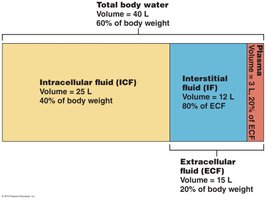
Total body water: ~40 L (60% of body weight)
Intracellular fluid (ICF): 2/3 of total body water (~25 L), inside cells
Extracellular fluid (ECF): 1/3 of total body water (~15 L), includes:
Plasma: 3 L
Interstitial fluid (IF): 12 L (spaces between cells)
Other ECF: lymph, cerebrospinal fluid (CSF), eye humors, synovial fluid, serous fluid, gastrointestinal secretions
Composition of Body Fluids
Body fluids contain water (the universal solvent) and solutes, which are classified as nonelectrolytes or electrolytes.
Nonelectrolytes: Organic molecules (e.g., glucose, lipids, creatinine, urea) that do not dissociate in water.
Electrolytes: Compounds that dissociate into ions in water (e.g., inorganic salts, acids, bases, some proteins). They have greater osmotic power and influence fluid shifts.
Electrolyte Concentration
Electrolyte concentration is measured in milliequivalents per liter (mEq/L), reflecting the number of electrical charges per liter of solution.
For single-charged ions (e.g., Na+): 1 mEq = 1 mOsm
For bivalent ions (e.g., Ca2+): 1 mEq = 1/2 mOsm
Osmolality: Number of solute particles in 1 kg of water
Extracellular and Intracellular Fluids: Electrolyte Patterns
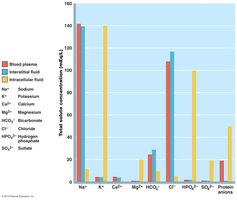
Each fluid compartment has a distinctive pattern of electrolytes.
ECF: Major cation is Na+; major anion is Cl–
ICF: Major cation is K+; major anion is HPO42–
Fluid Movement Among Compartments
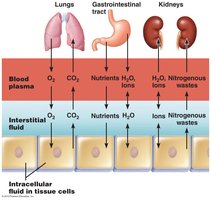
Water moves freely between compartments by osmosis, regulated by osmotic and hydrostatic pressures. Ion movement requires active transport or channels. Changes in solute concentration in any compartment lead to net water flow.
Water Balance and ECF Osmolality
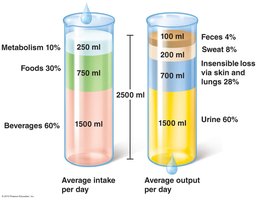
Water intake and output are balanced to maintain proper hydration and ECF osmolality (~2500 ml/day).
Intake: Beverages, food, metabolic water
Output: Urine, insensible loss (skin/lungs), perspiration, feces
Regulation of Water Intake
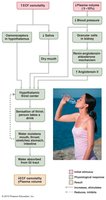
The thirst mechanism, controlled by hypothalamic centers, is the primary regulator of water intake. It is stimulated by increased ECF osmolality, dry mouth, decreased blood volume/pressure, and angiotensin II.
Regulation of Water Output
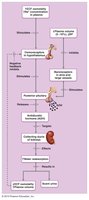
Obligatory water losses include insensible loss, feces, and minimum urine output. Water reabsorption in the kidneys is regulated by antidiuretic hormone (ADH).
Low ADH: Dilute urine, decreased body fluid volume
High ADH: Concentrated urine, increased body fluid volume
Disorders of Water Balance
Dehydration
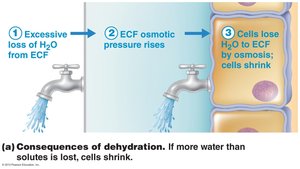
Dehydration is a negative fluid balance due to excessive ECF water loss (e.g., hemorrhage, burns, vomiting, diarrhea, sweating, water deprivation, diuretics). Symptoms include thirst, dry skin, oliguria, and can progress to shock and electrolyte loss.
Hypotonic Hydration (Water Intoxication)
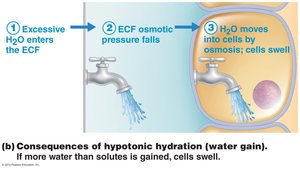
Occurs with renal insufficiency or rapid water intake, leading to hyponatremia and cellular swelling. Symptoms include nausea, vomiting, cramping, cerebral edema, and can be fatal.
Edema
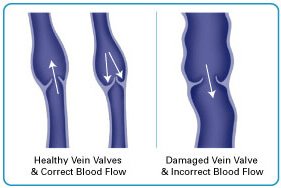
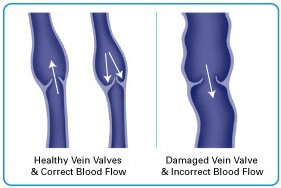
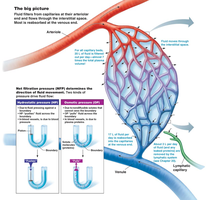
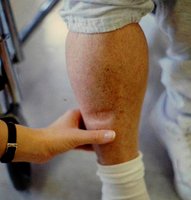
Edema is the atypical accumulation of interstitial fluid, causing tissue swelling. Causes include increased capillary pressure, permeability, venous valve incompetence, lymphatic blockage, and hypoproteinemia.

Electrolyte Balance
Importance of Electrolytes
Electrolytes (salts, acids, bases) are vital for fluid movement, excitability, secretory activity, and membrane permeability. The main ions of focus are Na+, K+, and Ca2+.
Central Role of Sodium
Sodium is the most abundant cation in ECF and is crucial for osmotic balance, blood pressure, and volume regulation. Sodium content may change, but its concentration remains stable due to osmosis.
Regulation of Sodium Balance
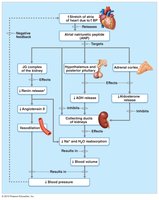
Sodium balance is regulated by mechanisms that also control blood pressure and volume, including baroreceptors, osmoreceptors, aldosterone, and atrial natriuretic peptide (ANP).
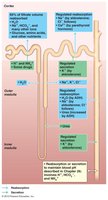
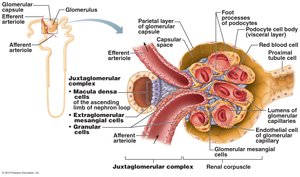
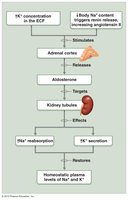
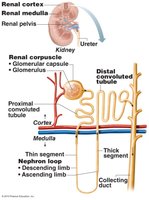
Aldosterone: Increases Na+ reabsorption in the distal tubules and collecting ducts
Renin-angiotensin mechanism: Main trigger for aldosterone release
ANP: Released in response to increased blood pressure; inhibits ADH, renin, and aldosterone, increasing Na+ and water excretion
Regulation of Potassium Balance
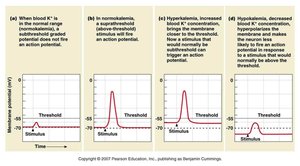
Potassium is essential for resting membrane potential in neurons and muscle cells. Imbalances can cause hyperkalemia (depolarization, reduced excitability) or hypokalemia (hyperpolarization, nonresponsiveness).
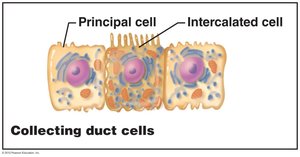
K+ balance is controlled by secretion in the cortical collecting ducts
Aldosterone stimulates K+ secretion
Acid-base imbalances cause shifts in K+ between ICF and ECF
Regulation of Calcium
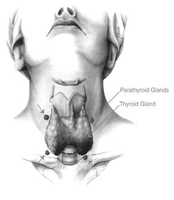
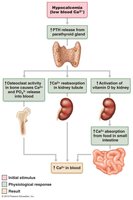
Calcium in ECF is important for neuromuscular excitability, blood clotting, membrane permeability, and secretory activities. Calcium balance is controlled by parathyroid hormone (PTH) and calcitonin.
Hypocalcemia: Increases excitability and muscle tetany
Hypercalcemia: Inhibits neurons and muscle cells, may cause arrhythmias
Regulation of Anions
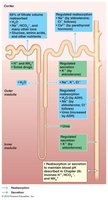
Chloride (Cl–) is the major ECF anion, helping maintain osmotic pressure. Most Cl– is reabsorbed passively with Na+. In acidosis, HCO3– is reabsorbed instead of Cl–.
Acid-Base Balance
pH and Its Importance
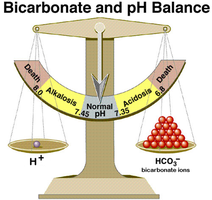
pH affects all functional proteins and biochemical reactions. Normal arterial blood pH is 7.4. Deviations cause alkalosis (pH > 7.45) or acidosis (pH < 7.35).
Sources of H+: Metabolism (phosphoric acid, lactic acid, fatty acids, CO2 conversion)
Regulation of Hydrogen Ion Concentration
H+ concentration is regulated by:
Chemical buffer systems (rapid, first line of defense)
Brain stem respiratory centers (1–3 min)
Renal mechanisms (most potent, hours to days)
Chemical Buffer Systems
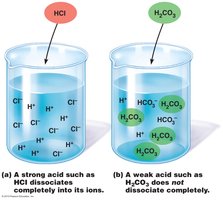
Buffers resist pH changes when strong acids or bases are added. Main buffer systems:
Bicarbonate buffer system: Important in ECF
Phosphate buffer system: Important in urine and ICF
Protein buffer system: Most plentiful and powerful, especially intracellularly
Bicarbonate Buffer System
If strong acid is added:
If strong base is added:
Phosphate Buffer System
If strong acid is added:
If strong base is added:
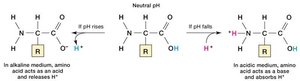
Protein Buffer System
Proteins act as amphoteric molecules, functioning as both acids and bases depending on the pH.
Physiological Buffer Systems
Chemical buffers act quickly but cannot eliminate acids or bases from the body. The lungs and kidneys provide physiological buffering by removing CO2 and metabolic acids, respectively.
Respiratory Regulation of H+
The respiratory system regulates pH by controlling CO2 exhalation. The equilibrium is:
Hypercapnia (high CO2): Increases respiratory rate and depth
Acidosis: Stimulates respiratory center, increasing ventilation
Alkalosis: Depresses respiratory center, decreasing ventilation
Renal Mechanisms of Acid-Base Balance
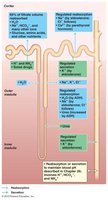
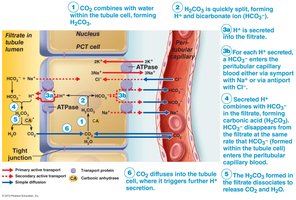
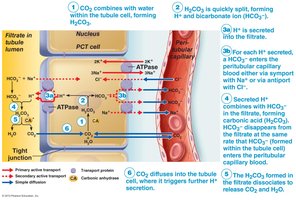
The kidneys regulate acid-base balance by reabsorbing or generating new HCO3– and excreting H+. H+ secretion occurs in the proximal convoluted tubule and collecting duct intercalated cells.
Abnormalities of Acid-Base Balance
Respiratory acidosis: PCO2 > 45 mm Hg (e.g., emphysema, COPD)
Respiratory alkalosis: PCO2 < 35 mm Hg (e.g., hyperventilation)
Metabolic acidosis: HCO3– < 22 mEq/L (e.g., diarrhea, lactic acidosis, ketoacidosis, renal failure)
Metabolic alkalosis: HCO3– > 26 mEq/L (e.g., vomiting, antacid intake)
Compensation Mechanisms
If one physiological buffer system fails, the other compensates:
Respiratory compensation: Adjusts ventilation to correct metabolic imbalances
Renal compensation: Adjusts HCO3– reabsorption/excretion to correct respiratory imbalances
Example Table: Summary of Acid-Base Disorders
Disorder | pH | PCO2 | HCO3– | Compensation |
|---|---|---|---|---|
Respiratory Acidosis | Low | High | High (renal) | Renal compensation |
Respiratory Alkalosis | High | Low | Low (renal) | Renal compensation |
Metabolic Acidosis | Low | Low (respiratory) | Low | Respiratory compensation |
Metabolic Alkalosis | High | High (respiratory) | High | Respiratory compensation |
Additional info: These notes provide a comprehensive overview of fluid, electrolyte, and acid-base balance, integrating key concepts, mechanisms, and clinical relevance for Anatomy & Physiology students.
