 Back
Fluid, Electrolyte, and Acid–Base Homeostasis: ANP College Study Guide
Study Guide - Smart Notes
 Tailored notes based on your materials, expanded with key definitions, examples, and context.
Fluid, Electrolyte, and Acid–Base Homeostasis
Body Fluids Overview
Body fluids are essential for transport, cellular function, and maintaining homeostasis. They are found both inside and outside cells, and their main component is water.
Types of body fluids: Plasma, interstitial fluid, cytosol, cerebrospinal fluid (CSF), lymph, and secretions
Main component: Water
Location: Intracellular fluid (ICF) and extracellular fluid (ECF)
Fluid Balance
Fluid balance refers to maintaining the proper volume and concentration of body fluids, focusing mainly on water balance between ICF and ECF.
Key factors: Water intake, physical activity, kidney function, medications, digestive processes
Mass balance principle: What enters the body must equal what leaves the body
Functions of Water
Water is the universal solvent due to its polar covalent bonds and molecular shape. It plays several critical roles in the body:
Absorbs heat: Requires significant energy to change state
Carries heat: Sweating removes heat to cool the body
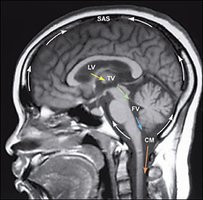
Cushions and protects: High density allows the brain to be suspended in water, reducing its effective weight
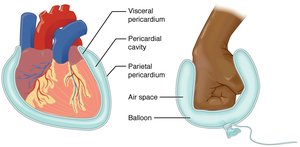
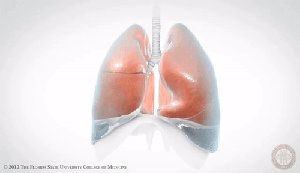
Acts as a lubricant: Reduces friction between moving surfaces, such as serous membranes around organs
Water Loss and Gain
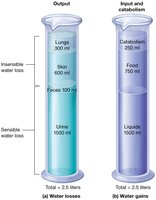
The body must balance water loss and gain to maintain blood pressure, cell function, and electrolyte balance. Average daily water turnover is about 2.5 L.
Water loss sources: Urine (500 mL/day obligatory), feces (100 mL/day), skin/sweat (600 mL/day), lungs (300 mL/day)
Water gain sources: Metabolic water (250 mL/day), liquids consumed (1500 mL/day), water from food (750 mL/day)
Hormonal Regulation of Fluid Balance
Fluid volume is regulated by hormones such as RAAS and ADH:
RAAS: Low blood pressure triggers renin release, forming angiotensin II, which increases thirst and fluid retention
ADH: Controls water reabsorption in kidneys; more ADH means less urine and more body water
Fluid Imbalances
Imbalances in fluid volume and osmolarity can be dangerous:
Dehydration: Low ECF volume, high osmolarity; cells lose water and shrink
Overhydration: High ECF volume, low osmolarity; cells swell, may cause hyponatremia and brain swelling
Isosmotic fluid imbalance: Equal loss/gain of water and solutes; cell size unchanged but homeostasis disrupted
Hypervolemia: Excess ECF fluid without osmotic change
Edema: Fluid buildup in interstitial spaces, causing tissue swelling
Total Body Water and Fluid Compartments
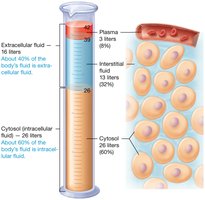
Total body water is about 60% of body weight in a standard 70-kg adult (≈42 L), varying with age, gender, body fat, and muscle mass. Body fluids are divided into compartments:
Intracellular fluid (ICF): 60% of total body water
Extracellular fluid (ECF): 40% of total body water, includes plasma and interstitial fluid
Transcellular Fluids
Transcellular fluids are specialized ECF, including CSF, synovial fluid, pleural, pericardial, peritoneal fluids, aqueous humor, digestive secretions, and lymph.
Water Movement Between Compartments
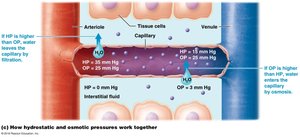
Water movement depends on hydrostatic and osmotic pressure gradients:
Hydrostatic pressure: Pushes water away from high pressure
Osmotic pressure: Pulls water toward higher solute concentration
Capillary Fluid Exchange
At the arteriolar end, high hydrostatic pressure moves water out to interstitial fluid. At the venular end, high osmotic pressure moves water back into plasma. Excess fluid is returned by the lymphatic system.
Acids and Bases
Acids and bases are defined by their behavior with hydrogen ions:
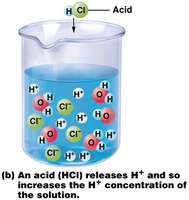
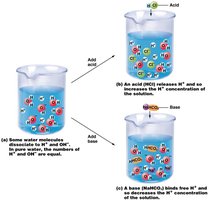
Acid: Hydrogen ion donor (proton donor)
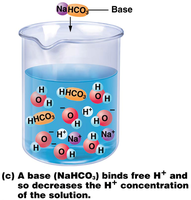
Base: Hydrogen ion acceptor
Examples
Hydrochloric acid (HCl): Dissociates into H+ and Cl-
Sodium bicarbonate (NaHCO3): Dissociates into Na+ and HCO3-; bicarbonate can accept free H+
pH Scale
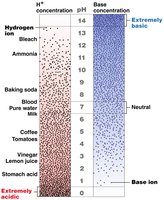
The pH scale represents hydrogen ion concentration in solution, ranging from 0 (most acidic) to 14 (most basic). Each unit is a tenfold change in [H+].
Low pH: High H+ (acidic)
High pH: Low H+ (basic)
pH 7: Neutral
Buffers
A buffer resists changes in pH when acids or bases are added. The carbonic acid-bicarbonate system is a major buffer in the body:
Carbonic acid-bicarbonate buffer:
When pH rises: Carbonic acid releases H+ to offset alkalosis
When pH falls: Bicarbonate binds H+ to offset acidosis
Acid–Base Balance Overview
Normal body pH range is 7.35–7.45. Imbalances occur when buffers and compensatory systems fail. Main control systems are the respiratory system (CO2 control) and urinary system (H+ and HCO3- control).
Acidosis
Acidosis: pH < 7.35; caused by excess H+ or decreased HCO3-
Effects: Decreased neuron excitability, nervous system depression
Respiratory acidosis: Caused by hypoventilation, CO2 retention
Metabolic acidosis: Caused by excess metabolic acids or HCO3- loss
Alkalosis
Alkalosis: pH > 7.45; caused by excess base or low H+
Effects: Increased neuron excitability, tingling, seizures, coma if severe
Respiratory alkalosis: Caused by hyperventilation, CO2 loss
Metabolic alkalosis: Caused by H+ loss or excess HCO3-
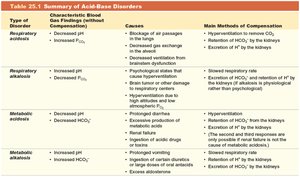
Type of Disorder | Causes | Main Methods of Compensation |
|---|---|---|
Respiratory Acidosis | Blockage of air passages, decreased gas exchange, hypoventilation | Increased ventilation, excretion of H+ by kidneys |
Respiratory Alkalosis | Hyperventilation, psychological causes, fever | Slowed respiratory rate, excretion of HCO3- by kidneys |
Metabolic Acidosis | Prolonged diarrhea, renal failure, diabetic ketoacidosis, lactic acid buildup | Hyperventilation, excretion of H+ by kidneys |
Metabolic Alkalosis | Prolonged vomiting, diuretics, excess antacid use | Hypoventilation, excretion of HCO3- by kidneys |
Salts and Electrolytes
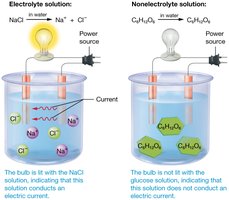
Salts are compounds formed from metal cations and non-metal anions held together by ionic bonds. Electrolytes are ions formed from dissociation of salts in solution.
Examples: Calcium phosphate in bones, Na+ and K+ for muscle and nerve function
Electrolytes: Substances that dissociate into ions in water (e.g., Na+, K+)
Nonelectrolytes: Do not form ions in water
Electrolyte Balance and Homeostasis
Electrolyte balance is maintained by mass balance (intake equals loss), controlled mainly by hormones and depends on the number of ions and amount of water present.
Main electrolytes: Sodium (Na+), potassium (K+), calcium (Ca2+), phosphate (PO4-), chloride (Cl-), magnesium (Mg2+)
Balance maintained by: Kidneys, hormones, cellular pumps
Sodium (Na+)
Most abundant extracellular cation
Maintained by Na+/K+ ATPase pump
Critical for nerve signals and muscle contraction
Hormones: Angiotensin II, aldosterone (increase Na+ retention); ANP (decreases Na+ and water reabsorption)
Imbalances: Hypernatremia (high Na+), hyponatremia (low Na+)
Potassium (K+)
Most abundant intracellular cation
Maintained by Na+/K+ ATPase pump
Essential for nerve and muscle cell function
Hormones: Insulin, aldosterone, epinephrine (move K+ into cells)
Imbalances: Hyperkalemia (high K+), hypokalemia (low K+)
Calcium and Phosphate
Stored together in bone as hydroxyapatite
Needed for muscle contraction, cardiac action potentials, blood clotting, nerve signaling
Regulation: Bone tissue, kidneys, small intestine; hormones include parathyroid hormone (PTH) and vitamin D3 (calcitriol)
Imbalances: Hypercalcemia (high Ca2+), hypocalcemia (low Ca2+)
Other Important Electrolytes
Chloride (Cl-): Works with sodium for osmotic balance, forms stomach acid (HCl)
Magnesium (Mg2+): Activates many enzymes, important for bone structure
Key Takeaways: Fluid, electrolyte, and acid–base balance are essential for homeostasis. Imbalances can be life-threatening and are regulated by multiple systems and hormones.
