 Back
BackFundamentals of the Nervous System and Nervous Tissue: Study Notes
Study Guide - Smart Notes
 Tailored notes based on your materials, expanded with key definitions, examples, and context.
Fundamentals of the Nervous System and Nervous Tissue
The Nervous System: Structure and Function
The nervous system is responsible for receiving, integrating, and responding to information throughout the body. It is divided into structural and functional components that work together to maintain homeostasis and enable complex behaviors.
Basic Functions: Gathering sensory input, integration of information, and motor output to effector organs.
Central Nervous System (CNS): Composed of the brain and spinal cord; serves as the integrating and control center.
Peripheral Nervous System (PNS): Located outside the CNS; includes sensory (afferent) and motor (efferent) divisions.
Sensory Division: Carries impulses toward the CNS from sensory receptors.
Motor Division: Carries impulses from the CNS to muscles and glands.
Somatic Nervous System: Controls voluntary movements of skeletal muscles.
Autonomic Nervous System (ANS): Regulates involuntary activities of smooth muscle, cardiac muscle, and glands.
Neuroglia: Support Cells of the Nervous System
Neuroglia, or glial cells, provide structural and functional support to neurons. They are essential for maintaining the environment necessary for neuronal function.
Astrocytes: Regulate the chemical environment and facilitate exchange between neurons and capillaries.
Microglial Cells: Monitor neuronal health and perform defense functions.
Ependymal Cells: Line the central cavities of the brain and spinal cord; help circulate cerebrospinal fluid.
Oligodendrocytes: Form myelin sheaths around CNS axons.
Satellite Cells: Surround neuron cell bodies in the PNS; function largely unknown.
Schwann Cells: Form myelin sheaths around PNS axons.
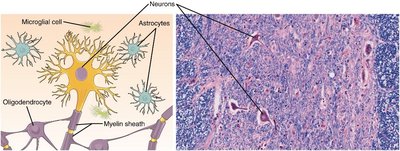
Neurons: Structural Units of the Nervous System
Neurons are specialized cells that transmit electrical impulses. Their structure is closely related to their function in communication and integration.
Cell Body (Soma/Perikaryon): Major biosynthetic center; contains organelles and cytoskeletal elements.
Dendrites: Receptive regions; receive signals from other neurons.
Axon: Conducting region; transmits impulses away from the cell body.
Myelin Sheath: Insulates axons and increases conduction velocity; formed by Schwann cells (PNS) and oligodendrocytes (CNS).
Structural Classes: Multipolar (most common), bipolar (retina, olfactory mucosa), unipolar (sensory receptors).
Functional Classes: Sensory (afferent), motor (efferent), interneurons (association).
Nucleus vs. Ganglion: Nucleus = cluster of cell bodies in CNS; Ganglion = cluster in PNS.
Nerve vs. Tract: Nerve = bundle of axons in PNS; Tract = bundle in CNS.
Electrical Properties of Neurons
Neurons communicate via electrical signals generated by differences in ion concentration and membrane permeability.
Voltage: Potential difference between two points.
Current: Flow of electrical charge; depends on voltage and resistance.
Ion Channels: Chemically gated, voltage-gated, and mechanically gated channels regulate ion flow.
Resting Membrane Potential: Typically –70 mV; due to ionic differences and membrane permeability, especially to K+.
Key Equation
The relationship between current, voltage, and resistance is given by:
Graded and Action Potentials
Neurons use changes in membrane potential to communicate. These changes can be graded (short-distance) or action potentials (long-distance).
Graded Potentials: Local changes; decay with distance.
Action Potentials: All-or-none; do not decay; occur on axons.
Depolarization: Membrane becomes less negative.
Hyperpolarization: Membrane becomes more negative.
Threshold: Minimum depolarization required to trigger an action potential.
Refractory Periods: Absolute (no new AP possible), Relative (strong stimulus required).
Saltatory Conduction: Rapid AP propagation at nodes of Ranvier; faster than continuous conduction.
Synapses: Signal Transmission Between Neurons
Synapses are junctions that mediate information transfer. They can be chemical or electrical.
Chemical Synapses: Use neurotransmitters; involve presynaptic axon terminals and postsynaptic receptor regions.
Electrical Synapses: Direct ion exchange via protein channels.
Steps in Chemical Synaptic Transmission:
AP arrives at axon terminal.
Voltage-gated Ca2+ channels open.
Ca2+ triggers neurotransmitter release.
Neurotransmitter binds to postsynaptic receptors.
Ion channels open, creating graded potentials.
Neurotransmitter effects terminated.
Postsynaptic Potentials and Integration
Postsynaptic potentials can be excitatory (EPSPs) or inhibitory (IPSPs), affecting the likelihood of action potential generation.
EPSPs: Depolarize membrane; may trigger AP.
IPSPs: Hyperpolarize membrane; reduce AP likelihood.
Summation: Temporal (successive releases) and spatial (multiple terminals).
Synaptic Potentiation: Enhanced neurotransmitter release with repeated stimulation.
Presynaptic Inhibition: Inhibition of neurotransmitter release.
Neurotransmitters and Their Receptors
Neurotransmitters are classified by chemical structure and function. Their effects depend on the type of receptor they bind to.
Chemical Classes: Acetylcholine, biogenic amines, amino acids, peptides, purines, gases, and lipids.
Functional Classification: Excitatory or inhibitory; direct or indirect effects.
Receptor Types: Channel-linked (ligand-gated ion channels) and G protein–coupled receptors (second messenger systems).
Neuronal Organization and Processing
Neurons act together in pools and circuits, enabling complex behaviors and higher-level processing.
Neuronal Pools: Groups of neurons integrating and relaying information.
Serial Processing: Sequential stimulation (e.g., reflexes).
Parallel Processing: Simultaneous stimulation of multiple pathways; essential for higher functions.
Circuit Types: Patterns of synaptic connections determine functional capabilities.
Developmental Aspects of Neurons
The nervous system develops from the neural tube and neural crest, with differentiation and synapse formation guided by various factors.
Neuroepithelial Cells: Differentiate into CNS components.
Axon Growth: Guided by pathfinding neurons, glial cells, nerve growth factor, and tropic chemicals.
Growth Cone: Evaluates pathway for further growth and synapse formation.
Apoptosis: Unsuccessful synapse formation leads to cell death; final neuron population is established.
Additional info: These notes expand on brief points with academic context, definitions, and examples to provide a comprehensive study guide for exam preparation.
