 Back
BackFundamentals of the Nervous System and Nervous Tissue – Study Notes
Study Guide - Smart Notes
 Tailored notes based on your materials, expanded with key definitions, examples, and context.
Fundamentals of the Nervous System and Nervous Tissue
Overview of the Nervous System
The nervous system is the master controlling and communicating system of the body. It uses electrical and chemical signals to coordinate rapid and specific responses, ensuring the body can react almost immediately to internal and external changes.
Sensory Input: Information gathered by sensory receptors about internal and external changes.
Integration: Processing and interpretation of sensory input.
Motor Output: Activation of effector organs (muscles and glands) to produce a response.
Divisions of the Nervous System
The nervous system is divided into two principal parts:
Central Nervous System (CNS): Consists of the brain and spinal cord. It is the integration and control center, interpreting sensory input and dictating motor output.
Peripheral Nervous System (PNS): Consists mainly of nerves that extend from the brain and spinal cord (cranial and spinal nerves) and ganglia. It serves as communication lines between the CNS and the rest of the body.
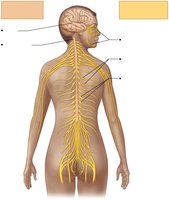
Functional Divisions of the PNS
Sensory (Afferent) Division: Conducts impulses from receptors to the CNS. Includes somatic sensory fibers (from skin, skeletal muscles, joints) and visceral sensory fibers (from visceral organs).
Motor (Efferent) Division: Conducts impulses from the CNS to effectors (muscles and glands). Subdivided into:
Somatic Nervous System: Voluntary control of skeletal muscles.
Autonomic Nervous System (ANS): Involuntary control of smooth muscle, cardiac muscle, and glands. Further divided into:
Sympathetic Division: Mobilizes body systems during activity.
Parasympathetic Division: Promotes housekeeping functions during rest and conserves energy.
Nervous Tissue Histology
Principal Cell Types
Neuroglia (Glial Cells): Small cells that support, protect, and insulate neurons.
Neurons (Nerve Cells): Excitable cells that transmit electrical signals.
Neuroglia of the CNS
There are four main types of neuroglia in the CNS:
Astrocytes: Most abundant, versatile, and highly branched. They support neurons, regulate the chemical environment, and participate in information processing.
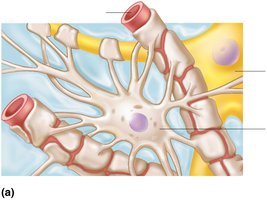
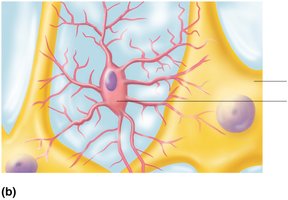
Microglial Cells: Small, ovoid cells with thorny processes. They act as the main defense cells in the CNS, monitoring neuron health and phagocytizing debris and pathogens.
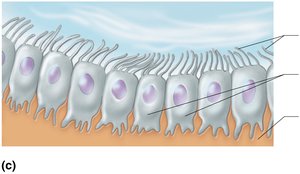
Ependymal Cells: Line the central cavities of the brain and spinal cord. Their cilia help circulate cerebrospinal fluid (CSF), forming a barrier between CSF and CNS tissue fluid.
Oligodendrocytes: Branched cells that form insulating myelin sheaths around CNS nerve fibers, increasing the speed of nerve impulse conduction.
Neuroglia of the PNS
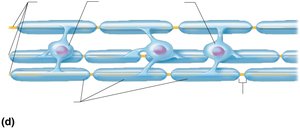
Satellite Cells: Surround neuron cell bodies in the PNS, providing support and regulating the environment, similar to astrocytes in the CNS.
Schwann Cells (Neurolemmocytes): Surround all peripheral nerve fibers and form myelin sheaths in thicker fibers. They are vital for the regeneration of damaged peripheral nerve fibers.
Neurons: Structure and Function
General Characteristics
Neurons are large, highly specialized cells that conduct impulses.
They have extreme longevity, are mostly amitotic, and have a high metabolic rate (requiring continuous oxygen and glucose).
All neurons have a cell body and one or more processes (dendrites and axons).
Neuron Cell Body (Soma/Perikaryon)
Biosynthetic center of the neuron, containing the nucleus, nucleolus, and rough ER (Nissl bodies).
Most neuron cell bodies are located in the CNS (called nuclei); in the PNS, they are found in ganglia.
Neuron Processes
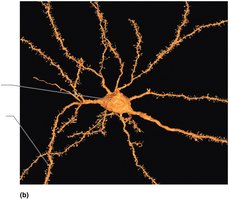
Dendrites: Short, tapering, highly branched processes that receive input and convey it toward the cell body as graded potentials.
Axon: Each neuron has one axon, which generates and transmits nerve impulses away from the cell body. Axons may be very long (nerve fibers) and branch extensively at their ends (axon terminals).
Myelination of Nerve Fibers
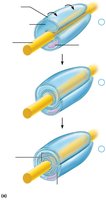
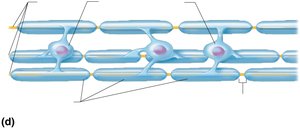
In the PNS: Myelin sheaths are formed by Schwann cells wrapping around axons in a jelly roll fashion. Myelin increases the speed of nerve impulse transmission.
Myelin sheath gaps (nodes of Ranvier) are sites where axon collaterals can emerge.
Nonmyelinated fibers are thin and surrounded by Schwann cells without coiling.
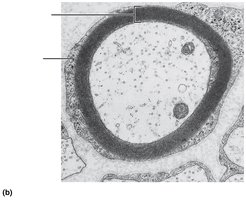
In the CNS: Myelin sheaths are formed by oligodendrocyte processes. Each oligodendrocyte can myelinate multiple axons. White matter consists of myelinated fibers; gray matter consists mostly of neuron cell bodies and nonmyelinated fibers.
Classification of Neurons
Structural Classification
Multipolar: Three or more processes (one axon, others dendrites); most common in the CNS.
Bipolar: Two processes (one axon, one dendrite); rare, found in the retina and olfactory mucosa.
Unipolar (Pseudounipolar): One T-like process (two axons); found mainly in sensory neurons of the PNS.
Functional Classification
Sensory (Afferent) Neurons: Transmit impulses from sensory receptors toward the CNS; mostly unipolar, with cell bodies in PNS ganglia.
Motor (Efferent) Neurons: Carry impulses from the CNS to effectors; multipolar, with most cell bodies in the CNS.
Interneurons (Association Neurons): Lie between sensory and motor neurons, shuttle signals through CNS pathways, and make up 99% of the body's neurons.
Additional info: The notes above expand on the original slides by providing definitions, examples, and context for each cell type and functional division, ensuring a comprehensive and self-contained study guide.
