 Back
BackGas Exchange and Breathing: Pulmonary Physiology Study Guide
Study Guide - Smart Notes
 Tailored notes based on your materials, expanded with key definitions, examples, and context.
Gas Exchange and Breathing
Overview of Pulmonary Ventilation and Gas Transport
Pulmonary ventilation (breathing) and gas exchange are essential processes for maintaining homeostasis in the human body. Oxygen (O2) and carbon dioxide (CO2) are transported between the lungs and tissues via the blood, ensuring cellular respiration and removal of metabolic waste.
Pulmonary ventilation refers to the movement of air into and out of the lungs.
Gas exchange occurs at the alveoli, where O2 enters the blood and CO2 is expelled.
Blood flow through the pulmonary and systemic circuits is tightly regulated to match metabolic demands.
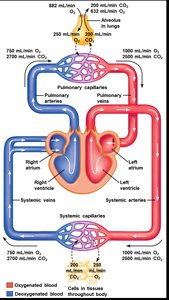
Review of Blood Flow and Gas Exchange
Blood circulates through two main circuits: the pulmonary circuit (lungs) and the systemic circuit (body tissues). Oxygenated and deoxygenated blood are separated, and gas exchange occurs at specific sites.
Pulmonary arteries carry deoxygenated blood to the lungs.
Pulmonary veins return oxygenated blood to the heart.
Systemic arteries deliver oxygen-rich blood to tissues.
Systemic veins return CO2-rich blood to the heart.
Respiratory Membrane and Gas Diffusion
Structure of the Respiratory Membrane
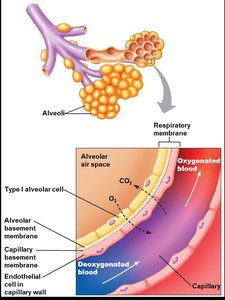
The respiratory membrane is the site of gas exchange between alveolar air and blood in pulmonary capillaries. Its thin structure facilitates rapid diffusion of gases.
Composed of Type I alveolar cells, alveolar basement membrane, capillary basement membrane, and endothelial cells.
O2 diffuses from alveolar airspace into blood; CO2 diffuses from blood into alveolar airspace.

Gradients for Gas Diffusion
Gas diffusion across the respiratory membrane depends on partial pressure gradients and solubility of gases in liquids.
Partial pressure is the pressure exerted by a single gas in a mixture.
Gases diffuse from areas of higher partial pressure to lower partial pressure.
Solubility affects how much gas dissolves in blood.
Dalton’s Law and Partial Pressures
Dalton’s Law of Partial Pressures
Dalton’s Law states that the total pressure exerted by a mixture of gases is equal to the sum of the partial pressures of each individual gas.
Each gas in a mixture contributes to the total pressure in proportion to its concentration.
Partial pressure is calculated as:

Calculating Partial Pressures in Air
Atmospheric air is composed mainly of nitrogen, oxygen, and a small amount of carbon dioxide. Partial pressures are calculated based on their percentages.
Oxygen: 20.93% ( mmHg)
Nitrogen: 79.04% ( mmHg)
Carbon Dioxide: 0.03% ( mmHg)
Humidity (water vapor) also contributes to total pressure in humid air.
Solubility of Gases in Liquids
Gas Solubility and Partial Pressure
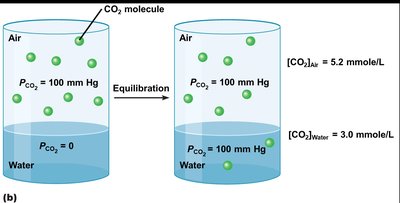
Gases can exist in both gaseous and dissolved forms. The concentration of a gas in a liquid depends on its partial pressure and solubility.
CO2 is about 20 times more soluble in water than O2.
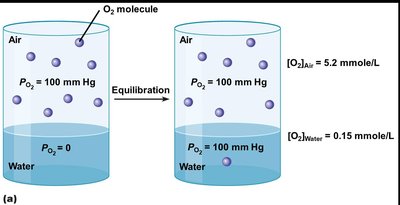
At equilibrium, partial pressures are equal, but concentrations may differ due to solubility.

Application: Carbonated Beverages
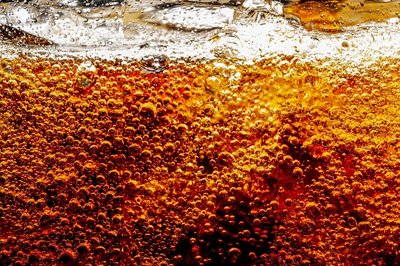
Carbonated beverages illustrate gas solubility. CO2 is dissolved under pressure; when opened, CO2 escapes rapidly.
High pressure increases gas solubility.
Rapid pressure decrease causes gas to come out of solution.

Equilibration of Gases
At equilibrium, the partial pressure of a gas in liquid equals that in air, but concentrations differ due to solubility.
O2 in water: lower concentration than in air at same partial pressure.
CO2 in water: higher concentration than O2 at same partial pressure.
Clinical Correlation: The Bends
Decompression Sickness
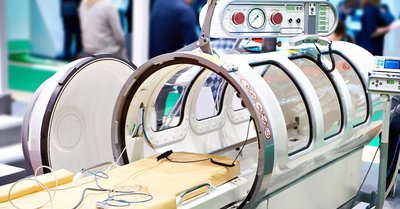
Scuba divers are at risk for decompression sickness (the bends) due to increased nitrogen solubility at depth. Rapid ascent causes nitrogen to form bubbles in blood.
Hyperbaric chambers are used for treatment.

Partial Pressures at Different Sites
Typical Partial Pressures of O2 and CO2
Partial pressures of O2 and CO2 vary at different sites in the body, reflecting gas exchange and transport.
Site | Oxygen | Carbon dioxide |
|---|---|---|
Atmospheric air | 160 mm Hg | 0.3 mm Hg |
Alveolar air | 100 mm Hg | 40 mm Hg |
Pulmonary veins | 100 mm Hg | 40 mm Hg |
Systemic arteries | 100 mm Hg | 40 mm Hg |
Cells | <40 mm Hg | >46 mm Hg |
Systemic veins | 40 mm Hg | 46 mm Hg |
Pulmonary arteries | 40 mm Hg | 46 mm Hg |

Oxyhemoglobin Dissociation Curve
Hemoglobin Saturation and Oxygen Delivery
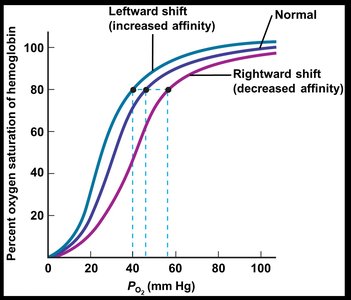
The oxyhemoglobin dissociation curve describes the relationship between PO2 and hemoglobin saturation. It is sigmoidal due to cooperative binding.
At high PO2 (lungs), hemoglobin is nearly fully saturated.
At low PO2 (tissues), hemoglobin releases O2.
Normal resting venous blood is 75% saturated.

Factors Affecting Hemoglobin Affinity
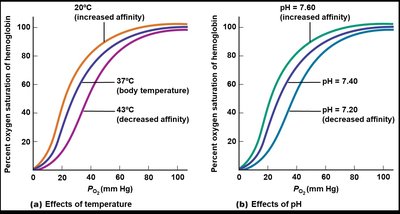
Hemoglobin's affinity for O2 can shift left (increased affinity) or right (decreased affinity) due to temperature, pH, PCO2, and 2,3-BPG.
Increased temperature or decreased pH shifts curve right (Bohr effect).
Decreased temperature or increased pH shifts curve left.

Transport of Gases in the Blood
Oxygen Transport
Oxygen is transported in blood both dissolved in plasma and bound to hemoglobin.
Only a small fraction is dissolved; most is bound to hemoglobin.
Hemoglobin saturation depends on PO2.

Carbon Dioxide Transport
CO2 is transported in three forms: dissolved in plasma, bound to hemoglobin (carbaminohemoglobin), and as bicarbonate ions.
90% of CO2 is transported as bicarbonate, formed by the reaction:
Regulation of Ventilation
Control of Breathing
Ventilation is regulated by chemoreceptors that detect changes in arterial PO2 and PCO2. The brainstem adjusts breathing rate to maintain homeostasis.
Central chemoreceptors (medulla) respond to CO2 and pH.
Peripheral chemoreceptors (carotid bodies) respond to O2, CO2, and pH.
Acid-Base Homeostasis
Buffer Systems in the Blood
Blood pH is tightly regulated by buffer systems, including hemoglobin and bicarbonate ions. The Henderson-Hasselbalch equation describes the relationship between pH, bicarbonate, and CO2:
Normal pH: 7.38–7.42
Acidosis: pH < 7.35; Alkalosis: pH > 7.45
Respiratory and renal systems compensate for disturbances in acid-base balance.
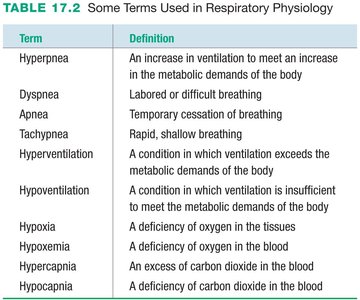
Respiratory Physiology Terms
Key Definitions
Understanding terminology is essential for interpreting respiratory physiology.
Term | Definition |
|---|---|
Hyperpnea | Increase in ventilation to meet increased metabolic demands |
Dyspnea | Labored or difficult breathing |
Apnea | Temporary cessation of breathing |
Tachypnea | Rapid, shallow breathing |
Hyperventilation | Ventilation exceeds metabolic demands |
Hypoventilation | Ventilation insufficient for metabolic demands |
Hypoxia | Deficiency of oxygen in tissues |
Hypoxemia | Deficiency of oxygen in blood |
Hypercapnia | Excess of carbon dioxide in blood |
Hypocapnia | Deficiency of carbon dioxide in blood |
Additional info: This study guide covers the essential concepts of pulmonary ventilation, gas exchange, partial pressures, gas transport, regulation of breathing, and acid-base homeostasis, as outlined in Chapters 16 and 17 of a typical college-level anatomy and physiology course.
