 Back
BackGas Exchange and Regulation of Breathing: The Respiratory System
Study Guide - Smart Notes
 Tailored notes based on your materials, expanded with key definitions, examples, and context.
The Respiratory System: Gas Exchange and Regulation of Breathing
Overview of Pulmonary Circulation
The pulmonary circulation is responsible for the exchange of oxygen (O2) and carbon dioxide (CO2) between the lungs and the blood. Arterial blood O2 and CO2 levels remain relatively constant due to tightly regulated gas exchange processes. Oxygen moves from alveoli to blood at the same rate it is consumed by cells, while carbon dioxide moves from blood to alveoli at the same rate it is produced by cells.
Respiratory quotient: The ratio of CO2 produced to O2 consumed; typically 0.8 at rest.
Key values: Cells consume ~250 mL O2 and produce ~200 mL CO2 per minute at rest.
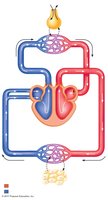
The Respiratory Membrane
The respiratory membrane is the site of gas exchange in the lungs, consisting of three layers that facilitate the diffusion of gases.
Type I alveolar cells: Form the lining of the alveoli.
Endothelial cells: Line the capillaries.
Capillary basement membrane: Fuses the alveolar and capillary walls.
Partial Pressure of Gases
Partial pressure is a fundamental concept in understanding gas exchange. It refers to the pressure exerted by a single gas in a mixture of gases, and it drives the movement of gases across membranes.
Partial pressure formula:
Calculation:
Air composition: 79% nitrogen, 21% oxygen, trace CO2 and other gases.
Example: At sea level (760 mm Hg), mm Hg.
Solubility of Gases in Liquids
Gases can exist in both vaporized and dissolved forms. The solubility of a gas in a liquid depends on the properties of both the gas and the liquid. At equilibrium, the partial pressures of vaporized and dissolved gases are equal.
Key point: The partial pressure and solubility together determine how much gas dissolves in a liquid.
Gas Exchange in the Lungs
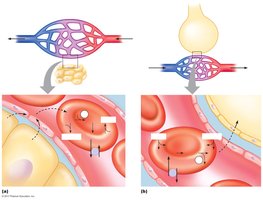
Gas exchange occurs by diffusion, with gases moving down their partial pressure gradients. Each gas diffuses independently of others present in the mixture.
Oxygen: Diffuses from alveoli (high partial pressure) to blood (low partial pressure).
Carbon dioxide: Diffuses from blood (high partial pressure) to alveoli (low partial pressure).
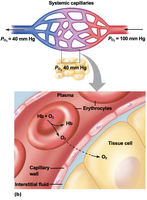
Transport of Gases in the Blood
Oxygen and carbon dioxide are transported in the blood by different mechanisms, reflecting their solubility and chemical properties.
Oxygen Transport
Hemoglobin: 98.5% of O2 is transported bound to hemoglobin; only 1.5% is dissolved in plasma.
Binding reaction:
Carbon Dioxide Transport
Dissolved in plasma: 5–6% of CO2 is transported this way.
Bound to hemoglobin: 5–8% as carbaminohemoglobin.
As bicarbonate: 86–90% is converted to bicarbonate by erythrocytes and transported in plasma.
Carbonic Anhydrase Reaction
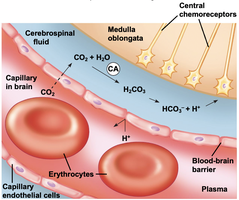
Carbonic anhydrase is an enzyme that catalyzes the conversion of CO2 and water to carbonic acid, which then dissociates to bicarbonate and hydrogen ions.
Reaction:

Central Regulation of Ventilation
Breathing is regulated by neural mechanisms involving motor neurons and respiratory centers in the brainstem. Peripheral input from various receptors modulates respiratory activity.
Respiratory muscles: Skeletal muscles controlled by motor neurons.
Inspiration: Phrenic nerve (diaphragm), external intercostal nerve (external intercostal muscles).
Expiration: Internal intercostal nerve (internal intercostal muscles).
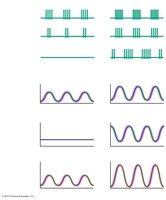
Brainstem respiratory centers: Located in the medulla and pons; include inspiratory, expiratory, and mixed neurons.
Peripheral input: Chemoreceptors, pulmonary stretch receptors, irritant receptors, muscle and joint proprioceptors, arterial baroreceptors, nociceptors, thermoreceptors.
Control of Ventilation by Chemoreceptors
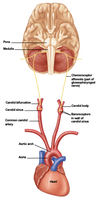
Chemoreceptors detect blood levels of O2 and CO2 and play a crucial role in regulating ventilation. There are two main types: peripheral and central chemoreceptors.
Peripheral Chemoreceptors
Location: Carotid bodies near the carotid sinus.
Function: Respond mainly to changes in blood pH; communicate with medullary respiratory control areas via afferent neurons.
Central Chemoreceptors
Location: Ventral surface of the medulla oblongata.
Function: Respond to changes in pH of cerebrospinal fluid (CSF); indirectly responsive to CO2 via pH changes.
Not responsive to: Changes in O2 concentration.
Acid-Base Disturbances in Blood
Blood pH is tightly regulated by the respiratory and renal systems. Small changes in pH can have significant physiological effects, particularly on protein activity and central nervous system function.
Normal blood pH: 7.4 (range 7.38–7.42)
Acidosis: Blood pH < 7.35; causes CNS depression.
Alkalosis: Blood pH > 7.45; causes CNS over-excitation.
Study Questions
What are the layers of the respiratory membrane?
Explain the concept of partial pressures. How do partial pressures influence the movement of gases?
A sealed vessel contains 50% oxygen, 10% carbon dioxide, and 40% nitrogen gas. The total pressure of the gas mixture is 5 atmospheres. What is the partial pressure of the carbon dioxide?
How is oxygen transported in the blood? Carbon dioxide?
What nerves innervate the muscles of respiration and when do these nerves fire/muscles contract?
What regions of the brainstem are responsible for integrating respiratory information? Where does the peripheral input reaching the respiratory system come from?
What is the most important reason for tight regulation of blood pH? What are the two conditions that can result from a blood pH that is too acidic or too basic?
Additional info: The notes have been expanded to provide academic context and explanations for each topic, including definitions, examples, and relevant equations.
